
Kinematic Analysis and Field Performance Evaluation of a Chain-clamp-typeTransplanter for Bare-root Medicinal Crop Seedlings
This is an open access article distributed under the terms of the Creative Commons Attribution Non-Commercial License (http://creativecommons.org/licenses/by-nc/3.0/) which permits unrestricted non-commercial use, distribution, and reproduction in any medium, provided the original work is properly cited.
Abstract
This study evaluated the kinematic characteristics and field performance of a chain-clamp-type transplanter designed for bare-root Rehmannia glutinosa seedlings.
A kinematic model was developed to analyze planting trajectory, velocity synchronization, and soil disturbance associated with the combined chain motion and forward travel of the transplanter. Field tests were conducted at a forward speed of 1.6 ㎞ h-1, transplanting rate of 72 seedlings min-1, and target planting depth of 40 ㎜. Under the selected kinematic condition (λ = 1.068), horizontal dragging near the planting position was reduced. The longitudinal and transverse dimensions of the soil opening ranged from 99.20 to 120.40 ㎜ and 31.67 to 36.53 ㎜, respectively. Compared with that in the conventional reference mechanism, the transverse opening width was reduced by 41.4% to 49.3%, yielding a soil disturbance area of 2430 ± 170 ㎜2 per planting position. The missed-planting and seedling damage rates were 1% and 2%, respectively, whereas stable planting posture and relatively uniform depth were maintained.
The chain-clamp-type mechanism is suitable for mechanized transplanting of delicate bare-root medicinal crop seedlings. However, manual seedling feeding remained the primary limitation restricting further improvements in operational capacity.
Keywords:
Rehmannia glutinosa, Bare-root Seedlings, Chain-clamp Transplanter, Kinematic Analysis, Soil DisturbanceINTRODUCTION
Rehmannia glutinosa is widely cultivated as an important medicinal crop in East Asia and in several agricultural regions of South Korea (Lee et al., 2019; Lee et al., 2020). In South Korea, cultivation was concentrated in regions including Geumsan, Jeongeup, Andong, and Yeongju (Lee et al., 2019). Seedling growth and nutrient uptake were reported to be influenced by root-zone conditions, indicating the importance of appropriate cultivation management for stable crop establishment (Park et al., 2026). In medicinal and vegetable crop production, substantial labor requirements have been associated with manual transplanting and harvesting operations, and mechanization has therefore been investigated to improve field capacity and reduce labor demand (Mohammod et al., 2024; Habineza et al., 2025). However, most conventional transplanting mechanisms were developed for relatively robust vegetable or plug-type seedlings, while delicate bare-root seedlings required greater control of clamping force, planting posture, and root protection (Wang et al., 2024). Therefore, development of a transplanting mechanism suitable for bare-root medicinal crop seedlings was considered necessary.
In contrast to plug seedlings supported by a soil substrate, bare-root seedlings have exposed roots and shoots, directly in contact with gripping, conveying, and planting components during transplanting operations (Yuan et al., 2026). This exposure increases the likelihood of mechanical crushing, bruising, root deformation, and stem damage when rigid gripping mechanisms are used on delicate medicinal crop seedlings (Wang et al., 2024). Instability is further exacerbated under upland field conditions, where plastic mulching film and uneven surfaces are common in medicinal crop production. At high operating speeds, conventional linkage-based transplanting mechanisms exhibit increased vibration and dynamic fluctuation (Khadatkar et al., 2018). During transportation and release, bare-root seedlings must extend beyond the gripping point to achieve adequate planting depth, which could cause stem bending due to centrifugal and inertial forces during rotation. These unfavorable dynamic conditions contributed to increased seedling oscillation, unstable release trajectories, reduced planting verticality, seedling lodging, dragging, and missing plants (Ryu et al., 2001).
Various mechanical and mechatronic approaches have been explored to enhance transplanting accuracy and minimize seedling damage (Cheng et al., 2024). Multi-link mechanisms, such as optimized double-crank five-bar linkages, have enabled precise planting trajectories and relatively high transplanting capacities. However, increased inertia, mechanical vibration, and timing errors limit operating accuracy at higher transplanting speeds (Ali et al., 2024a). Two-degree-of-freedom robotic transplanting mechanisms offer greater trajectory flexibility, enabling vertical, inclined, and boat-shaped planting trajectories (Liu et al., 2021). Automated detection of gripping conditions and corrective replanting have also been investigated using Linear Model Predictive Control and vision-based monitoring systems with EfficientDet and CBAM-based networks (Liu et al., 2022). Despite improved control flexibility, practical adoption on small- and medium-scale farms remains constrained by high structural complexity, increased manufacturing costs, and demanding operational requirements (Xu et al., 2025).
Rotary finger-type transplanting mechanisms with rubber-coated gripping components have been investigated as mechanically simpler alternatives for delicate seedlings, as they can generate smooth and continuous trajectories with reduced mechanical vibration (Ali et al., 2024b; Ali et al., 2025). Achieving stable transplanting performance requires proper coordination among the feeding mechanism, gripping components, seedling morphology, and planting trajectory (Yuan et al., 2026). Stable ridge entry is associated with minimizing the relative velocity between the planting component and the soil surface, and optimizing the dimensionless kinematic characteristic coefficient reduces disturbance of plastic mulching film and enhances seedling establishment (Zhao et al., 2024). Release stability is further improved when mechanical support extends beyond the gripping position during the transition from conveying to soil insertion. Maintaining stem support during the critical release stage reduces seedling oscillation and yields approximately 25% lower soil landing deviation (Perez-Ruiz and Slaughter, 2021). Considering these factors, a chain-clamp-type transplanting mechanism is suitable for bare-root medicinal crop seedlings, as it combines continuous seedling transport, controlled gripping, and mechanical support within a simple structure. Accordingly, the kinematic characteristics of a chain-clamp-type transplanter were analyzed, and the field performance for bare-root medicinal crop seedlings was evaluated in this study.
MATERIALS AND METHODS
1. Morphological characteristics of bare-root seedlings and transplanter design constraints
In contrast to soil-block plugs, which are protected by a surrounding substrate matrix, bare-root seedlings have exposed and mechanically vulnerable root systems. During mechanized transplanting, direct contact occurs between the roots, stems, and leaves and the metallic and elastomeric components of the conveying, positioning, and clamping units. As a result, the structural dimensions of the chain-clamp mechanism are determined by the physical characteristics of the seedlings to minimize bruising, stem compression, root damage, and misplanting losses. Primary morphological parameters considered for mechanical compatibility include seedling height (SH), leaf canopy width (SW), main root length (RL), root-stem junction diameter (RD), and stem thickness (ST).
Stable seedling transport during chain conveying is necessary to minimize displacement due to machine vibration and dynamic motion. Accordingly, the width of the horizontal feeding section was selected to provide adequate support for seedlings on the conveyor. The spacing between adjacent flexible positioning members was chosen to ensure sufficient clearance around the stem, while lateral movement was restricted by the seedling canopy. During clamping, the gap between the elastic clamping surfaces was adjusted based on stem thickness and the root-stem junction diameter. The clamping force must be sufficient to prevent slippage during linear chain movement and rotation around the sprockets, but not so great as to cause excessive compression of the stem and root-stem junction. A distributed normal force is applied through the elastic clamping surfaces to maintain seedling retention without exceeding the mechanical tolerance of plant tissues (Yuan et al., 2026).
As presented in Fig. 1, the principal morphological characteristics of the bare-root Rehmannia glutinosa seedlings, including seedling height, leaf canopy width, root-stem junction diameter, and main root length, were considered in determining the release position and planting depth. Release height and soil insertion depth are critical mechanical boundary conditions for maintaining an upright planting posture. Excessive clearance between the opened clamp and the soil surface increases uncontrolled seedling movement during free fall, resulting in greater landing deviation, stem inclination, and lodging. Conversely, insufficient clearance restricts complete separation of the roots from the clamping surfaces before soil contact. In such cases, forward movement of the chain may cause seedling dragging, root bending, and excessive inclination during soil covering. Therefore, the release position, clamping geometry, and planting depth are coordinated with measured seedling morphology to enhance seedling release stability and upright establishment during field operation.
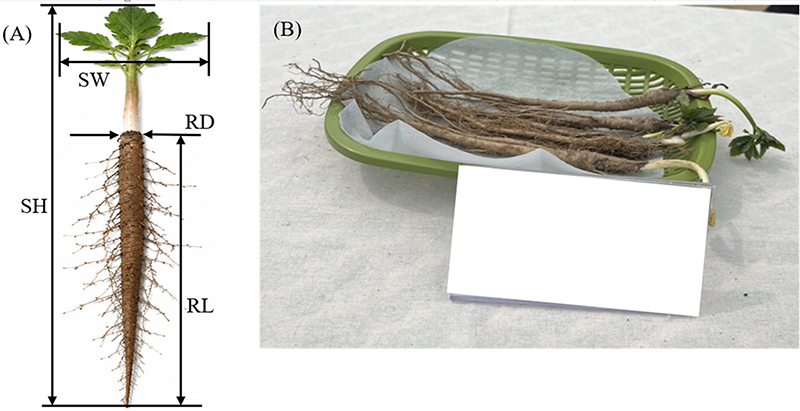
Bare-root Rehmannia glutinosa seedlings used for field evaluation.(A) Morphological parameters of a representative seedling, including seedling height SH, leaf canopy width SW, root-stem junction diameter RD, and main root length RL. (B) Seedlings prepared for transplanting during the field experiment.
2. Overview and working principle of the chain-clamp-type transplanter
A chain-clamp-type transplanting system was developed on a tractor-drawn platform to enable mechanized transplanting of delicate bare-root medicinal crop seedlings. The main components comprised a seedling feeding section, a chain-driven sprocket assembly, clamp-type planting units with elastic gripping surfaces, a furrow opener, and a rear soil compaction wheel. This structural configuration was designed to ensure continuous seedling conveyance while minimizing mechanical pressure on stems and roots during transplanting.
In field operation, bare-root Rehmannia glutinosa seedlings were manually supplied to the feeding section and positioned between the elastic clamping surfaces. Rotational motion from the drive system was transmitted to the planting chain via the driving and driven sprockets. As the chain advanced, the clamp-type planting units retained the seedlings and conveyed them toward the soil surface. A planting furrow was created prior to seedling insertion. At the predetermined planting position, clamping pressure was gradually released, allowing the seedling to be deposited into the furrow. The soil surrounding the root region was then compressed by the rear compaction wheel to enhance root-soil contact and maintain an upright planting posture.
A three-dimensional computer-aided design (CAD) model of the chain-clamp-type transplanter was developed using SOLIDWORKS 2020 (Dassault Systèmes SolidWorks Corp., Waltham, MA, USA). The chain arrangement, sprocket dimensions, planting-unit spacing, and clamping geometry were specified based on the required planting interval and the morphological characteristics of the bare-root seedlings. Synchronization between chain movement and clamp release was prioritized to ensure stable seedling transport and precise placement. The overall structural configuration and principal components of the chain-clamp-type transplanter are shown in Fig. 2.
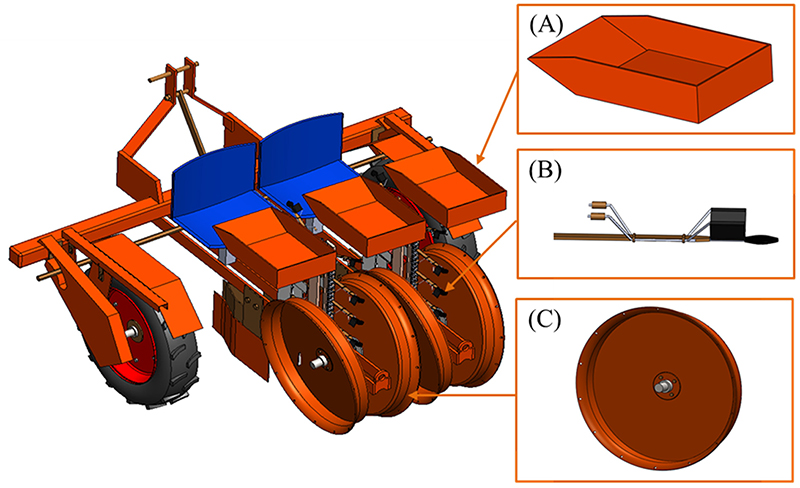
Three-dimensional CAD model and principal structural components of the chain-clamp-type transplanter.(A) Seedling feeding section, (B) chain-mounted planting unit, and (C) soil compaction wheel.
The transplanting process comprised four stages: seedling pickup, transportation, placement, and soil compaction (Ali et al., 2024b). Bare-root seedlings were manually positioned between rubberized clamping surfaces at the feeding section. Planting units were uniformly mounted along the transport chain using hinged connections, and the effective length of each unit was adjustable by altering the fastening-bolt position. Rotational motion from the power source was transmitted to the planting chain via the driving mechanism. Synchronized rotation of the driving and driven sprockets ensured uniform movement of the planting units and consistent planting intervals. The structural arrangement and operating sequence of the chain-clamp-type planting mechanism are shown in Fig. 3.
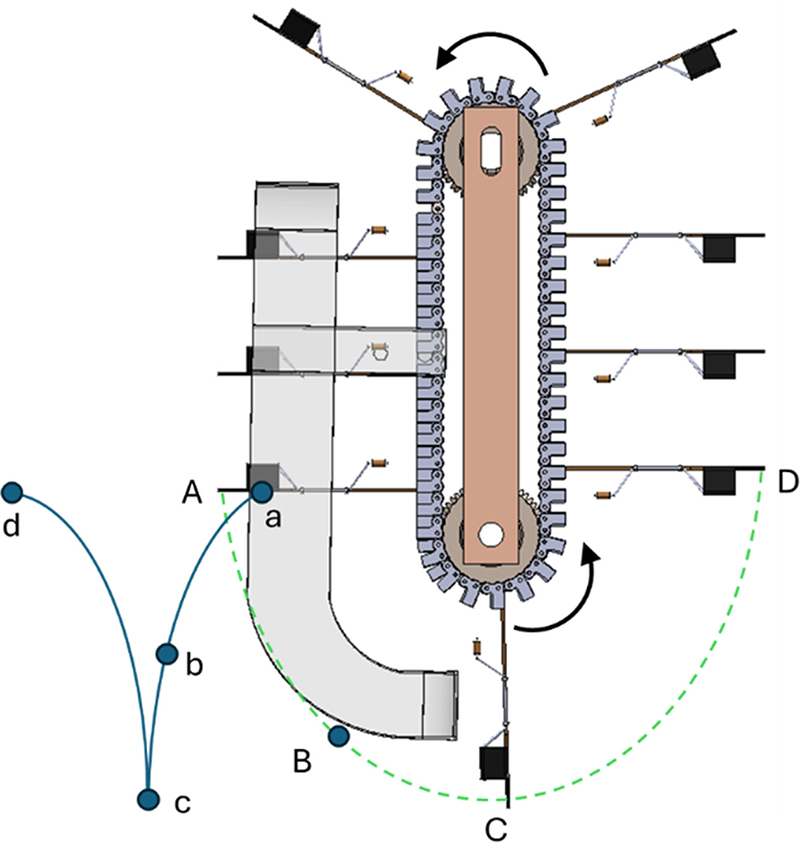
Operational sequence of the chain-clamp-type planting mechanism during seedling insertion and release.Positions A to D represent clamp entry, downward movement, seedling release, and withdrawal, respectively.
During chain movement, planting units were guided by dual guide slideways. Downward pressure from the slideways was transmitted to the actuator, compressing the elastic clamping pads around the seedling stem. This maintained sufficient clamping force during transportation and prevented premature seedling release. Movement from position A to B corresponded to trajectory segment a to b, from B to C to segment b to c, and from C to D to segment c to d.
At position A, corresponding to point a, the clamped seedling was guided toward the pre-opened planting furrow. At position B, corresponding to point b, contact between the planting unit and the guide slideway gradually decreased, thereby releasing pressure on the clamping pads. At position C, corresponding to point c, the clamping surfaces opened, and the seedling was released into the furrow. The soil surrounding the root region was then compressed by the rear compaction wheel to enhance root-soil contact and maintain an upright planting posture. At position D, corresponding to point d, the planting unit was withdrawn from the furrow and returned to the feeding section. This operating sequence was repeated continuously during field transplanting (Ji et al., 2024; Ali et al., 2025).
The planting unit underwent rotational motion about the sprocket, while forward translation resulted from transplanter movement (Ali et al., 2024b). For the kinematic analysis, point P at the lower end of the clamp-type planting unit was designated as the reference point. A two-dimensional Cartesian coordinate system was established, with the sprocket rotational center defined as the origin (0,0), as shown in Fig. 4 (Zhao et al., 2024). The instantaneous horizontal and vertical positions of point P at time t were defined in Equations (1) and (2) (Ali et al., 2025).
| (1) |
| (2) |
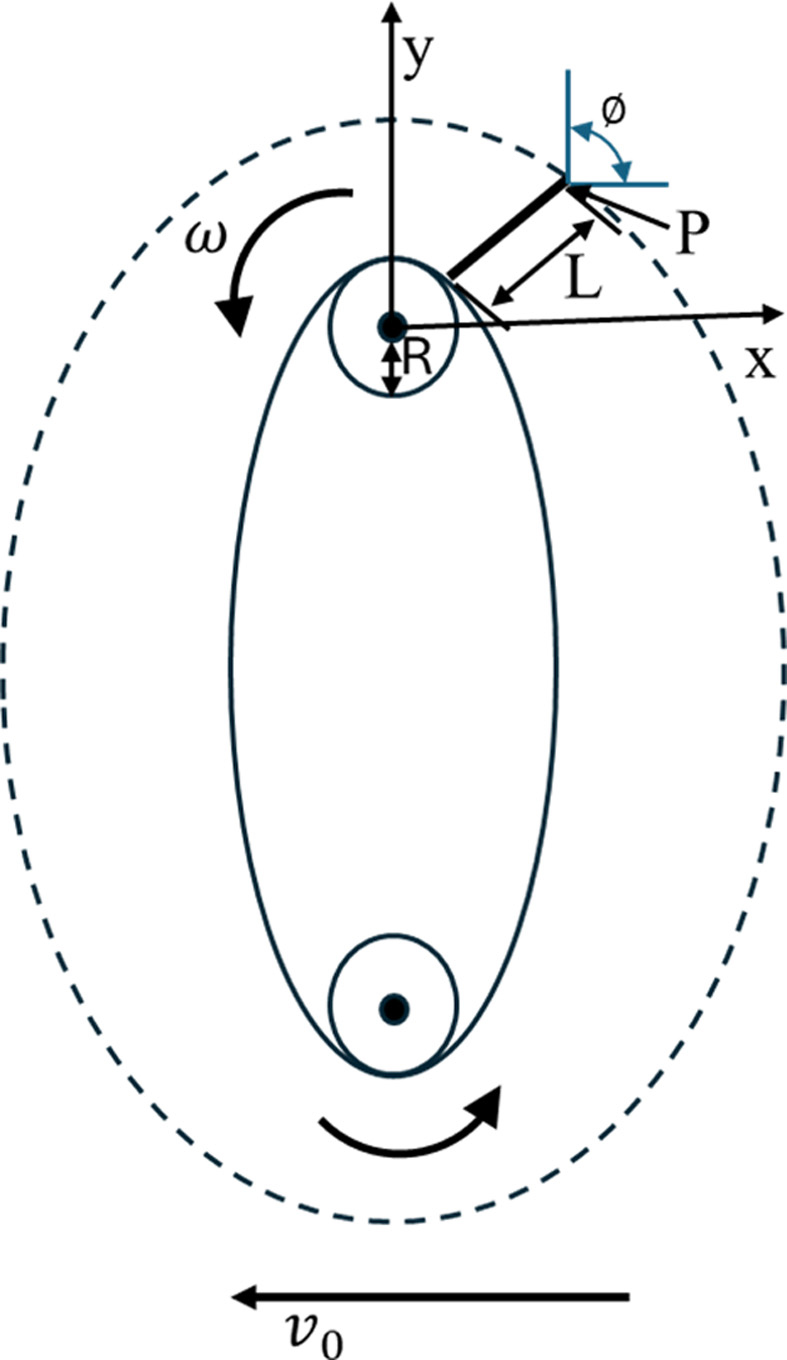
Kinematic model of the chain-clamp-type transplanting mechanism with combined chain motion around the sprocket and forward travel of the transplanter.
Where x and y were the instantaneous horizontal and vertical coordinates of planting point P, respectively, in m. The constant forward velocity of the transplanter was denoted by v0 in m s-1, and elapsed time was denoted by t in s. The effective rotational radius of the planting unit around the sprocket center was denoted by R in m. The angular velocity of sprocket rotation was denoted by ω in rad s-1. The effective distance from the rotational reference point to planting point P was denoted by L in m. The instantaneous angular position of the planting unit was denoted by φ, as presented in Fig. 4, and was related to the rotational motion by φ = ωt. For ground-referenced trajectory analysis, the horizontal coordinate of planting point P was calculated by including both rotational motion around the lower sprocket and forward translation of the transplanter. Therefore, the term v0t was included in the horizontal position equation. The resulting trajectory represented the absolute motion of planting point P relative to the ground rather than the trajectory relative to the transplanter frame. The horizontal and vertical velocity components of point P were determined by first-order differentiation of the respective position equations, as shown in Equations (3) and (4).
| (3) |
| (4) |
The acceleration components were obtained by performing second-order differentiation of the position equations, as demonstrated in Equations (5) and (6).
| (5) |
| (6) |
Where vx and vy were the horizontal and vertical velocity components of planting point P, respectively, in m s-1, and ax and ay were the corresponding horizontal and vertical acceleration components in m s-2. The calculated position, velocity, and acceleration components characterize the motion of the planting unit during soil approach, seedling release, and withdrawal. The release region was of particular interest, as excessive horizontal velocity may increase seedling dragging and planting inclination, while excessive acceleration may increase dynamic disturbance during clamping and release. The kinematic parameters were therefore evaluated to identify suitable operating conditions for stable seedling placement and upright establishment.
2. Kinematic trajectory control for minimum soil disturbance
In raised-ridge medicinal crop cultivation, soil disturbance at the planting position is a critical factor influencing root placement, seedling stability, and overall crop establishment. Excessive horizontal movement of the planting component beneath the soil surface enlarges the planting opening, disrupts the surrounding soil structure, and diminishes the vertical stability of transplanted seedlings. Conventional transplanting mechanisms with bulky planting components have also been shown to cause significant soil displacement during both insertion and withdrawal.
In the chain-clamp-type mechanism, a narrow clamp profile with rubberized contact surfaces was utilized to minimize soil disturbance at the planting position. A continuous soil-entry and withdrawal trajectory was achieved through the combined motion of the chain around the lower sprocket and the forward movement of the transplanter. Since lateral expansion was not required for seedling release, transverse soil disturbance was primarily determined by the physical width of the clamp. Longitudinal soil disturbance was mainly influenced by the horizontal relative displacement of planting point P beneath the soil surface. Consequently, synchronization between sprocket rotational speed and forward travel speed was necessary to reduce horizontal dragging and unnecessary soil displacement. The horizontal displacement of planting point P beneath the soil surface was determined by the trajectory between soil entry point A and soil exit point B. The kinematic characteristic coefficient λ represents the ratio of the peripheral velocity of the planting unit around the lower sprocket to the forward velocity of the transplanter, as shown in Equation (7) (Zhao et al., 2024).
| (7) |
Where, R was the effective sprocket rotation radius in meters, ω was the angular velocity of the lower sprocket in radians per second, and v0 was the forward velocity of the transplanter in meters per second. At soil entry point A, planting point P was positioned at a target planting depth H of 40 ㎜ below the ridge surface. When the center of the lower sprocket was defined as the coordinate origin, the corresponding vertical coordinate is provided in Equation (8).
| (8) |
Where, L was the effective distance from the chain hinge to planting point P, and H was the target planting depth. When λ exceeds 1, a trochoidal trajectory was generated beneath the soil surface due to the combined rotational and translational motion of planting point P (Zhao et al., 2024). The horizontal distance between soil entry and exit points was denoted by lAB, while the maximum subsurface trajectory width was denoted by lCD. Excessively high values of λ increase lCD and, consequently, subsurface soil displacement. Conversely, values approaching 1.0 reduce backward relative motion of the planting unit but increase forward horizontal dragging, resulting in a larger lAB.
The minimum theoretical horizontal soil displacement occurs when the entry-exit span and the maximum subsurface trajectory width were approximately equal, expressed as lAB = lCD. Accordingly, a planting depth of 40 ㎜ was maintained, and the rotational and forward velocities were coordinated to minimize horizontal dragging and subsurface soil displacement. This kinematic condition enhances seedling release stability, reduces soil disturbance around the root zone, and maintains an upright planting posture. Among the five simulated trajectory conditions presented in Fig. 5, Track 3 corresponded to λ = 1.068. Under this condition, the entry-exit span and maximum subsurface trajectory width were approximately balanced, and reduced horizontal soil displacement was therefore expected.
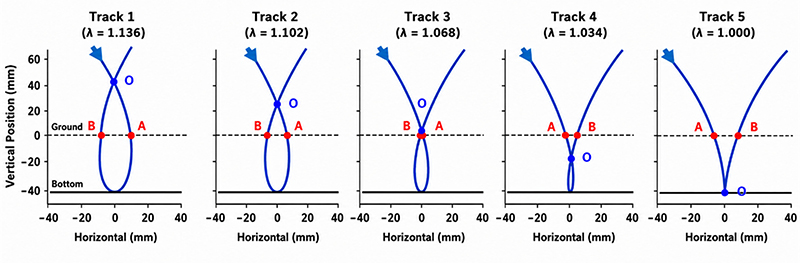
Kinematic trajectories of the hole-forming mechanism in the transplanting unit for varying transplanting characteristic coefficients λ.Track 3 corresponded to the selected condition of λ = 1.068.
Five kinematic characteristic coefficients were evaluated, as presented in Fig. 5. Track 3 corresponded to λ = 1.068. For values greater than 1.068, the maximum subsurface loop width lCD was increased, whereas values approaching 1.0 produced a larger entry-exit span lAB because backward relative motion of the planting unit was reduced. The condition at λ = 1.068 was selected because lAB and lCD were approximately balanced, through which the maximum horizontal disturbance beneath the soil surface was minimized among the evaluated conditions. Therefore, Track 3 was selected as the operating condition for subsequent field evaluation.
3. Field experiment and performance evaluation procedure
Field tests of the chain-clamp-type transplanter were performed at a commercial farm in South Jeolla Province, Republic of Korea, as shown in Fig. 6. A field section approximately 100 m in length was selected to assess transplanting performance under practical operating conditions. The experiment utilized bare-root Rehmannia glutinosa seedlings, and the transplanter was operated under uniform field conditions throughout the testing period. Planting time, row spacing, plant spacing, seedling damage, missed planting, and planting posture were recorded as the primary performance indicators. The soil disturbance area was calculated from the measured longitudinal and transverse dimensions and was expressed in ㎜2.
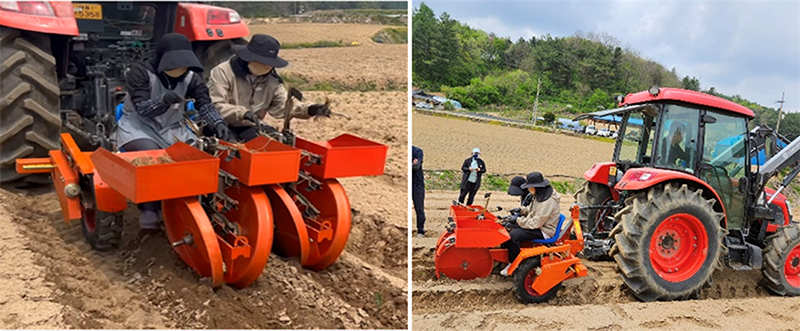
Field evaluation of the chain-clamp-type transplanter for bare-root Rehmannia glutinosa seedlings at the experimental site.
Ambient temperature and relative humidity were monitored during the field experiment, ranging from 20 to 23°C and 65 to 70%, respectively. To minimize variation related to machine operation, an experienced operator was employed, and a standardized operating procedure was followed. Identical machine settings and planting conditions were maintained throughout the 100 m test section, ensuring that observed differences in transplanting performance could be attributed primarily to the operating characteristics of the chain-clamp-type mechanism.
Field performance was evaluated based on planting frequency, seedling damage rate, missed-planting rate, and transplanting accuracy. These parameters quantified operational capacity, seedling handling quality, reliability of seedling delivery, and planting quality under field conditions. Planting frequency was determined by the forward speed of the transplanter and the prescribed plant spacing. The calculation followed the method described by Vlahidis et al. (2024), as shown in Equation (9).
| (9) |
Where, Fs was the planting frequency in seedlings per second, Vm was the machine forward speed in m/s, and dpm was the prescribed plant spacing in meters. The calculation assumed constant forward speed and uniform plant spacing. Higher planting frequency corresponded to greater field capacity. However, excessive operating speed could increase seedling displacement and mechanical damage. Seedling damage was assessed post-transplanting based on visible mechanical injuries, such as stem crushing, bending, tearing, and root damage. The seedling damage rate was calculated following Feng et al. (2024), as shown in Equation (10).
| (10) |
Where, DSR was the seedling damage rate in percent, D1 was the number of damaged seedlings, and T1 was the total number of evaluated seedlings. Lower DSR values indicated reduced mechanical damage during clamping, conveying, and release processes. The missed planting rate was determined by identifying planting positions where no seedling was successfully deposited into the furrow. Missed plants could result from unsuccessful clamping, seedling slippage, incorrect release timing, or interruptions in the feeding process. The missed planting rate was calculated according to Vlahidis et al. (2024), as shown in Equation (11).
| (11) |
Where, MSR was the missed planting rate in percent, Ms was the number of missed planting positions, and s was the total number of planting attempts. Lower MSR values indicated greater reliability of the seedling feeding and release processes. Transplanting accuracy was evaluated by recording occurrences of exposed seedlings, lodging, missed planting, and multiple planting. Lodging was defined as an inclination angle of a transplanted seedling exceeding 60 degrees from the vertical. Transplanting accuracy was calculated according to Ji et al. (2024), as shown in Equation (12).
| (12) |
Here, L represented transplanting accuracy in percent, n1 represented the exposed seedling rate, n2 represented the lodging rate, n3 represented the missed planting rate, and n4 represented the multiple planting rate. Higher values of L indicated improved planting quality and more reliable field performance of the chain-clamp-type transplanter.
Field performance evaluation was conducted over a 100 m test section, which was divided into four 25 m sections. Each 25 m section was treated as one independent field replicate. A nominal plant spacing of 0.20 m was maintained, resulting in approximately 125 planting positions per replicate and approximately 500 planting positions over the entire test section. Planting frequency, missed planting rate, seedling damage rate, planting depth, and planting posture were recorded separately for each replicate. Continuous variables were summarized as mean ± standard deviation based on the four field replicates. Missed planting and seedling damage were expressed as the number of affected seedlings relative to the total number of evaluated planting positions and as percentages.
Planting posture was evaluated by measuring the angle between the main seedling axis and the horizontal soil surface after soil compaction. A planting angle of 90° represented a completely upright seedling. The planting angle was measured for the evaluated seedlings in each 25 m field replicate, and mean values were calculated for the four replicates. Planting depth was measured as the vertical distance from the ridge surface to the defined planting reference position after seedling placement. Measurements were obtained using a ruler or digital measuring device, and the mean planting depth and standard deviation were calculated from the four field replicates.
RESULTS AND DISCUSSION
1. Kinematic path verification
The motion path of the chain-clamp-type transplanting mechanism was analyzed using software simulation of the developed kinematic model, as shown in Fig. 7. The simulated trajectory characterized the horizontal and vertical movements of the planting unit under the combined effects of chain motion around the sprocket and the forward travel of the transplanter. The mechanism demonstrated a wide operating range, approximately 0 to 750 ㎜ horizontally and 0 to 1200 ㎜ vertically. A continuous and smooth trajectory was maintained throughout the conveying, soil approach, insertion, and withdrawal stages, with reduced abrupt changes in lateral movement within the planting region. Comparable smooth trajectory characteristics have been reported for rotary and chain-driven transplanting mechanisms, in which continuous motion was associated with reduced dynamic disturbance and improved handling of delicate seedlings (Ali et al., 2024b). Thus, the obtained trajectory was considered mechanically advantageous for bare-root Rehmannia glutinosa seedlings, as excessive lateral motion may cause root displacement, stem oscillation, and unstable soil insertion.
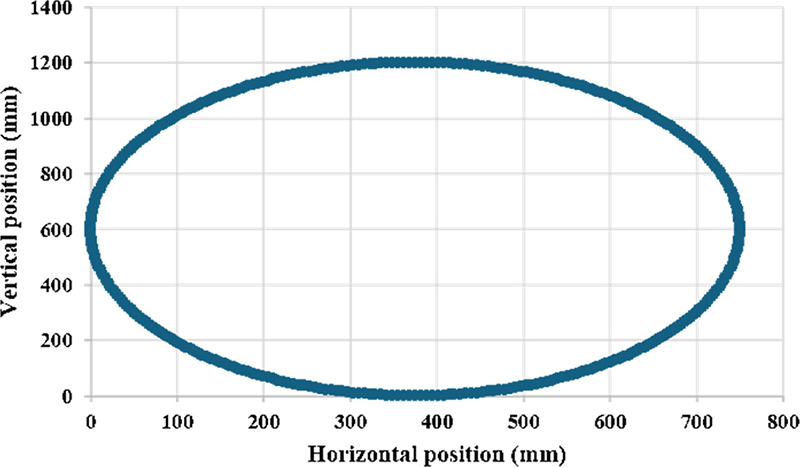
Simulated ground-referenced trajectory of planting point P under combined chain motion around the lower sprocket and forward travel of the chain-clamptype transplanter.
The simulated ground-referenced trajectory was calculated from the complete kinematic model, in which forward translation of the transplanter was included together with rotational movement of the planting unit. Therefore, the trajectory presented in Fig. 7 represented absolute movement of planting point P relative to the ground. Among the five evaluated characteristic coefficients shown in Fig. 5, Track 3 corresponded to λ = 1.068 and was selected because the entry-exit span lAB and maximum subsurface trajectory width lCD were approximately balanced. Reduced horizontal displacement near the soil-entry and release region was consequently obtained under the selected condition.
Reduced relative horizontal velocity near the planting position is critical for minimizing seedling displacement and mechanical disturbance during release. The simulated trajectory was evaluated based on the zero-speed planting principle, which reduces horizontal motion of the planting point relative to the ground near soil insertion. Similar kinematic synchronization between rotational motion and forward travel has been shown to decrease horizontal dragging and soil disturbance at the planting position (Zhao et al., 2024). Under the simulated conditions, controlled downward movement was maintained and lateral displacement near the release region was limited. As a result, root dragging, mechanical stress, and planting inclination were minimized, promoting stable vertical placement. Enhanced synchronization between seedling release and planting-unit motion was also linked to reduced missed planting and improved planting posture in mechanized transplanting systems (Ji et al., 2024). These motion characteristics are therefore suitable for the controlled insertion and release of delicate bare-root medicinal crop seedlings.
2. Experimental assessment of soil disturbance mitigation
A field test was performed under raised-ridge field conditions to assess the kinematic trajectory of the chain-clamp-type transplanting mechanism. A constant forward travel speed of 1.6 ㎞ h1, corresponding to a transplanting frequency of approximately 72 seedling min-1, was maintained throughout the experiments. The planting unit produced a longitudinal soil opening length ranging from 99.20 to 120.40 ㎜ and a transverse opening width ranging from 31.67 to 36.53 ㎜. The measured longitudinal opening exceeded the theoretical trajectory displacement, which was attributed to mechanical vibration, contact between the rubberized clamp and the soil surface, and minor deviations between simulated and actual operating conditions. A relatively narrow transverse opening was maintained because lateral expansion of the clamp was unnecessary during seedling release.
Relative to the transverse opening width of 62.41 ㎜ reported by Zhao et al. (2024), the measured transverse soil disturbance width corresponded to a 41.4–49.3% lower value. However, this comparison was based on a literature reference obtained under different experimental conditions and was therefore considered an indirect benchmark rather than a direct experimental comparison. This reduction resulted from the narrow clamp profile and the continuous soil-entry and withdrawal trajectory of the chain-clamp mechanism. Comparable reductions in soil disturbance were observed when planting components operated with limited transverse movement and enhanced synchronization between rotational and forward velocities (Zhao et al., 2024). These conditions minimized excessive lateral soil displacement around the root zone while maintaining adequate opening dimensions for seedling insertion. Reduced disturbance at the planting position was advantageous for preserving root-soil contact and enhancing the vertical stability of transplanted seedlings.
As presented in Fig. 5, Track 3 corresponded to the selected kinematic condition of λ = 1.068. Under this condition and a target planting depth of 40 ㎜, reduced horizontal displacement of the planting point was obtained near the soil-entry region. A soil disturbance area of 2430 ± 170 ㎜2 per planting position was measured. This reduced disturbance was attributed to decreased horizontal dragging at the planting point (P) and improved synchronization between sprocket rotation and forward travel. Similar kinematic optimization has been reported to reduce subsurface displacement and enhance planting stability by limiting relative horizontal movement near the release position (Zhao et al., 2024; Ali et al., 2025). The experimentally measured opening dimensions and disturbance area confirmed the suitability of the selected kinematic condition for bare-root Rehmannia glutinosa transplanting, where minimal soil displacement and stable upright establishment are required.

Experimental validation of kinematic trajectory and soil disturbance performance of the chain-clamp-type transplanter.
3. Transplanting efficiency and accuracy
A stable transplanting rate of 72 seedling min-1 was achieved under field conditions, with missed planting and seedling damage rates of 1% and 2%, respectively. Reliable seedling delivery resulted from the continuous chain motion and the adequate loading interval prior to clamping. Comparable improvements in transplanting reliability have been observed when seedling feeding and planting-unit motion were properly synchronized. The low damage rate was attributed to the use of elastic clamping surfaces, which reduced localized compression at the stem and root-stem junction. Similarly, flexible gripping surfaces and controlled release conditions have been shown to minimize mechanical damage to delicate seedlings Stable planting posture and relatively uniform planting depth were maintained throughout the trials. Reduced horizontal movement near the release position corresponded with decreased seedling dragging, lateral displacement, and inclination following soil entry. Effective coordination among chain movement, clamp opening, planting depth, and soil compaction was identified as critical for maintaining planting quality. Zhao et al. (2024) similarly reported that reduced relative horizontal velocity near the planting position resulted in reduced soil disturbance and improved seedling placement. The kinematic and field performance characteristics observed in this study were therefore deemed suitable for bare-root Rehmannia glutinosa seedlings.
Manual seedling feeding remained the primary operational limitation, as the maximum transplanting rate depended on the loading capacity of the operator. Repetitive loading was also likely to increase operator fatigue during extended field operations. Integration of a semi-automatic feeding system could further enhance performance, provided that the established clamping and release characteristics are maintained. The principal performance, kinematic, and agronomic indicators are summarized in Table 2.
Performance and agronomic indicators of the chain-clamp-type transplanter.
The field performance observed in this study was generally consistent with previous findings for mechanized transplanting systems designed for delicate seedlings. Comparable low rates of missed planting and seedling damage were reported when continuous planting trajectories, synchronized feeding, and flexible gripping components were employed to minimize abrupt seedling movement and mechanical impact (Ali et al., 2024a; Ali et al., 2024b). Improved planting posture was also associated with reduced horizontal relative velocity near the soil-entry position, which minimized seedling dragging and lateral displacement (Zhao et al., 2024). Ji et al. (2024) further emphasized the importance of accurate release timing and stable clamping for reducing leakage and maintaining planting quality. Collectively, these findings suggest that the continuous chain motion, controlled clamp release, and elastic gripping surfaces utilized in the present transplanter offer performance characteristics comparable to those of previously developed mechanisms for precision seedling placement.
The post-transplantation failures shown in Fig. 8 were attributed to a combination of operational and biological factors. Seedling misplacement may have resulted from minor deviations in manual loading or clamp release timing, which shifted the seedling release position away from the intended planting point. Variations in local soil moisture and compaction likely reduced soil support around the root zone, increasing the incidence of seedling inclination or lodging. Additionally, differences in seedling height, root length, and stem diameter may have influenced clamping contact and release consistency. Previous mechanized transplanting studies have reported similar impacts of release timing, soil-entry conditions, and seedling morphology on transplanting quality (Ji et al., 2024; Zhao et al., 2024; Yuan et al., 2026). Thus, the observed failure cases likely resulted from the combined effects of operating timing, field conditions, and seedling morphology, rather than from a single mechanical factor.
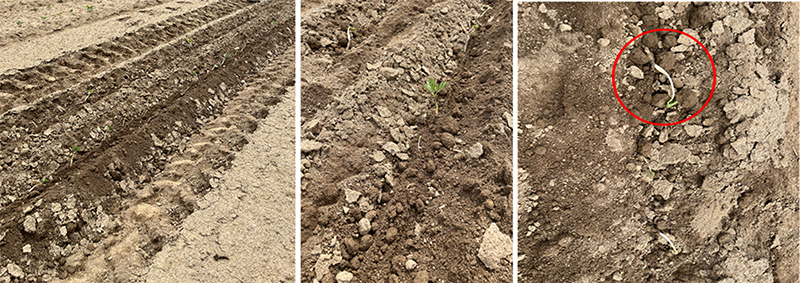
Post-transplantation issues included seedling misplacement and loss of upright planting posture.
Under the evaluated field conditions, the chain-clamp-type transplanter maintained a continuous planting trajectory at the selected kinematic condition (λ = 1.068) and a target planting depth of 40 ㎜. The measured longitudinal and transverse soil disturbance dimensions ranged from 99.20 to 120.40 ㎜ and from 31.67 to 36.53 ㎜, respectively. The soil disturbance area was measured as (2430 ± 170) ㎜2 per planting position. Missed planting and seedling damage rates were recorded as 1% and 2%, respectively, across the evaluated field section. Comparison with the reference mechanism relied on published data rather than direct experimental comparison under identical conditions. Manual seedling feeding remained the principal operational limitation. Further evaluation under varied field conditions is recommended.
Acknowledgments
This work was carried out with the support of “Cooperative Research Program for Agriculture Science & Technology Development (Project No.RS-2022-RD010298)”, Rural Development Administration, Republic of Korea.
References
- Ali MR, Ali M, Reza MN, Jang GH, Kang BS, Choi IJ and Koo JM. (2024a). Trends of vegetable transplanting mechanism for biodegradable seedling pots: A review. Precision Agriculture Science and Technology. 6:179-194.
-
Ali MR, Reza MN, Habineza E, Haque MA, Kang BS and Sun-Ok C. (2024b). Kinematic analysis of a cam-follower-type transplanting mechanism for a 1.54 kW biodegradable potted cabbage transplanter. Machines. 12:925. https://www.mdpi.com/2075-1702/12/12/925, (cited by 2026 Oct 13).
[https://doi.org/10.3390/machines12120925]

- Ali MR, Reza MN, Rahman MA, Choi JM, Lee KH, Chung SO and Jeong K. (2025). Design and performance evaluation of a double crank five bar and finger type medicinal crop transplanter. Precision Agriculture Science and Technology. 7:243-263.
-
Bai H, Li X, Zeng F, Cui J and Zhang Y. (2022). Study on the impact damage characteristics of transplanting seedlings based on pressure distribution measurement system. Horticulturae. 8:1080.
[https://doi.org/10.3390/horticulturae8111080]
- Chen X, Xu X and Wang M. (2022). A novel automatic transplanter for field vegetables. Biosystems Engineering. 212:1-9.
-
Cheng B, Wu H, Zhu H, Liang J, Miao Y, Cui Y and Song W. (2024). Current status and analysis of key technologies in automatic transplanters for vegetables in China. Agriculture. 14:2168. https://www.mdpi.com/2077-0472/14/12/2168, (cited by 2026 Oct 13).
[https://doi.org/10.3390/agriculture14122168]
-
Cho Y and Nam JS. (2024). Soil mechanical systems and related farming machinery. Agriculture. 14:1661. https://www.mdpi.com/2077-0472/14/9/1661, (cited by 2026 Oct 13).
[https://doi.org/10.3390/agriculture14091661]
-
Feng Y, Liu M, Wang K, Ling Y, Hu Q, Zhang H and Zhang H. (2024). Optimal seeding rate enhances seedling quality, mechanical transplanting quality, and yield in hybrid rice. Frontiers in Plant Science. 15:1427972.
[https://doi.org/10.3389/fpls.2024.1427972]
-
Frasconi C, Martelloni L, Raffaelli M, Fontanelli M, Abou Chehade L, Peruzzi A and Antichi D. (2019). A field vegetable transplanter for use in both tilled and no-till soils. Transactions of the ASABE. 62:593-602.
[https://doi.org/10.13031/trans.12896]
- Gaowei XU, Hongxin LIU, Shichun JIAN, Song SHI and Tengfe HE. (2018). Design and test of transplanting mechanism on mulch-film of Salvia miltiorrhiza based on five-bar mechanism. Nongye Jixie Xuebao / Transactions of the Chinese Society of Agricultural Machinery. 49:55-65.
-
Habineza E, Ali M, Reza MN, Woo JK, Chung SO and Hou Y. (2023). Vegetable transplanters and kinematic analysis of major mechanisms: A review. Korean Journal of Agricultural Science. 50:113-129.
[https://doi.org/10.7744/kjoas.20230007]
-
Habineza E, Ali MR, Reza MN, Lee KH, Park SH, Lee DH and Chung SO. (2025). Kinematic modeling and preliminary field evaluation of a link-driven hopper planting mechanism for a 3.4 kW walking-type pepper transplanter. Machines. 13:1074. https://www.mdpi.com/2075-1702/13/12/1074, (cited by 2026 Oct 13).
[https://doi.org/10.3390/machines13121074]
-
Ji D, Liu L, Zeng F, Zhang G, Liu Y, Diao H and Zhao Z. (2024). Design and experimental study of a traction double-row automatic transplanter for Solanum lycopersicum seedlings. Horticulturae. 10:692.
[https://doi.org/10.3390/horticulturae10070692]
- Jiaodi L, Weibin C, Dongyang T, Haiyang T and Hongzheng Z. (2016). Kinematic analysis and experiment of planetary five-bar planting mechanism for zero-speed transplanting on mulch film. International Journal of Agricultural and Biological Engineering. 9:84-91.
-
Jin X, Li M, Li D, Ji J, Pang J, Wang J and Peng L. (2018). Development of automatic conveying system for vegetable seedlings. EURASIP Journal on Wireless Communications and Networking. 2018:178.
[https://doi.org/10.1186/s13638-018-1200-8]
-
Jin X, Cheng Q, Zhao B, Ji J and Li, M. (2020). Design and test of 2ZYM-2 potted vegetable seedlings transplanting machine. International Journal of Agricultural and Biological Engineering. 13:101-110.
[https://doi.org/10.25165/j.ijabe.20201301.5494]
-
Khadatkar A, Mathur SM and Gaikwad BB. (2018). Automation in transplanting: A smart way of vegetable cultivation. Current Science. 115:1884-1892.
[https://doi.org/10.18520/cs/v115/i10/1884-1892]
-
Khadatkar A, Pandirwar AP and Paradkar VJSR. (2023). Design, development and application of a compact robotic transplanter with automatic seedling picking mechanism for plug-type seedlings. Scientific Reports. 13:1883.
[https://doi.org/10.1038/s41598-023-28760-4]
-
Khadatkar A, Magar AP, Sawant CP and Modi RU. (2024). Development and testing of automatic seedling extractor in robotic transplanter using mechatronics for nursery seedlings. Discover Applied Sciences. 6:51.
[https://doi.org/10.1007/s42452-024-05670-2]
- Kim HS, Yoo SH, Seol M, Moon SH and Kim HY. (2020). Revision of Biotechnology Support Act for Accelerating the Bioeconomy. Asian Journal of Innovation and Policy. 9:240-256.
- Kumar P and Raheman H. (2012). Automatic feeding mechanism of a vegetable transplanter. International Journal of Agricultural and Biological Engineering. 5:20-27.
- Lee, SH, Koo SC, Hur M, Lee WM, Chang JK and Han JW. (2019). Appropriateness evaluation of cultivation of Rehmannia glutinosa(Gaertn.) Libosch. ex Steud. in the region of Southern Gangwon Province, South Korea. Korean Journal of Plant Resources. 32:471-477.
-
Lee ES, An TJ, Park WT, Jeong JT, Lee YJ, Hur M and Kim YI. (2020). A trend analysis of the cultivation status of medicinal crop farmers in Korea. Korean Journal of Agricultural Science. 47:139-161.
[https://doi.org/10.7744/kjoas.2020007]
-
Li P, Yun Z, Gao K, Si L and Du X. (2022). Design and test of a force feedback seedling pick-up gripper for an automatic transplanter. Agriculture. 12:1889.
[https://doi.org/10.3390/agriculture12111889]
- Li R, Feng H and Wang M. (2019). Mechanical behavior of root transplanting systems under field conditions. Agricultural Mechanization Research. 41:22-27.
-
Liu Z, Wang X, Zheng W, Lv Z and Zhang W. (2021). Design of a sweet potato transplanter based on a robot arm. Applied Sciences. 11:9349.
[https://doi.org/10.3390/app11199349]
-
Liu Z, Lv Z, Zheng W and Wang X. (2022). Trajectory control of two-degree-of-freedom sweet potato transplanting robot arm. IEEE Access. 10:31576-31600.
[https://doi.org/10.1109/ACCESS.2022.3157600]
-
Liu W, Tian S, Wang Q and Jiang H. (2023). Key technologies of plug tray seedling transplanters in protected agriculture: A review. Agriculture. 13:1488. https://www.mdpi.com/2077-0472/13/8/1488, (cited by 2026 Oct 13).
[https://doi.org/10.3390/agriculture13081488]
- Mohammod A, Haque MA, Rahman MA, Moon JM, Kim KJ, Chung SO and Kim HI. (2024). Mechanization trends of cabbage harvesting practices: A review. Precision Agriculture Science and Technology. 6:218-237.
- Park J, Lee H and Kim S. (2025). Effects of light conditions and root development on plug seedling quality of Angelica gigas Nakai under plant factory environment. Horticultural Science & Technology. 43:21-31.
-
Park MS, Park IS, Shim CY, Choi JM and Chun JP. (2026). Effect of root zone temperatures on seedling growth and nutrient uptake of Rehmannia glutinosa and Codonopsis lanceolata. Horticulture, Environment, and Biotechnology. 67:679-687.
[https://doi.org/10.1007/s13580-026-00806-2]
-
Perez-Ruiz M and Slaughter DC. (2021). Development of a precision 3-row synchronised transplanter. Biosystems Engineering. 206:67-78.
[https://doi.org/10.1016/j.biosystemseng.2021.03.014]
-
Reza MN, Ali M, Habineza E, Kabir MS, Kabir MSN, Lim SJ, Choi IS and Chung SO. (2023). Analysis of operating speed and power consumption of a gear-driven rotary planting mechanism for a 12-kW six-row self-propelled onion transplanter. Spanish Journal of Agricultural Research. 21:e0207.
[https://doi.org/10.5424/sjar/2023213-20245]
-
Reza MN, Karim MR, Ali MR, Lee KH, Bicamumakuba E, Lee KY and Chung SO. (2025). Field evaluation of a transplanter and a collector under development for Korean spring cabbage production in greenhouses. AgriEngineering. 7:226.
[https://doi.org/10.3390/agriengineering7070226]
-
Ryu KH, Kim G and Han JS. (2001). Development of a robotic transplanter for bedding plants. Journal of Agricultural Engineering Research. 78:141-146.
[https://doi.org/10.1006/jaer.2000.0656]
-
Son J, Kim C, Park M, Choi D and Yun SW. (2020). Traditional medicine analysis and sustainable use of Korean pond wetland plants in the agricultural landscape. Sustainability. 12:5963. https://www.mdpi.com/2071-1050/12/15/5963, (cited by 2026 Oct 13).
[https://doi.org/10.3390/su12155963]
-
Sun L, Xu H, Zhou Y, Shen J, Yu G, Hu H and Miao Y. (2023). Kinematic synthesis and simulation of a vegetable pot seedling transplanting mechanism with four exact task poses. International Journal of Agricultural and Biological Engineering. 16:85-95.
[https://doi.org/10.25165/j.ijabe.20231602.6739]
-
Theckes B, De Langre E and Boutillon X. (2011). Damping by branching: A bio-inspiration from trees. Bioinspiration & Biomimetics. 6:046010.
[https://doi.org/10.1088/1748-3182/6/4/046010]
-
Timene A and Djalo H. (2023). Design of a five-bar duckbill-type mechanism for sorghum transplanting. Journal of Agricultural Engineering. 54:109-119.
[https://doi.org/10.4081/jae.2023.1473]
-
Vlahidis V, Roșca R and Cârlescu PM. (2024). Evaluation of the functional parameters for a single-row seedling transplanter prototype. Agriculture. 14:388. https://www.mdpi.com/2077-0472/14/3/388, (cited by 2026 Oct 13).
[https://doi.org/10.3390/agriculture14030388]
- Wang H, Yu L and Chen Z. (2021). Kinematic analysis and optimization of a double crank seedling transplanter. Biosystems Engineering. 198:96-107.
-
Wang H, Sun W, Wang H and Simionescu PA. (2024). Automated mulched transplanting of Angelica seedlings using a pneumatic sowing device. Agronomy. 14:1–25. https://www.mdpi.com/2073-4395/14/12/3076, (cited by 2026 Oct 13).
[https://doi.org/10.3390/agronomy14123076]
-
Wang T, Sun D, Xiong W, Kuang F, Xue K, Shi M and Zhu D. (2024). Impact of root-stem coupling damage from mechanical transplanting on the growth of large rice seedlings. Plant Growth Regulation. 104:1075-1086.
[https://doi.org/10.1007/s10725-024-01219-w]
-
Xu T, Li X, He J, Han S, Wang G, Yin D and Zhou M. (2025). Research progress and future prospects of key technologies for dryland transplanters. Applied Sciences. 15:8073.
[https://doi.org/10.3390/app15148073]
- Yuan H, Liao Q, Yuan J, Liu K, Li L, Wang L, Du W and Wan X. (2026). Compatibility between rapeseed bare-root seedling morphological characteristics and the transplanter parameters. International Journal of Agricultural and Biological Engineering. 19:31-41.
- Zhao Y, Li Y and Zhou H. (2018). Dynamic simulation of seedling delivery mechanisms using multi-body modeling. Journal of Agricultural Engineering Research. 64:187-193.
-
Zhao X, Hou Z, Zhang J, Yu H, Hao J and Liu Y. (2024). Study on the hole-forming performance and opening of mulching film for a dibble-type transplanting device. Agriculture. 14:494.
[https://doi.org/10.3390/agriculture14030494]
-
Zhou M, Wang G, Zhang Y, Yang J, Wei Z, Sun H and Yin J. (2024). Design and test of walk-type rice potted seedling transplanting machine. Advances in Mechanical Engineering. 16:16878132241237710.
[https://doi.org/10.1177/16878132241237710]