
1H NMR-Based Primary Metabolite Profiling of Trichosanthes kirilowii Roots and Exploratory Comparison between Male and Female Plants
This is an open access article distributed under the terms of the Creative Commons Attribution Non-Commercial License (http://creativecommons.org/licenses/by-nc/3.0/) which permits unrestricted non-commercial use, distribution, and reproduction in any medium, provided the original work is properly cited.
Abstract
Trichosanthes kirilowii Maxim. is a dioecious plant whose roots are widely used in traditional medicine. Previous phytochemical studies have focused on secondary metabolites, whereas comprehensive profiling of primary metabolites in its roots, including possible sex-related differences, remains limited.
Root samples from two female and two male plants were extracted in triplicate and analyzed using 600 MHz 1H nuclear magnetic resonance spectroscopy. Forty-nine endogenous metabolites were identified and quantified, with citrulline, fructose, and glucose being the most abundant. Principal component analysis revealed clear differences among individual plants, whereas hierarchical cluster analysis grouped the samples by sex. Ten metabolites showed at least 1.5-fold differences in abundance between the sexes. Six were more abundant in males, including tryptophan, asparagine, and sarcosine, whereas four were more abundant in females: lactate, niacinamide, ornithine, and trehalose.
Despite the small number of plants analyzed per sex, this study provides a profile of primary metabolites in T. kirilowii roots and suggests sex-associated differences, particularly in amino acid and organic acid composition.
Keywords:
Trichosanthes kirilowii Maxim., Dioecious Plant, Metabolomics, 1H NMR, Primary MetabolitesINTRODUCTION
Trichosanthes kirilowii Maxim., a perennial climbing plant belonging to the family Cucurbitaceae, has long been used as a medicinal resource in East Asia. Various plant parts, including the root, fruit, and seed, have been utilized for medicinal purposes, and the root is traditionally used as Trichosanthis Radix (Ji et al., 2026). Previous phytochemical and metabolomic studies have demonstrated that T. kirilowii contains diverse primary and secondary metabolites, including amino acids, carbohydrates, nucleosides, flavonoids, phenolic compounds, and cucurbitane-type triterpenoids (Zhang et al., 2019). Recent multi-omics profiling has further demonstrated tissue-specific differences in the accumulation of both primary and secondary metabolites in T. kirilowii, with roots containing abundant amino acids, sugars, and several triterpenoids (Gao et al., 2026).
T. kirilowii is a dioecious species in which male and female flowers are produced on separate individuals. Accordingly, sex-related differences in this species have increasingly been investigated at morphological, physiological, transcriptomic, and post-transcriptional levels. Transcriptome analysis of male and female flower buds revealed extensive differential gene expression associated with reproductive development, hormone signaling, and carbohydrate metabolism (Hu et al., 2020), while subsequent miRNA profiling identified numerous sex-associated regulatory miRNAs and target genes (Hu et al., 2023). Moreover, chemical differences between female and male floral tissues have also been reported in the related species Trichosanthes anguina, in which volatile profiles differed significantly between sexes (Song et al., 2022). In other dioecious medicinal plants, sex-related differences have been reported not only in aerial tissues but also in roots. For example, root metabolomes and the accumulation of sinomenine differed between sexes in Sinomenium acutum (Luo et al., 2025). Despite this growing interest in sex-associated variation, whether such differences extend to the primary metabolite composition of T. kirilowii roots remains unclear.
Metabolomics provides a useful approach for characterizing biochemical variation associated with biological and environmental factors, and has been applied to the classification and quality-related evaluation of medicinal crops (Yang et al., 2014; Jiang and Leem, 2016). Previous studies have also shown that developmental stage and cultivation environment can substantially influence amino acid and major metabolite composition in medicinal crops (Im et al., 2021; Jeong et al., 2025). 1H nuclear magnetic resonance (NMR) spectroscopy is particularly suitable for comparative profiling of plant primary metabolism because of its high reproducibility, quantitative capability, and ability to detect a broad range of low-molecular-weight metabolites with minimal sample preparation (Schripsema, 2010; Mascellani Bergo et al., 2024). To our knowledge, comprehensive 1H NMR-based comparison of male and female T. kirilowii roots has not been reported. Therefore, the present study aimed to profile the primary metabolites of T. kirilowii roots by 1H NMR and to make an exploratory comparison of their concentrations between male and female plants.
MATERIALS AND METHODS
1. Plant materials
T. kirilowii Maxim. plants were cultivated in an open field at Hamyang, Gyeongsangnam-do, Korea, for one year under natural environmental conditions. Plant sex was determined based on floral characteristics after flowering, and roots were then collected from four individual plants, two females and two males (Fig. 1). Whole roots were dried, cut into pieces, and stored until analysis. Each root was homogenized using a Retsch MM400 mixer mill (Retsch GmbH, Haan, Germany) and three 100 mg aliquots of the powder were extracted and analyzed separately as technical replicates, giving a total of 12 samples for NMR analysis.
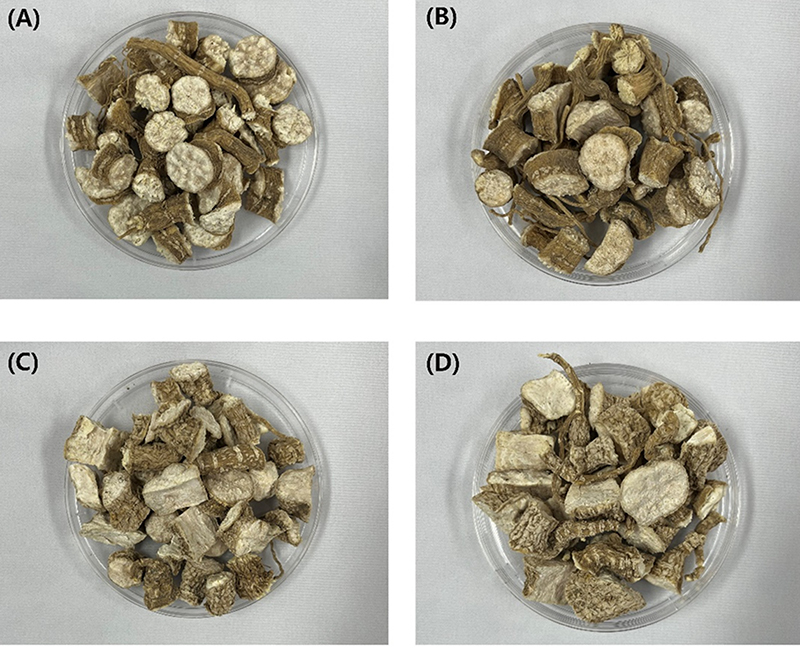
Roots of T. kirilowii.(A, B) Female plant; (C, D) Male plant.
2. Sample preparation and extraction
An aliquot of 100 mg of each powdered sample was extracted with 30% methanol (v/v) by ultrasonication at room temperature for 30 min. The resulting suspensions were centrifuged at 13,000 × g for 10 min at 4°C, and the supernatants were collected and filtered through a 0.22 μm polyvinylidene fluoride (PVDF) syringe filter. The filtered extracts were dried using a centrifugal evaporator (CVE-3100, EYELA, Tokyo, Japan), followed by freeze-drying using a freeze dryer (FDU-1200, EYELA, Tokyo, Japan).
The dried residues were reconstituted in 0.1 M sodium phosphate buffer (pH 7.5) prepared in deuterium oxide (D2O) containing 2 mM 3-(trimethylsilyl)-propionic-2,2,3,3-d4 acid sodium salt (TSP-d4). TSP-d4 was used as an internal standard for chemical shift calibration (δ 0.00 ppm) and metabolite quantification. The resulting solutions were transferred into 5 mm NMR tubes for NMR measurements.
3. 1H NMR analysis
1H NMR spectra were acquired using a Bruker Avance 600 spectrometer (Bruker BioSpin, Rheinstetten, Germany) equipped with a cryogenic triple-resonance probe, operating at a 1H frequency of 600.20 MHz and a temperature of 298 K. One-dimensional (1D) spectra were recorded using a nuclear Overhauser effect spectroscopy (NOESY)-presaturation pulse sequence (noesygppr1d) with 64 scans and 32,768 acquired data points over a spectral width of 12,500 Hz. The acquisition time and relaxation delay were set to 2.6 and 4.0 s, respectively.
Manual phase and baseline corrections were applied using TOPSPIN software (version 4.1.0; Bruker Biospin). Metabolite identification and quantification were performed using Chenomx NMR Suite 8.4 Professional (Chenomx Inc., Edmonton, AB, Canada). A metabolite was assigned only when all of its characteristic resonances in the library matched the observed signals in chemical shift, multiplicity, and coupling pattern. Each identified metabolite was quantified by fitting its reference spectral profile to the corresponding signals, and its absolute concentration (mM) was calculated relative to the TSP-d4 (2 mM). Metabolite concentrations obtained by Chenomx profiling were averaged over the three replicates of each plant.
4. Data analysis
For multivariate statistical analysis, 1H NMR spectra were divided into 0.04 ppm spectral bins over the range of 0.5–10.0 ppm, excluding the residual water region. The binned spectral data were normalized to the total spectral area and Pareto-scaled prior to analysis.
Principal component analysis (PCA) and hierarchical cluster analysis (HCA, Ward’s method) were performed as unsupervised, exploratory approaches using SIMCA version 15 (Sartorius Stedim Data Analytics AB, Umeå, Sweden) to visualize overall patterns of variation among the plants and their replicates.
For each metabolite, the log2 fold change (log2FC) was calculated as log2-transformed ratio of the mean concentration of the two female plants to that of the two male plants (positive, higher in females; negative, higher in males). Metabolites with a fold change of ≥ 1.5 in either direction (i.e., |log2FC| ≥ 0.585), in which both plants of one sex were higher than both plants of the other sex, were regarded as notably different between the sexes. Because only two independent biological replicates (plants) were available per sex, no statistical tests were applied.
RESULTS
1. 1H NMR-based primary metabolite profiling of T. kirilowii roots
Representative 1H NMR spectra of T. kirilowii root extracts are shown in Fig. 2. The spectra exhibited numerous resonances across the aliphatic, carbohydrate, and aromatic regions, reflecting the diverse primary metabolite composition of the roots. A total of 49 endogenous metabolites were identified, including 14 amino acids, nine amino acid-related metabolites, nine organic acids, eight sugars and sugar-related metabolites, four nucleosides and related compounds, two nitrogen-containing compounds, and three other metabolites (Table 1).
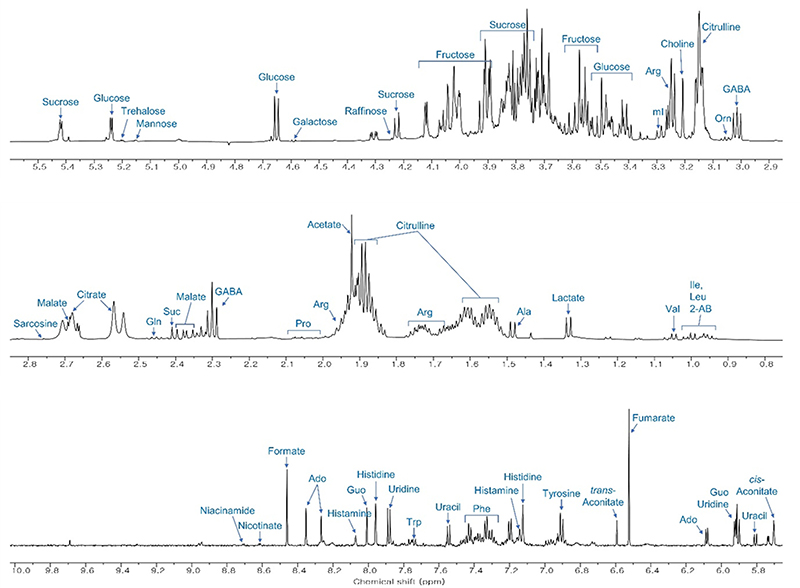
Representative 1H NMR spectrum of T. kirilowii root extract with assignments of major metabolites.2-AB, 2-aminobutyrate; Ala, alanine; Ado, adenosine; Arg, arginine; GABA, 4-aminobutyrate; Gln, glutamine; Guo, guanosine; Ile, isoleucine; Leu, leucine; mI, myo-inositol; Orn, ornithine; Pro, proline; Suc, succinate; Trp, tryptophan.

Concentrations of the 49 metabolites identified in the roots of T. kirilowii.
Among the identified metabolites, citrulline was one of the most abundant components in both female and male roots, together with fructose and glucose. Arginine and citrate were also present at relatively high levels in both groups. Other comparatively abundant metabolites included sucrose, 4-aminobutyrate (GABA), malate, and acetate. Overall, T. kirilowii roots were characterized by relatively high levels of citrulline and soluble sugars, together with substantial amounts of amino acids and organic acids.
2. Multivariate statistical analysis of root metabolomes
PCA was performed to evaluate overall variation in the 1H NMR spectral profiles of T. kirilowii roots (Fig. 3A). PC1 and PC2 accounted for 67.4% and 23.7% of the total variance, respectively. The three replicates of each plant clustered closely together, whereas the four plants were clearly separated from oone another, indicating pronounced inter-individual differences in root metabolite profiles. Along PC1, the female samples were located on the negative side and the male samples on the positive side, showing a tendency toward separation by sex. Hierarchical cluster analysis separated the 12 samples into two clusters, one containing all female and the other all male samples, and within each cluster the replicates grouped according to individual plant (Fig. 3B). Thus, although the plants differed from one another, the overall spectral profiles clustered by sex.
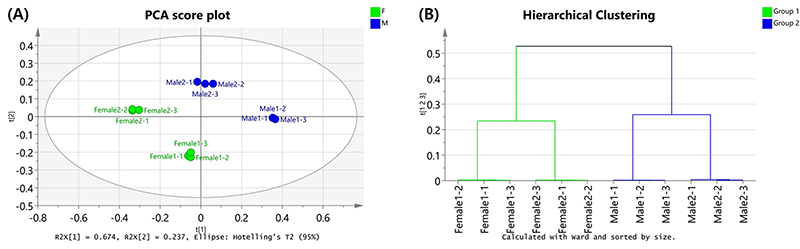
Multivariate statistical analysis of NMR spectral data from T. kirilowii roots.(A) PCA score plot; (B) Hierarchical clustering analysis; F, female; M, male.
3. Differences in metabolites between male and female roots
Ten metabolites differed by at least 1.5-fold between the sexes, with six higher in male roots and four higher in female roots (Table 1). Because only two independent plants were available per sex, no significance tests were applied, and these differences should be regarded as exploratory.
Among the metabolites higher in male roots, tryptophan showed the largest difference (3.1-fold; log2FC = −1.64), followed by asparagine (2.6-fold; −1.38), sarcosine (1.9-fold; −0.95), and pyroglutamate, 2-aminobutyrate, and histamine (1.5–1.6-fold; −0.64 to −0.61). In females, lactate (2.2-fold; log2FC = 1.15), niacinamide (1.9-fold; 0.94), ornithine, and trehalose (each about 1.5-fold; 0.60 and 0.59) were higher; the lactate difference was due mainly to one female plant.
Several other metabolites differed in the same direction in both plants of a sex but by smaller fold changes (1.1–1.5-fold): phenylalanine, tyrosine, histidine, and glutamine in males, and citrulline, GABA, malate, succinate, formate, and valine in females. Citrulline, one of the most abundant metabolites, was on average 1.29-fold higher in female roots than in male roots (log2FC = 0.37), but this difference was similar in magnitude to that between the two plants within each sex.
The major sugars, glucose and fructose, showed little difference between the sexes (fold change within 1.1; log2FC = 0.03 and −0.09).
DISCUSSION
In this study, 49 primary metabolites were identified and quantified in T. kirilowii roots by 1H NMR. 1H NMR allows simultaneous, derivatization-free detection of amino acids, sugars, and organic acids in a single measurement (Schripsema, 2010; Mascellani Bergo et al., 2024), and because signal intensity is proportional to the number of contributing protons, metabolites can be quantified against an internal standard (TSP-d4) without compound-specific calibration curves. Although identification was not confirmed with authentic standards or 2D NMR, metabolites were assigned only when all characteristic resonances matched the library, and those that could not be reliably fitted because of signal overlap or limited sensitivity, particularly low-abundance ones, were not assigned. The absolute concentrations can therefore serve as baseline data for future studies (Table 1).
Citrulline, fructose, and glucose were the dominant constituents, together accounting for approximately 59% of the total quantified concentration, followed by arginine, citrate, GABA, sucrose, and malate. The prominence of citrulline and arginine, which together accounted for about one-third of the quantified metabolites, is consistent with the high accumulation of citrulline reported in Cucurbitaceae and its role as a nitrogen-rich storage compound (Winter et al., 2015; Joshi and Fernie, 2017; Joshi et al., 2019). Citrulline has also been reported as a major amino acid-related constituent of T. kirilowii roots (Zhang et al., 2019), and it serves as the reference compound for the identification of Trichosanthis Radix in the Korean and Chinese pharmacopoeias (MFDS, 2024; Chinese Pharmacopoeia Commission, 2025). The abundance of soluble sugars (fructose, glucose, sucrose, raffinose, and trehalose) and organic acids (citrate and malate) suggests that the root is a storage organ rich in both carbohydrates and nitrogen reserves.
Root metabolite profiles of T. kirilowii differed considerably among individual plants, although sex-related patterns were also observed. Sex-related differences in metabolite composition have been reported in several dioecious medicinal plants, including Sinomenium acutum, Eucommia ulmoides, and Morus alba (Wu et al., 2022; Luo et al., 2025; Wang et al., 2025). In the present study, however, only two plants per sex were available, so no valid statistical test could be applied and the comparison was limited to differences in mean concentration. Ten metabolites differed by at least 1.5-fold between the sexes, with both plants of one sex higher than both plants of the other sex. Tryptophan (3.1-fold), asparagine (2.6-fold), sarcosine (1.9-fold), pyroglutamate, 2-aminobutyrate, and histamine (1.5–1.6-fold) were higher in males, whereas lactate (2.2-fold), niacinamide (1.9-fold), ornithine, and trehalose (1.5-fold) were higher in females. For ornithine, pyroglutamate, histamine, and lactate, however, some individual female–male pairs differed only slightly, and the lactate difference was driven mainly by one female plant.
Phenylalanine and tyrosine also tended to be higher in males, although by smaller margins (1.2–1.3-fold). Together with tryptophan, these aromatic amino acids are closely associated with the shikimate pathway at the interface of primary and secondary metabolism (Maeda and Dudareva, 2012). This suggests that secondary metabolites may also differ by sex. In females, citrulline and GABA (1.2–1.3-fold) and malate and succinate (1.2–1.4-fold) tended to be higher, along with ornithine. Citrulline and ornithine are intermediates of arginine metabolism, which contributes to nitrogen storage and remobilization in plants (Winter et al., 2015; Joshi and Fernie, 2017), and GABA catabolism through the GABA shunt generates succinate, linking amino acid metabolism with the tricarboxylic acid cycle (Fait et al., 2008; Michaeli et al., 2011; Michaeli and Fromm, 2015). These patterns may reflect sex-related differences in nitrogen and carbon metabolic pools, possibly related to reproductive investment after flowering, although this remains to be confirmed. Notably, citrulline, the pharmacopoeial identification marker of Trichosanthis Radix, tended to be higher in females (1.29-fold), and whether such differences, together with possibly linked secondary metabolites, affect the quality and efficacy of this medicinal material should be verified in a larger number of plants.
This study has several limitations. First, only two plants per sex were analyzed, so no inferential statistics could be applied and the sex-related differences remain tentative. Second, the plants came from a single cultivation site and sampling time. Future studies with a larger number of plants should therefore confirm whether these primary metabolite differences are reproducible. In addition, secondary metabolite analysis by LC-MS or GC-MS, integrated with the primary metabolite analysis, would help determine whether sex-related differences extend to pharmacologically relevant constituents and to the quality of Trichosanthis Radix.
Acknowledgments
This work was carried out with the support of “Cooperative Research Program for Agriculture Science and Technology Development (Project No. RS-2026-25518677)” Rural Development Administration, Republic of Korea.
References
- Chinese Pharmacopoeia Commission. (2025). Pharmacopoeia of the People’s Republic of China. 2025 ed. Vol. I. China Medical Science and Technology Press. Beijing, China.
-
Fait A, Fromm H, Walter D, Galili G and Fernie AR. (2008). Highway or byway: The metabolic role of the GABA shunt in plants. Trends in Plant Science. 13:14-19.
[https://doi.org/10.1016/j.tplants.2007.10.005]

-
Gao H, Li X, Wang C, Li Y, Liu T, Chang N, Xu Y, Wang Y, Ren Y and Zhou G. (2026). Integrated multiomics profiling elucidates the spatiotemporal metabolic dynamics and regulatory networks of the bioactive components of Trichosanthes kirilowii. Frontiers in Plant Science. 17:1735703.
[https://doi.org/10.3389/fpls.2026.1735703]
-
Hu X, Liao Z, Zhang B, Yue J, Wang Z, Jie X and Liu J. (2020). Transcriptome sequencing and screening of genes related to sex determination of Trichosanthes kirilowii Maxim. PLoS ONE. 15:e0239230.
[https://doi.org/10.1371/journal.pone.0239230]
-
Hu XQ, Song H, Li N, Hao CX, Zhang B, Li XP, Xin J and Zhang YQ. (2023). Identification and analysis of miRNAs differentially expressed in male and female Trichosanthes kirilowii Maxim. BMC Genomics. 24:81.
[https://doi.org/10.1186/s12864-023-09178-8]
-
Im DH, Kim JH, Gwon HM and Rho IR. (2021). Contents of main components according to growth period in Codonopsis lanceolata (Siebold & Zuccarini) Benth. & Hook.f. ex Trautvetter. Korean Journal of Medicinal Crop Science. 29:51-59.
[https://doi.org/10.7783/KJMCS.2021.29.1.51]
-
Jeong MJ, Yong SH, Kim HG, Kim DH, Park KB, Lee JH, Cha SA, Kim SA and Choi MS. (2025). Changes in amino acids, minerals and volatile composition of wild garlic according to forest cultivation environment. Korean Journal of Medicinal Crop Science. 33:102-116.
[https://doi.org/10.7783/KJMCS.2025.33.2.102]
-
Ji H, Choi WR, Choi JW and Song JH. (2026). Comparative study on the morphological and anatomical characteristics of Trichosanthes kirilowii var. kirilowii and T. kirilowii var. japonica(Cucurbitaceae). Korean Journal of Medicinal Crop Science. 34:105-116.
[https://doi.org/10.7783/KJMCS.2026.34.2.105]
-
Jiang G and Leem JY. (2016). Comparative analysis of cultivation region of Angelica gigas using a GC-MS-based metabolomics approach. Korean Journal of Medicinal Crop Science. 24:93-100.
[https://doi.org/10.7783/KJMCS.2016.24.2.93]
-
Joshi V and Fernie AR. (2017). Citrulline metabolism in plants. Amino Acids. 49:1543-1559.
[https://doi.org/10.1007/s00726-017-2468-4]
-
Joshi V, Joshi M, Silwal D, Noonan K, Rodriguez S and Penalosa A. (2019). Systematized biosynthesis and catabolism regulate citrulline accumulation in watermelon. Phytochemistry. 162:129-140.
[https://doi.org/10.1016/j.phytochem.2019.03.003]
-
Luo Y, Xu W, Fan Y, Ma X, Deng Q, Li M and Sun W. (2025). Metabolomic insights into sexual multi-morphism of sinomenine accumulation in Sinomenium acutum. Plants. 14:1885.
[https://doi.org/10.3390/plants14121885]
-
Maeda H and Dudareva N. (2012). The shikimate pathway and aromatic amino acid biosynthesis in plants. Annual Review of Plant Biology. 63:73-105.
[https://doi.org/10.1146/annurev-arplant-042811-105439]
-
Mascellani Bergo A, Leiss K and Havlik J. (2024). Twenty years of 1H NMR plant metabolomics: A way forward toward assessment of plant metabolites for constitutive and inducible defenses to biotic stress. Journal of Agricultural and Food Chemistry. 72:8332-8346.
[https://doi.org/10.1021/acs.jafc.3c09362]
-
Michaeli S, Fait A, Lagor K, Nunes-Nesi A, Grillich N, Yellin A, Bar D, Khan M, Fernie AR and Turano FJ. (2011). A mitochondrial GABA permease connects the GABA shunt and the TCA cycle, and is essential for normal carbon metabolism. The Plant Journal. 67:485-498.
[https://doi.org/10.1111/j.1365-313X.2011.04612.x]
-
Michaeli S and Fromm H. (2015). Closing the loop on the GABA shunt in plants: are GABA metabolism and signaling entwined? Frontiers in Plant Science. 6:419.
[https://doi.org/10.3389/fpls.2015.00419]
- Ministry of Food and Drug Safety (MFDS). (2024). Korean Pharmacopoeia. 12th ed. Ministry of Food and Drug Safety. Cheongju, Korea.
-
Schripsema J. (2010). Application of NMR in plant metabolomics: Techniques, problems and prospects. Phytochemical Analysis. 21:14-21.
[https://doi.org/10.1002/pca.1185]
-
Song P, Xu B, Liu Z, Cheng Y and Chao Z. (2022). The difference of volatile compounds in female and male buds of Trichosanthes anguina L. based on HS-SPME-GC-MS and multivariate statistical analysis. Molecules. 27:7021.
[https://doi.org/10.3390/molecules27207021]
-
Wang PL, You JL, Hua QM, Li HQ, Shi Q, Li WL, Sheng YJ, Liu KH, He BQ and Zhang QY. (2025). Integrated metabolomics and transcriptomics analysis comprehensively revealed the underlying metabolite mechanism difference between male and female Eucommia ulmoides Oliver. BMC Plant Biology. 25:573.
[https://doi.org/10.1186/s12870-025-06575-x]
-
Winter G, Todd CD, Trovato M, Forlani G and Funck D. (2015). Physiological implications of arginine metabolism in plants. Frontiers in Plant Science. 6:534.
[https://doi.org/10.3389/fpls.2015.00534]
-
Wu C, Wang H, Liu Z, Xu B, Li Z, Song P and Chao Z. (2022). Untargeted metabolomics coupled with chemometrics for leaves and stem barks of dioecious Morus alba L. Metabolites. 12:106. https://www.mdpi.com/2218-1989/12/2/106, (cited by 2026 Oct 16).
[https://doi.org/10.3390/metabo12020106]
-
Yang SO, Lee SW, Kim YO, Lee SW, Kim NH, Choi HK, Jung JY, Lee DH and Shin YS. (2014). Comparative analysis of metabolites in roots of Panax ginseng obtained from different sowing methods. Korean Journal of Medicinal Crop Science. 22:17-22.
[https://doi.org/10.7783/KJMCS.2014.22.1.17]
-
Zhang HQ, Liu P, Duan JA, Dong L, Shang EX, Qian DW, Zhu ZH, Li HW and Li WW. (2019). Comparative analysis of carbohydrates, nucleosides and amino acids in different parts of Trichosanthes kirilowii Maxim. by (ultra) high-performance liquid chromatography coupled with tandem mass spectrometry and evaporative light scattering detector methods. Molecules. 24:1440. https://www.mdpi.com/1420-3049/24/7/1440, (cited by 2026 Oct 16).
[https://doi.org/10.3390/molecules24071440]