A Comparison of Antioxidant Content and Radical Scavenging Activity in the Fruits of the Native Korean Plant Ribes fasciculatum var. chinense by Region
This is an open access article distributed under the terms of the Creative Commons Attribution Non-Commercial License (http://creativecommons.org/licenses/by-nc/3.0/) which permits unrestricted non-commercial use, distribution, and reproduction in any medium, provided the original work is properly cited.
Abstract
Ribes fasciculatum var. chinense is a deciduous shrub native to Korea that has traditionally been used and is valued for its pharmacological properties and edible fruit. Recently, its potential as a functional ingredient has garnered attention owing to its antioxidant, anti-inflammatory, anti-obesity, and neuroprotective properties. However, systematic research on variations in antioxidant constituents across native habitats remains limited.
Fruits from eight sites in Korean were analyzed for morphological traits, antioxidant activities (DPPH, ABTS, and FRAP); and total anthocyanin, polyphenol, and flavonoid contents. Morphological characteristics and antioxidant activity differed significantly (p < 0.05) between the sites. Polyphenol content, flavonoid content, and antioxidant activity were the highest in the HY and DY groups. Total polyphenols showed strong correlations with ABTS and FRAP (r > 0.85, p < 0.01), whereas total flavonoid content showed a weak correlation with DPPH activity. Principal component analysis, which explained 93.6% of the total variance, clearly distinguished habitats based on antioxidant characteristics.
Antioxidant properties of R. fasciculatum berries varied significantly depending on the natural habitat, and the total phenolic content was suggested to be a key contributor to ABTS and FRAP activities. The HY and DY groups exhibited superior antioxidant properties and are excellent candidates for the development of functional materials.
Keywords:
Ribes fasciculatum var. chinense, Antioxidant Activity, Multivariate Analysis, Regional Variation, Secondary MetabolitesINTRODUCTION
Recently, South Korea has seen a surge in demand for health functional foods and naturally derived functional ingredients aimed at preventing chronic diseases, driven by the country’s transition to an aging society and changes in lifestyle habits (Kim et al., 2017).
Excessive production of reactive oxygen species (ROS) during metabolic processes in the body causes cellular damage and is a major contributor to aging, inflammation, and various adult diseases. In particular, research is underway to elucidate the mechanisms underlying age-related diseases and disorders, with a focus on their association with ROS-mediated pathways. At the cellular level, oxidation can be counteracted by antioxidant defense mechanisms, and antioxidants such as anthocyanins, melatonin, polyphenols, and vitamin C play a role in maintaining oxidative balance by effectively scavenging intracellular ROS. Therefore, the search for safe and effective naturally derived antioxidants capable of regulating these mechanisms is recognized as a critical task in the field of modern functional materials research (Lourenço et al., 2019; Anik et al., 2022).
R. fasciculatum is a deciduous broadleaf shrub belonging to the Grossulariaceae family and the genus Ribes, native to Korea, Japan, and China. It grows to a height of 1 to 1.5 meters and has leaves that are shallowly lobed into 3 to 5 segments with fine serrations along the edges. R. fasciculatum is also called “chilhaemok (漆解木)” and in traditional Korean medicine, its roots have been used to treat menstrual irregularities and dysmenorrhea, its fruits as antipyretics and diuretics, and its leaves and stems as antidotes for poison ivy poisoning (Ahn 1998; Park et al., 2006; Park 2014). Recent studies have reported the anti-obesity effects of R. fasciculatum extracts and its derivative, afzelin, as well as their cognitive, memory, and neuroprotective effects in Alzheimer's models (Oh et al., 2021; Lee et al., 2022). However, most previous studies are biased toward testing the efficacy of specific parts, such as leaves and stems (branches), or specific single components.
Generally, the fruits of the genus Ribes are evaluated overseas as high functional berries containing abundant anthocyanins and phenolic compounds, and are considered a taxonomic group with high potential in terms of edible, medicinal, and functional aspects (Moyer et al., 2002; Sun et al., 2021). Some fruits of the Ribes genus are used in Europe for natural dyes, beverages (juices), jams, ice cream, and other processed foods, giving them economic significance (Kaiser and Ernst, 2020; Hussain et al., 2023).
R. fasciculatum exhibits excellent total phenolic content and DPPH antioxidant activity, and most of its biological activities have been attributed to its antioxidant and anti-inflammatory effects (Gupta et al., 2018), indicating a high-functional potential similar to overseas Ribes species.
R. fasciculatum is a wild plant widely used in traditional practice for food and medicinal purposes. Its fruits have been eaten raw or cooked, and its young leaves have also been consumed as an ingredient. Traditionally, it has been used not only for purposes such as reducing fever, promoting diuresis, and regulating menstruation, but has also been prescribed fothe treatment of various ailments including coughs, spasms, sore throats, and poison ivy poisoning, thereby gaining recognition for its pharmacological value (Ahn, 1998; Park, 2014). Despite this potential value, studies quantitatively analyzing the antioxidant activity of the fruit in native domestic populations and comparing regional variations have been extremely limited to date, and scientific validation research on the R. fasciculatum remains insufficient.
The composition of bioactive components and the concentration of antioxidant activity in natural products can vary depending on the climate, soil, growth environment, harvest time, and plant parts of the cultivation site (Akula and Ravishankar, 2011; Radušienė et al., 2012). In fact, it has been reported that the content of phenolic compounds in Ribes spp. varies according to the latitude and meteorological conditions of their native habitats, and in the case of berries, mechanical and sensory qualities are influenced by various factors such as climatic conditions, cultivation region, harvest period, and cultivar (Saftner et al., 2008; Kim et al., 2013). Therefore, comparing and analyzing the antioxidant activity of domestically native Ribes spp. berries by region is of great significance for selecting superior resources and standardizing functional ingredients.
In this study, we analyzed the total phenolic compound content and antioxidant activity of R. fasciculatum fruits collected from eight native habitats in Korea, and examined the variation in content among habitats to evaluate their potential as functional materials.
MATERIALS AND METHODS
1. Experimental materials
The fruits of R. fasciculatum used in this study were collected from eight natural habitats distributed across South Korea [Gimcheon-si (GC), Damyang-gun (DY), Haman-gun (HA), Gokseong-gun (GS), Namhae-gun (NH), Hamyang-gun (HY), Changnyeong-gun (CN), and Imsil-gun (IS)] between November 20 and December 5, 2025 (Table 1, Fig. 1). At each collection site, fruits were randomly harvested from 5 individuals, pooled to form a representative composite sample per site, and analyzed in triplicate. Fruits were harvested at full maturity, as indicated by fully red exocarp coloration based on the Royal Horticultural Society (RHS) Color Chart. The collected fruits were immediately transported to the laboratory for investigation of morphological characteristics. After being rinsed at least three times with tap water, excess moisture was removed and the samples were stored at –20°C until further analysis.

Geographic information of R. fasciculatum collection sites in Korea.
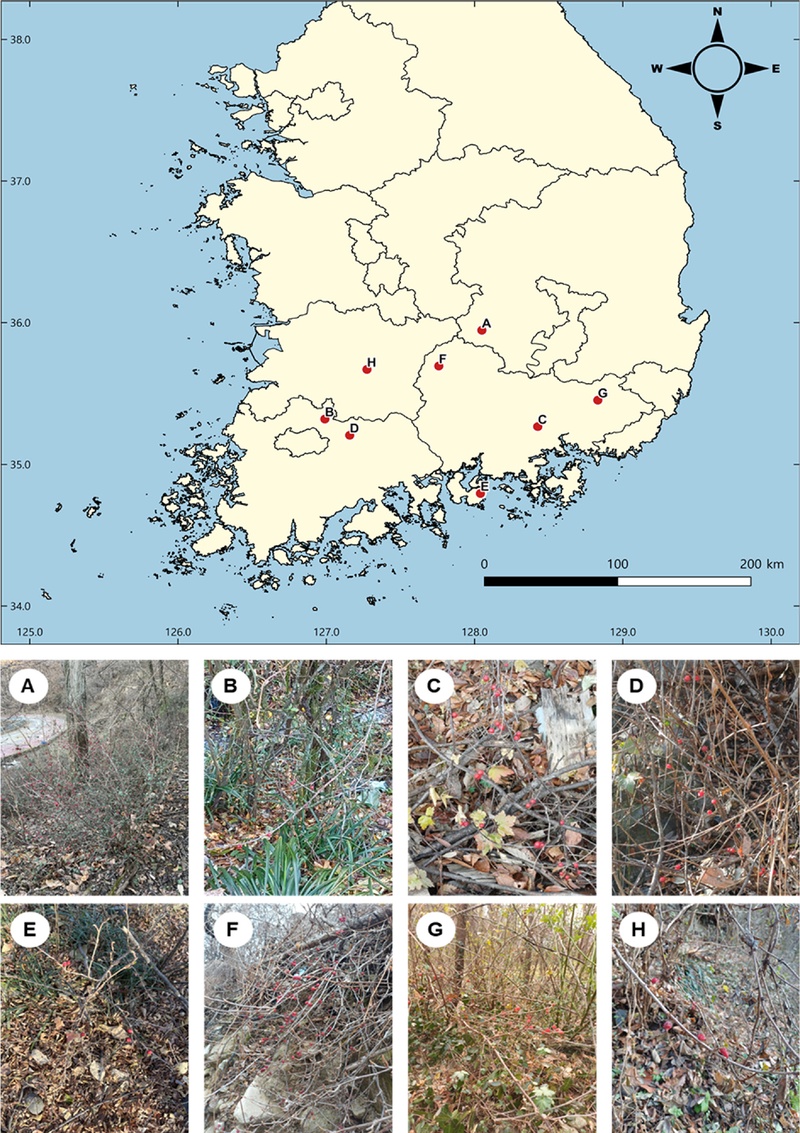
Status of R. fasciculatum fruits and individuals collected from eight native habitats in Korea.A: GC; B: DY; C: HA; D: GS; E: NH; F: HY; G: CN; H:IS.
2. Fruits characteristics
To investigate the morphological characteristics of the fruits, 30 healthy fruits were randomly selected from each habitat. Fruit length and width were measured using a vernier caliper. Fresh weight was measured using an electronic scale. Fruit surface color was compared with the RHS Color Chart to determine color differences.
3. Sample preparation
The fruits of R. fasciculatum were pre-frozen at –40℃ using a freeze dryer (LP03, Ilshinbiobase, Korea) and dried for 60 hours. The freeze-dried fruits were pulverized using liquid nitrogen and stored at -20℃ until analysis.
4. Preparation of sample extracts
To 2 g of the pulverized freeze-dried R. fasciculatum fruit sample, 40 mL of 80% ethanol (1:20, w/v) was added. The mixture was sealed with parafilm and extracted by stirring at 120 rpm for 2 hours at room temperature (25 ± 2℃) in the dark. The primary extract was filtered through a 0.45 μm syringe filter (Whatman, Marlborough, MA, USA) and adjusted to a fixed volume for anthocyanin analysis. The secondary extract was obtained by extracting under the same conditions for 18 hours, then filtered and adjusted to a fixed volume for the analysis of total flavonoid and total polyphenol contents, DPPH and ABTS radical scavenging activities, and ferric reducing antioxidant power (FRAP). All extracts were stored at 4℃ in the dark until analysis.
5. Total anthocyanin content
Total anthocyanin content was determined using the analytical method described by Benvenuti et al. (2004). Extracts were placed into two reaction reagents prepared with potassium chloride buffer and sodium acetate buffer, allowed to react in the dark for 20 minutes, and then measured at 510 and 700 nm using a spectrophotometer. The measured values were applied to the calculation formula, and the content was calculated using a calibration curve prepared with a standard substance.
6. Total phenolic content
The total phenolic content was analyzed by modifying the Folin-Ciocalteu method (Singleton et al., 1999). 0.8 mL of the diluted sample solution and 0.2 mL of Folin-Ciocalteu reagent were added and allowed to react for 3 minutes, followed by the addition of 1 mL of 2% sodium carbonate and a further 30-minute reaction period. Absorbance was measured at 750 nm using a spectrophotometer (Libra S22, Biochrom Ltd., Cambridge, CB, England). The content was calculated using a calibration curve (R2 > 0.99) prepared with gallic acid as a standard, and the results were expressed as mg gallic acid equivalent per 100 g of sample (mg GAE/100 g DW).
7. Total flavonoid content
The total flavonoid content was measured by partially modifying the method of Woisky and Salatino (1998). 45 μL of 5% NaNO2 was added to 750 μL of the diluted solution and allowed to react at room temperature for 6 minutes, followed by the addition of 90 μL of 10% AlCl3·6H2O and another 6 minutes of reaction. Subsequently, 300 μL of 1.0 M NaOH and 165 μL of distilled water were mixed sequentially, and the absorbance was measured at 510 nm. Quercetin was used as the standard, and the results were expressed as mg quercetin equivalents per dry weight of the sample (mg QE/g DW).
8. DPPH radical scavenging activity (1,1-diphenyl-2-picrylhydrazyl)
The DPPH radical scavenging activity of the R. fasciculatum extract was determined by partially modifying the method of Blois (1958). The DPPH solution (1 mM, ethanol) and the R. fasciculatum extract diluted by concentration were reacted for 30 minutes, after which the absorbance was measured at 517 nm. L-ascorbic acid (Sigma, St. Louis, MO, USA) was used as a positive control for antioxidant capacity, and the radical scavenging rate (%) was calculated according to Equation 1.
| Equation 1. DPPH radical scavenging activity (%) |
9. ABTS radical scavenging activity 2,2-azino-bis (3-ethylbenzthiazoline-6-sulfonic acid)
The ABTS radical scavenging activity of R. fasciculatum extract was determined using a method modified from that of Re et al. (1999). ABTS solution (7 mM, distilled water) and 2.45 mM potassium persulfate were mixed in a 2:1 ratio, and the mixture was allowed to stand in the dark for 24 hours to prepare the ABTS radical cation. A mixture of 3.8 mL of ABTS radical cation and 2 mL of sample extracts was prepared, allowed to stand for 6 minutes, and then the absorbance was measured at 734 nm. L-ascorbic acid (Sigma, St. Louis, MO, USA) was used as the positive control for antioxidant activity, and the radical scavenging rate (%) was calculated according to Equation 1.
10. Ferric reducing antioxidant power (FRAP)
The FRAP assay was performed according to the method described by Benzie and Strain (1996). Acetate buffer (300 mM, pH 3.6), a 10 mM TPTZ (2,4,6-tris(2-pyridyl)-s-triazine) solution dissolved in 40 mM HCl, and a 20 mM ferric chloride solution were mixed in a 10:1:1 (v/v/v) ratio and used immediately for analysis. Two milliliters of the FRAP solution were mixed with 50 μL of a 1:9 dilution, allowed to react at room temperature for 6 minutes, and then the absorbance was measured at 593 nm. Ferrous sulfate was used as the standard solution, and the reducing power was determined using a calibration curve.
11. Statistical analysis
All experimental treatments were conducted using a completely randomized design with three replicates. Data were analyzed using one-way analysis of variance (ANOVA) with SPSS 27.0 (SPSS Inc., Chicago, IL, USA). Significant differences between treatments were tested using Duncan’s multiple range test (p < 0.05). Pearson correlation analysis was conducted to identify correlations between antioxidant components and activities, as well as between morphological characteristics (fruit length, diameter, and length-to-diameter ratio) and antioxidant activities, and correlation coefficients were considered statistically significant at p < 0.01. A heatmap was generated to visualize the correlation coefficients among variables. Principal component analysis (PCA) was conducted on standardized data to assess the contributions of variables and similarities among samples.
RESULTS
1. Fruit characteristics
The morphological characteristics of R. fasciculatum fruits harvested from eight natural habitats were investigated (Table 2). The fruit weight ranged from 30.1 to 50.6 g, with the NH group recording the heaviest weight at 50.6 g and the IS group the lightest at 30.1 g. The longitudinal and transverse diameters of the fruit ranged from 0.70 to 0.89 cm and 0.68 to 0.83 cm, respectively. The IS group exhibited smaller fruit weight, length, and diameter compared to other natural habitats. The ratio of longitudinal to transverse diameter (L/D ratio) was close to 1 in most cases, but relatively high values were observed in some habitats (GS, NH). The color of the fruit exocarp was classified according to the RHS Color Chart (Royal Horticultural Society, London, UK): the GS, HY, and IS groups were classified as Orange-Red Group N34 Moderate Red A; the NH, DY, and CN groups as Grey-Purple Group 184 Greyish Red A; and the GC and HA groups as Grey-Purple Group 185 Deep Red A. All morphological characteristics showed statistically significant differences among the native habitats (p < 0.05).
Characteristics of R. fasciculatum fruits by 8 natural habitats.
2. Total anthocyanin, phenolic, and flavonoid content
The total anthocyanin, polyphenol, and flavonoid contents of R. fasciculatum fruits harvested from eight natural habitats are presented in Table 3. The anthocyanin content ranged from 14.70 to 43.72 mg·100g⁻¹ D.W., showing significant differences among habitats (p < 0.05). Total polyphenol content also showed significant differences among the habitats (p < 0.05), with the DY and HY habitats belonging to the same significant group and exhibiting the highest content. Total flavonoid content showed the greatest variation among habitats; in particular, the HY group (1270.91 ± 73.48 mg·100g⁻¹ D.W.) was significantly distinct from all other habitats and was 2.9 times higher than that of the GS group, which showed the lowest value.
Total anthocyanin, polyphenols, flavonoids contents of R. fasciculatum fruits by 8 natural habitats.
3. DPPH and ABTS radical scavenging activities and FRAP
The DPPH and ABTS radical scavenging activities and FRAP of R. fasciculatum fruits harvested from eight natural habitats are presented in Table 4. Significant differences were observed among the habitats across all parameters (p < 0.05). DPPH radical scavenging activity varied significantly depending on the habitat, with the DY group exhibiting the highest value (1909.82 ± 24.31 mg VCE·100g⁻¹ D.W.), followed by the HY and NH groups. ABTS radical scavenging activity was highest in the HY group (4234.72 ± 50.08 mg VCE·100g⁻¹ D.W.), followed by the DY and NH groups. Regarding FRAP, the HY group showed the highest value (531.29 μmol/g D.W.), followed by the DY group.
DPPH, ABTS, FRAP radical scavening of R. fasciculatum fruits by 8 natural habitats.
Overall, the HY, DY, and NH groups consistently exhibited high antioxidant activities across DPPH, ABTS, and FRAP assays.
4. Results of correlation analysis and PCA analysis
Correlations among the five measured variables (total phenols, total flavonoids, DPPH, ABTS, and FRAP) were analyzed (Fig. 2, Table 5). Total phenolic content showed a strong positive correlation with both FRAP (r = 0.88, p < 0.01) and ABTS (r = 0.86, p < 0.01), while total flavonoid content exhibited the strongest positive correlation with FRAP (r = 0.96, p < 0.01). The correlation coefficients between DPPH radical scavenging activity and phenolic and flavonoid contents were 0.70 (p < 0.01) and 0.57 (p < 0.01), respectively, indicating lower levels compared to the other indicators. In contrast, Pearson correlation analysis between morphological characteristics (fruit length, diameter, and length-to-diameter ratio) and antioxidant activities revealed no statistically significant correlation (p > 0.05) (Fig. 3).
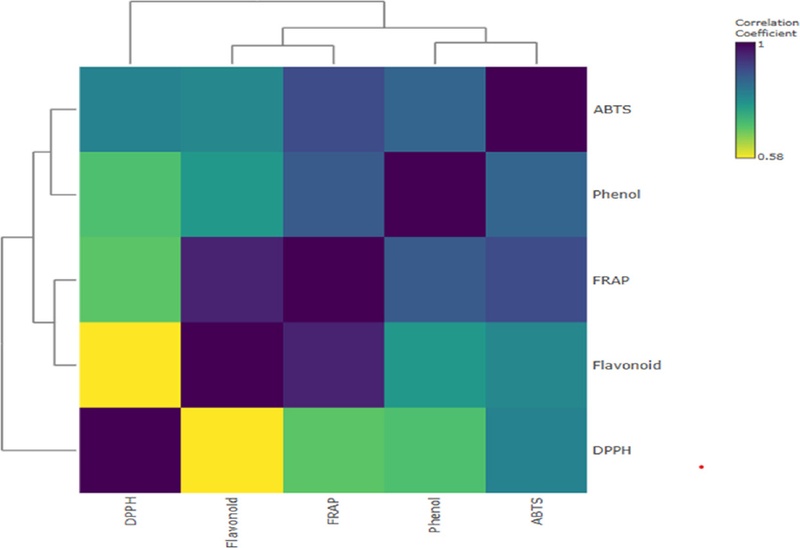
Heatmap of Pearson‘s correlation coefficients among phytochemical contents and antioxidant activities of R. fasciculatum fruits.
Pearson’s correlation among phytochemical contents and antioxidant activities of R. fasciculatum fruits.
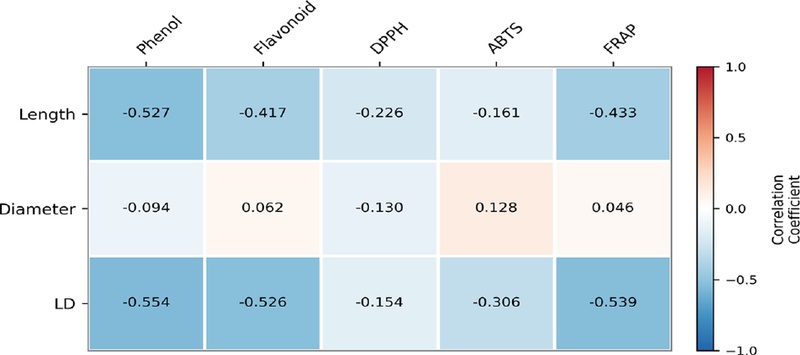
Heatmap of Pearson’s correlation coefficients between morphological characteristics and antioxidant activities of R. fasciculatum fruits.LD: length-to-diameter ratio.
According to the results of PCA, PC1 and PC2 accounted for the majority (93.6%) of the total variance (Fig. 4). PC1 accounted for 83.7% of the total variance, with all five variables showing similarly high positive loadings (FRAP: 0.48, ABTS: 0.47, Phenol: 0.45, Flavonoid: 0.44, DPPH: 0.40), indicating that PC1 represents overall antioxidant capacity. PC2 accounted for 9.9% of the variance and was primarily driven by DPPH radical scavenging activity (loading: 0.78), with flavonoid content showing a contrasting negative loading (loading: -0.53).
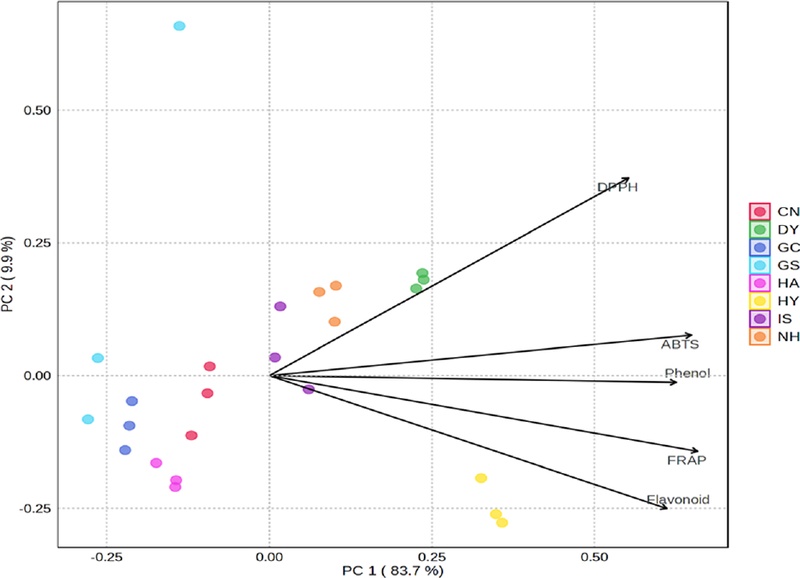
PCA biplot of antioxidant activities and polyphenol, flavonoid contents among R. fasciculatum fruits from 8 natural habitats.
In the distribution by habitat shown in Fig. 4, the DY, HY, and NH groups were clustered along the positive axis of PC1, indicating a correlation with high antioxidant activity. In contrast, the GS, GC, and HA groups were located along the negative axis of PC1, indicating relatively low levels of antioxidant activity.
DISCUSSION
1. Variation in the morphological characteristics of R. fasciculatum fruits according to natural habitat
In this study, the fruit weight, length, and diameter of the R. fasciculatum showed significant differences depending on the natural habitat. The NH group exhibited relatively high fruit weight and large fruit size, while the IS group was characterized by relatively small fruit types. This suggests that fruit morphology can vary significantly even within the same species due to growth environments and genetic factors. Such differences may arise from variations in soil moisture conditions, light environments, and temperatures between habitats, and it is known that genetic backgrounds also contribute to variations in the physical characteristics of fruits (Saftner et al., 2008; Akula and Ravishankar, 2011).
Overall, significant differences in the morphological characteristics of the fruit of R. fasciculatum were observed among its natural habitats. This is considered to be the result of a complex interplay between environmental and genetic factors. However, Pearson correlation analysis revealed no statistically significant correlations between morphological characteristics and antioxidant activities (p > 0.05), indicating that fruit size and shape are not reliable predictors of antioxidant capacity. These results provide foundational data for understanding habitat-dependent variation in R. fasciculatum and highlight the importance of integrated evaluation approaches for the efficient selection of superior resources.
2. Variation in phenolic compound and flavonoid content of R. fasciculatum fruits according to natural habitats
In this study, the total anthocyanin, polyphenol, and flavonoid contents of R. fasciculatum fruits showed significant differences depending on their natural habitats, which is consistent with the fact that the accumulation of secondary metabolites in plants is greatly influenced by environmental conditions and genetic factors (Akula and Ravishankar, 2011; Radušienė et al., 2012). Total polyphenol and flavonoid contents were highest in the DY and HY groups, and total flavonoid content showed the greatest variation among habitats. These results demonstrate that flavonoids are representative secondary metabolites that are highly sensitive to environmental factors. In particular, the flavonoid content observed in this study was higher than that reported in previous studies on Ribes spp., and the results were consistent with prior research indicating significant variation depending on cultivar and environmental conditions (Mattila et al., 2016; Shomali et al., 2022).
Flavonoids are widely known as major functional compounds exhibiting various physiological activities, including antioxidant and anti-inflammatory effects, and have been reported to play an important role in promoting human health (Rodriguez-Mateos et al., 2014). The high flavonoid contents observed in the DY and HY groups suggest their potential as functional materials and indicate that these groups could be targets for future superior genotype selection and propagation studies. The observed differences in antioxidant content among native habitats may be associated with geographic and environmental conditions of each collection site. In particular, the HY group, located at the highest altitude (550 m) among the study sites, showed superior antioxidant content, which may reflect increased UV radiation and temperature stress known to promote the biosynthesis of phenolic compounds as photoprotective metabolites in plants (Rao and Zheng, 2025). Although the DY group was collected at a relatively lower altitude (127 m), it also exhibited high antioxidant content, suggesting that factors other than altitude, such as light environment and soil conditions, may have contributed to secondary metabolite accumulation (Pant et al., 2021). However, as detailed environmental data were not collected in this study, the specific environmental factors driving the observed habitat-dependent variation remain to be fully elucidated. Future studies incorporating comprehensive environmental assessments would provide deeper insight into the mechanisms underlying these differences.
3. Variations in the antioxidant activity of R. fasciculatum fruits according to their natural habitat
In this study, the DPPH and ABTS radical scavenging activities and FRAP of R. fasciculatum fruits showed significant differences depending on their native habitat, which is attributed to differences in the content and composition of antioxidant substances by habitat. Generally, the antioxidant activity of plants is determined by secondary metabolites such as phenolic compounds and flavonoids, and it is reported that their structure and concentration directly affect antioxidant capacity (Rice-Evans et al., 1996; Cai et al., 2004; Tungmunnithum et al., 2018).
DPPH radical scavenging activity was highest in the DY group, followed by the HY group, while ABTS radical scavenging activity and FRAP were highest in the HY group. The variation in results among the antioxidant indices can be explained by the reaction mechanisms of each analytical method and the differences in reactivity of the antioxidant components in the samples. This may be attributed to the phenolic compound composition of the DY group possessing structural characteristics that are relatively advantageous for radical scavenging based on hydrogen-donating reactions (Rice-Evans et al., 1996; Platzer et al., 2022). Since each analytical method reflects different antioxidant mechanisms, it is difficult to fully explain the overall antioxidant capacity using a single indicator, and a multi-indicator approach is necessary for evaluating antioxidant activity (Rumpf et al., 2023). Therefore, although differences in antioxidant components and activity were observed depending on the native habitat, R. fasciculatum fruits are considered to have high potential for use as a naturally derived functional material with excellent antioxidant properties overall.
4. Analysis of correlations between antioxidant components and activity and multivariate analysis
In this study, a strong positive correlation was observed between total phenols, ABTS, and FRAP. This supports the notion that phenolic compounds are the primary contributors to antioxidant activity. Phenolic compounds remove reactive oxygen species through electron donation and metal ion reduction reactions, and these characteristics are known to be particularly well reflected in FRAP and ABTS assays (Rice-Evans et al., 1996; Huang et al., 2005).
The strong positive correlation between total flavonoid content and FRAP also supports this finding. Flavonoids, as representative phenolic compounds, possess strong reducing power and have been reported to contribute to metal ion reduction and free radical scavenging (Heim et al., 2002).
On the other hand, total polyphenol and total flavonoid content showed a relatively weak positive correlation with DPPH activity. This may be explained by two factors. First, the DPPH assay primarily relies on hydrogen donation reactions, whereas ABTS and FRAP reflect a broader range of electron transfer reactions. Therefore, even if the total amount of flavonoids increases, DPPH reactivity may not necessarily increase, which is reported to be influenced by the structural diversity and reaction specificity of flavonoids (Huang et al., 2005; Prior et al., 2005). Second, the Aluminium chloride-based colorimetric assay used for flavonoid quantification predominantly detects flavonoids possessing 3-hydroxyl or 5-hydroxyl groups with a 4-keto structure, such as flavones and flavonols, and may not fully capture all flavonoid subclasses present in the sample (Kim et al., 2011; Acquavia et al., 2021). Since DPPH radical scavenging activity is highly dependent on the number and position of hydroxyl groups in the phenolic structure, the total flavonoid content measured by this method may not comprehensively reflect the hydrogen-donating capacity of all flavonoid compounds, potentially explaining the weaker correlation with DPPH activity compared to ABTS and FRAP (Zeng et al., 2023).
PCA results showed that PC1 (83.7%) integrated the loading vectors of total phenolics, total flavonoids, ABTS, and FRAP in the positive direction, while PC2 (9.9%) separated the DPPH loading vector in the positive direction, reflecting antioxidant activity. Furthermore, in the distribution by native habitat, the HY, DY, NH, and IS groups were located in the positive direction of PC1, whereas the CN, GS, GC, and HA groups were located in the negative direction, clearly demonstrating differences in the accumulation of functional components depending on the native habitat. These results are consistent with previous reports indicating that secondary metabolites in plants are significantly influenced by environmental conditions and genetic factors (Akula and Ravishankar, 2011). The HY, DY, NH, and IS groups can be evaluated as candidate native habitats for functional materials with superior antioxidant properties for functional matereial development.
In this study, the antioxidant content and activity of R. fasciculatum fruits were found to vary significantly among eight native habitats, demonstrating that geographic and environmental conditions substantially influence secondary metabolite accumulation in this species. Total phenolic content was identified as a key contributor to antioxidant activity, while morphological characteristics showed no significant correlation with antioxidant potential, indicating that direct chemical analysis is essential for the evaluation and selection of superior resources. However, as detailed environmental parameters were not measured in this study, the specific factors driving habitat-dependent variation remain to be fully elucidated. Future investigations incorporating comprehensive environmental assessments, along with expanded population sampling, would provide deeper insight into these relationships. The HY and DY groups, which consistently exhibited superior antioxidant properties, are recommended as priority candidate resources, and these findings are expected to serve as foundational data for the systematic selection and utilization of native R. fasciculatum populations as functional materials.
Acknowledgments
This study was supported by the Korea Forestry Promotion Institute (KOFPI) under the “Forest Industry Customized Workforce Training Program (R&D)” (Project No. RS-2024-040519661382116530101), operated by the Short-term Income Forest Products Governance Education Center (SFPEC).
References
-
Acquavia MA, Pascale R, Martini F, Correale G and Bianco G. (2021). Analytical methods for extraction and identification of primary and secondary metabolites of apple fruits: A review. Separations. 8:1-24.
[https://doi.org/10.3390/separations8070091]

- Ahn DG. (1998). Illustrated book of Korean medicinal herbs. Kyohak Publishing Co. Seoul, Korea. p. 246.
-
Akula R and Ravishankar GA. (2011). Influence of abiotic stress signals on secondary metabolites in plants. Plant Signaling & Behavior. 6:1720-1731.
[https://doi.org/10.4161/psb.6.11.17613]
-
Anik MI, Mahmud N, Masud AA, Khan MI, Islam MN, Uddin S and Hossain MK. (2022). Role of reactive oxygen species in aging and age-related diseases: A review. ACS Applied Bio Materials. 5:4028-4054.
[https://doi.org/10.1021/acsabm.2c00411]
-
Benvenuti S, Pellati F, Melegari M and Bertelli D. (2004). Polyphenols, anthocyanins, and antioxidant activity of small fruits. Journal of Food Science. 69:164-169.
[https://doi.org/10.1111/j.1365-2621.2004.tb13352.x]
-
Benzie IF and Strain JJ. (1996). The ferric reducing ability of plasma(FRAP) as a measure of “antioxidant power”: The FRAP assay. Analytical Biochemistry. 239:70-76.
[https://doi.org/10.1006/abio.1996.0292]
-
Blois MS. (1958). Antioxidant determinations by the use of a stable free radical. Nature. 181:1199-1200.
[https://doi.org/10.1038/1811199a0]
-
Cai Y, Luo Q, Sun M and Corke H. (2004). Antioxidant activity and phenolic compounds of 112 traditional Chinese medicinal plants associated with anticancer. Life Sciences. 74:2157-2184.
[https://doi.org/10.1016/j.lfs.2003.09.047]
- Gupta S, Kumar S and Sharma D. (2018). Ribes fasciculatum: A review of pharmacological activities. International Journal of Research and Analytical Reviews. 5:458-462.
-
Heim KE, Tagliaferro AR and Bobilya DJ. (2002). Flavonoid antioxidants: Chemistry, metabolism and structure-activity relationships. Journal of Nutritional Biochemistry. 13:572-584.
[https://doi.org/10.1016/S0955-2863(02)00208-5]
-
Huang D, Ou B and Prior RL. (2005). The chemistry behind antioxidant capacity assays. Journal of Agricultural and Food Chemistry. 53:1841-1856.
[https://doi.org/10.1021/jf030723c]
-
Hussain S, Sharma M, Jarg T, Aav R and Bhat R. (2023). Natural pigments(anthocyanins and chlorophyll) and antioxidants profiling of European red and green gooseberry(Ribes uva-crispa L.) extracted using green techniques(UAE-citric acid-mediated extraction). Current Research in Food Science. 7:100629.
[https://doi.org/10.1016/j.crfs.2023.100629]
- Kaiser C and Ernst M. (2020). Gooseberries and Currants(CCD-CP-6). Center for Crop Diversification, University of Kentucky College of Agriculture, Food and Environment. Lexington, KY, USA. http://www.uky.edu/ccd/sites/www.uky.edu.ccd/files/currants.pdf, (cited by 2026 May 26).
-
Kim DO, Chun OK, Kim YJ, Moon HY and Lee CY. (2011). Antioxidant activities of hot water extracts from various spices. International Journal of Molecular Sciences. 12:4120-4131.
[https://doi.org/10.3390/ijms12064120]
-
Kim JG, Kim HL and Park KS. (2013). Fruit quality, anthocyanin and total phenol contents, and antioxidant activities of 45 blueberry cultivars grown in Suwon, Korea. Journal of Zhejiang University Science B(Biomedicine & Biotechnology). 14:793-799.
[https://doi.org/10.1631/jzus.B1300012]
- Kim SH, Lee YS and Heo SY. (2017). Senior-friendly Food Market and Its Vitalization(Research Report R811). Korea Rural Economic Institute. Naju, Korea. p.1-321.
-
Lee Y, Park YJ, Lee B, Park E, Kim H, Choi CW and Kim MS. (2022). Ribes fasciculatum ameliorates high-fat-diet-induced obesity by elevating peripheral thermogenic signaling. Molecules. 27:1649. https://www.mdpi.com/1420-3049/27/5/1649, (cited by 2026 May 16).
[https://doi.org/10.3390/molecules27051649]
-
Lourenço SC, Moldão-Martins M and Alves VD. (2019). Antioxidants of natural plant origins: From sources to food industry applications. Molecules. 24:4132.
[https://doi.org/10.3390/molecules24224132]
-
Mattila PH, Hellström J, Karhu S, Pihlava JM and Veteläinen M. (2016). High variability in flavonoid contents and composition between different North-European currant(Ribes spp.) varieties. Food Chemistry. 204:14-20.
[https://doi.org/10.1016/j.foodchem.2016.02.056]
-
Moyer RA, Hummer KE, Finn CE, Frei B and Wrolstad RE. (2002). Anthocyanins, phenolics, and antioxidant capacity in diverse small fruits: Vaccinium, Rubus, and Ribes. Journal of Agricultural and Food Chemistry. 50:519-525.
[https://doi.org/10.1021/jf011062r]
-
Oh SY, Jang MJ, Choi YH, Hwang H, Rhim H, Lee B, Choi CW and Kim MS. (2021). Central administration of afzelin extracted from Ribes fasciculatum improves cognitive and memory function in a mouse model of dementia. Scientific Reports. 11:10474.
[https://doi.org/10.1038/s41598-021-88463-6]
-
Pant P, Pandey S and Dall’Acua S. (2021). The influence of environmental conditions on secondary metabolites in medicinal plants: A literature review. Chemistry & Biodiversity. 18:e2100345.
[https://doi.org/10.1002/cbdv.202100345]
- Park KY, Jung TY and Song SH. (2006). Method for detoxification of lacquer, and lacquer-bagon its method. Korea. Patent. No. 10-2006-0041742.
- Park JH. (2014). Korean Medicinal Herbs. Shinil Publishing Co. Seoul, Korea. p. 625.
-
Platzer M, Kiese S, Tybussek T, Herfellner T, Schneider F, Schweiggert-Weisz U and Eisner P. (2022). Radical scavenging mechanisms of phenolic compounds: A quantitative structure-property relationship(QSPR) study. Frontiers in Nutrition. 9:882458.
[https://doi.org/10.3389/fnut.2022.882458]
-
Prior RL, Wu X and Schaich K. (2005). Standardized methods for the determination of antioxidant capacity and phenolics in foods and dietary supplements. Journal of Agricultural and Food Chemistry. 53:4290-4302.
[https://doi.org/10.1021/jf0502698]
-
Radušienė J, Karpavičienė B and Stanius Ž. (2012). Effect of external and internal factors on secondary metabolites accumulation in St. John’s Worth. Botanica Lithuanica. 18:101-108.
[https://doi.org/10.2478/v10279-012-0012-8]
-
Rao MJ and Zheng B. (2025). The role of polyphenols in abiotic stress tolerance and their antioxidant properties to scavenge reactive oxygen species and free radicals. Antioxidants. 14:74. https://www.mdpi.com/2076-3921/14/1/74, (cited by 2026 May 28).
[https://doi.org/10.3390/antiox14010074]
-
Re R, Pellegrini N, Proteggente A, Pannala A, Yang M and Rice-Evans C. (1999). Antioxidnat activity applying an improved ABTS radical cation decolorization assay. Free Radical Biology and Medicine. 26:1231-1237.
[https://doi.org/10.1016/S0891-5849(98)00315-3]
-
Rice-Evans CA, Miller NJ and Paganga G. (1996). Structure-antioxidant activity relationships of flavonoids and phenolic acids. Free Radical Biology and Medicine. 20:933-956.
[https://doi.org/10.1016/0891-5849(95)02227-9]
-
Rodriguez-Mateos A, Vauzour D, Krueger CG, Shanmuganayagam D, Reed J, Calani L, Mena P, Rio DD and Crozier A. (2014). Bioavailability, bioactivity and impact on health of dietary flavonoids and related compounds: An update. Archives of Toxicology. 88:1803-1853.
[https://doi.org/10.1007/s00204-014-1330-7]
-
Rumpf J, Burger R and Schulze M. (2023). Statistical evaluation of DPPH, ABTS, FRAP, and Folin-Ciocalteu assays to assess the antioxidant capacity of lignins. International Journal of Biological Macromolecules. 233:123470.
[https://doi.org/10.1016/j.ijbiomac.2023.123470]
-
Saftner R, Polashock J, Ehlenfeldt M and Vinyard B. (2008). Instrumental and sensory quality characteristics of blueberry fruit from twelve cultivars. Postharvest Biology and Technology. 49:19-26.
[https://doi.org/10.1016/j.postharvbio.2008.01.008]
-
Shomali A, Das S, Arif M, Zahra N, Yadav V, Aliniaeifard S, Chauhan DK and Hasanuzzaman M. (2022). Diverse physiological roles of flavonoids in plant environmental stress responses and tolerance. Plants. 11:3158.
[https://doi.org/10.3390/plants11223158]
-
Singleton VL, Orthofer R and Lamuela-Raventos RM. (1999). Analysis of total phenols and other oxidation substrates and antioxidants by means of Folin-Ciocalteu reagent. Methods in Enzymology. 299:152-178.
[https://doi.org/10.1016/S0076-6879(99)99017-1]
-
Sun Q, Wang N, Xu W and Zhou H. (2021). Genus Ribes Linn.(Grossulariaceae): A comprehensive review of traditional uses, phytochemistry, pharmacology and clinical applications. Journal of Ethnopharmacology. 276:114166.
[https://doi.org/10.1016/j.jep.2021.114166]
-
Tungmunnithum D, Thongboonyou A, Pholboon A and Yangsabai A. (2018). Flavonoids and other phenolic compounds from medicinal plants for pharmaceutical and medical aspects: An overview. Medicines. 5:93.
[https://doi.org/10.3390/medicines5030093]
-
Woisky RG and Salatino A. (1998). Analysis of propolis: Some parameters and procedures for chemical quality control. Journal of Apicultural Research. 37:99-105.
[https://doi.org/10.1080/00218839.1998.11100961]
-
Zeng L, Gong J, Liu H, Tang J, Liu S, Zhan R and Pang T. (2023). By-products of fruit and vegetables: Antioxidant properties of extractable and non-extractable phenolic compounds. Antioxidants. 12:1-28. https://www.mdpi.com/2076-3921/12/2/418, (cited by 2026 May 28).
[https://doi.org/10.3390/antiox12020418]