
Comparative Antiviral Activity of Three Scrophularia Species(S. buergeriana, S. takesimensis, and S. koraiensis) Against Influenza A Virus in MDCK Cells
This is an open access article distributed under the terms of the Creative Commons Attribution Non-Commercial License (http://creativecommons.org/licenses/by-nc/3.0/) which permits unrestricted non-commercial use, distribution, and reproduction in any medium, provided the original work is properly cited.
Abstract
Species of the genus Scrophularia have been traditionally used in East Asian medicine for anti-inflammatory and detoxifying purposes. However, comparative antiviral activity among different Scrophularia species remains insufficiently characterized.
Extracts of S. buergeriana, S. takesimensis, and S. koraiensis were evaluated for cytotoxicity, antiviral activity against influenza A virus (A/PR/8/34, H1N1), and neuraminidase (NA) inhibitory effects. MDCK cells were used for cytotoxicity and cytopathic effect (CPE) reduction assays. Zanamivir was used as a positive control. All three extracts showed minimal cytotoxicity (> 93.40% cell viability) across concentrations of 3.13–300.00 μg/mL. In antiviral assays, all extracts inhibited viral replication in a dose-dependent manner. Among them, S. buergeriana showed the highest activity, reducing CPE by 22.36% at 200 μg/mL. In contrast, NA inhibition was generally weak; S. takesimensis showed the highest inhibition (16.38% at 300 μg/mL), whereas S. buergeriana showed no significant activity.
These results suggest that Scrophularia extracts exert antiviral effects through mechanisms other than NA inhibition, potentially involving intracellular viral replication pathways.
Keywords:
Scrophularia buergeriana, Scrophularia koraiensis, Scrophularia takesimensis, Antiviral Activity, Influenza A Virus, MDCK Cells, NeuraminidaseINTRODUCTION
Viral infections, particularly those caused by influenza A virus (IAV), remain a major global health burden due to their high transmissibility, rapid antigenic variation, and pandemic potential (Taubenberger and Morens, 2008; Iuliano et al., 2018). Influenza viruses are responsible for significant morbidity and mortality worldwide each year, especially in vulnerable populations such as the elderly and immunocompromised individuals (Iuliano et al., 2018). Although antiviral drugs, including neuraminidase (NA) inhibitors such as oseltamivir and zanamivir, are widely used, the emergence of drug-resistant viral strains has limited their long-term clinical efficacy (O'Hanlon and Shaw, 2019). Therefore, the development of alternative antiviral agents with novel mechanisms of action is urgently required.
Natural products derived from medicinal plants have attracted considerable attention as potential antiviral agents due to their chemical diversity, multi-target properties, and relatively low toxicity profiles (Lin et al., 2014; Newman and Cragg, 2020). Among these, Scrophulariae Radix, derived from the dried roots of Scrophularia ningpoensis or Scrophularia buergeriana, has been widely used in traditional East Asian medicine for the treatment of fever, inflammation, and toxin-related disorders (Jung et al., 2020; Seo et al., 2024).
Previous studies have demonstrated that Scrophularia species possess a wide range of pharmacological activities, including anti-inflammatory, antioxidant, neuroprotective, and immunomodulatory effects (Jeong et al., 2009; Lee et al., 2019; Shin et al., 2020). These biological activities are largely attributed to secondary metabolites such as iridoid glycosides and phenylpropanoids, which are known to regulate inflammatory signaling pathways and host immune responses (Pasdaran and Hamedi, 2017). In particular, harpagoside, a representative iridoid glycoside found in Scrophularia species, has been reported to exhibit anti-inflammatory and immunoregulatory activities that may contribute to antiviral defense mechanisms (Bermejo et al., 2002; Kaur et al., 2026).
In Korea, Scrophularia koraiensis (To-Hyun-Sam) has traditionally been used as an antipyretic and anti-inflammatory agent, whereas Scrophularia takesimensis (Seom-Hyun-Sam), an endemic species restricted to Ulleung-do Island, remains insufficiently studied with respect to its biological activity (Nam et al., 2020). Although S. buergeriana has been relatively well characterized, comparative studies evaluating antiviral activities among different Scrophularia species are still limited.
Given the reported pharmacological properties of Scrophularia species and their potential immunomodulatory effects, it is hypothesized that these plants may exert antiviral activity against influenza virus infection. However, the antiviral efficacy and underlying mechanisms of S. buergeriana, S. takesimensis, and S. koraiensis have not yet been systematically investigated.
Therefore, in the present study, we compared the cytotoxicity, antiviral activity against IAV (H1N1), and NA inhibitory effects of extracts from three Scrophularia species. This study aimed to identify species-specific differences in antiviral efficacy and to provide a scientific basis for their potential use as natural antiviral agents.
MATERIALS AND METHODS
1. Plant materials and extraction
Three Scrophularia species—S. buergeriana, S. takesimensis, and S. koraiensis—were used in this study. Fresh plant materials were collected from cultivated plants in the experimental field of the National Institute of Horticultural and Herbal Science (Eumseong-gun, Chungcheongbuk-do, Korea) on March 21, 2017. Species identification was performed based on morphological characteristics, including leaf and stem features (Fig. 1), in accordance with the taxonomic keys described in the Flora of Korea (Choi et al., 2018) and previous taxonomic studies of the genus Scrophularia (Han et al., 2009; Jang and Oh, 2013). Voucher specimens were deposited at the Korean Herbarium of Standard Herbal Resources (Index Herbariorum code: KIOM), Korea Institute of Oriental Medicine, under accession numbers 2-18-0144 (S. buergeriana), 2-18-0145 (S. koraiensis), and 2-18-0146 (S. takesimensis). After taxonomic identification, the roots of the identified plants were dried and used as experimental materials. S. buergeriana (778.14 g), S. koraiensis (69.15 g), and S. takesimensis (92.50 g) were extracted with 70% ethanol (v/v) at a solvent-to-sample ratio of 10:1 (v/w). Each sample was refluxed for 2 h and this extraction procedure was repeated twice times to ensure complete extraction. The combined extracts were filtered through filter paper and evaporated in vacuo. The powders of the 70% ethanol extract for S. buergeriana, S. koraiensis, and S. takesimensis were 363.83 g (46.76% of yield, w/w), 30.40 g (43.96% of yield, w/w), and 53.91 g (58.28% of yield, w/w), respectively. The dried extracts were dissolved in dimethyl sulfoxide (DMSO) and diluted to the desired concentrations prior to use.
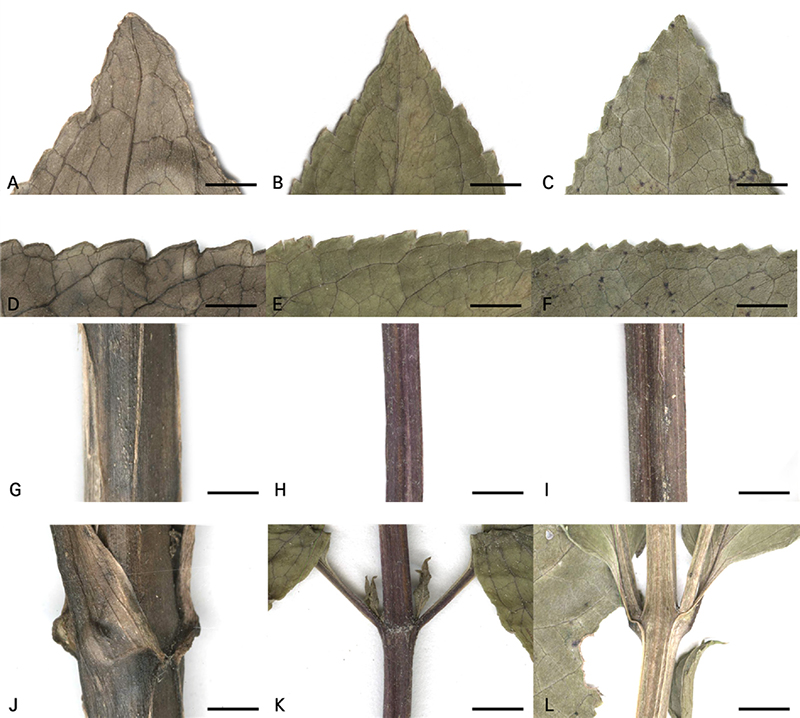
Comparative leaf and stem morphology of three Scrophularia species. A–C, leaf apex; D–F, leaf margin; G–I, stem internode; J–L, stem node. A, D, G, J, S. takesimensis; B, E, H, K, S. koraiensis; C, F, I, L, S. buergeriana; A representative individual (n = 1) is shown for each species, and all images are at the same magnification. Scale bar = 0.5 cm.
2. Cell culture and virus
Madin–Darby canine kidney (MDCK) cells (ATCC CCL-34, Manassas, VA, USA) were maintained in EMEM supplemented with 10% FBS, 100 U/mL penicillin, and 100 μg/mL streptomycin at 37℃ in 5% CO2. Influenza A/PR/8/34 (H1N1) virus (ATCC VR-1469) used for antiviral assays. The virus was propagated in MDCK cells in the presence of 2 μg/mL TPCK-treated trypsin and stored at −80℃ until use.
3. Cytotoxicity assay
The cytotoxic effects of extracts from three Scrophularia species were evaluated in MDCK cells. Cells were seeded in 96-well plates and cultured until reaching approximately 90% confluency. The cells were then treated with various concentrations (3.13–300 μg/mL) of each extract for 48 h. Cell viability was determined using an MTT assay, and the results were expressed as a percentage relative to untreated control cells.
4. Antiviral activity assay (cytopathic effect reduction)
The antiviral activity of extracts from three Scrophularia species against IAV was evaluated using a cytopathic effect (CPE) reduction assay. MDCK cells were infected with IAV at a multiplicity of infection (MOI) of 0.0005 for 1 h with rocking. After removal of inoculum, EMEM containing 2μg/mL TPCK-treated trypsin and each extract was added at varying concentrations (3.13–300 μg/mL) for 48 h. CPE reduction assays were independently performed three times as biological replicates, and each independent experiment included triplicate technical wells for each treatment group. After 48 h, cell viability was determined using an MTT assay. Normal control refers to uninfected and untreated MDCK cells, whereas virus control refers to IAV-infected MDCK cells without extract or zanamivir treatment. Zanamivir (5 μM) was used as a positive control. CPE reduction rate was calculated using the following formula:
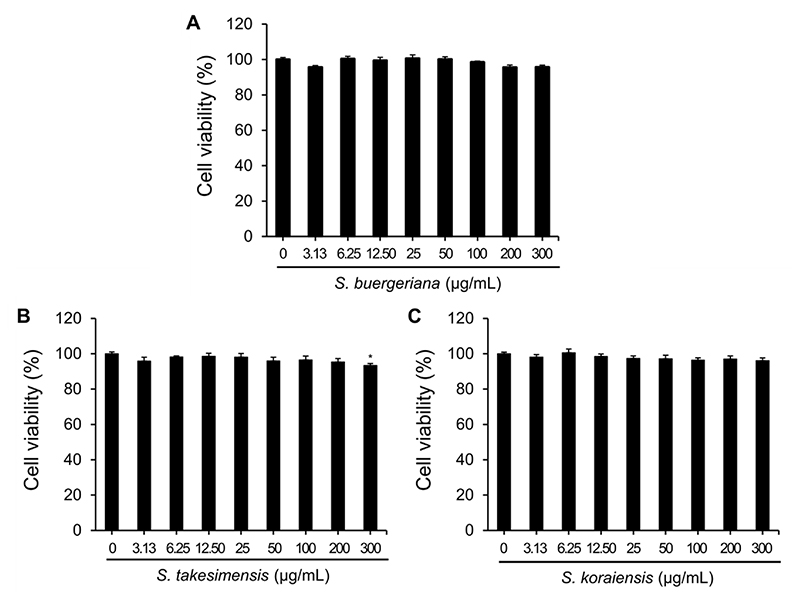
Effect of ethanol extracts of the three Scrophularia species on cell viability. A, S. buergeriana; B, S. takesimensis; C, S. koraiensis. MDCK cells were treated with various concentrations (3.13–300 μg/mL) for 48 h. Cell viability was assessed using the MTT assay and is presented as relative cell viability compared with untreated control. Data are presented as the mean ± SEM. Statistical significance was analyzed using one-way ANOVA followed by Tukey’s multiple comparisons test. * p < 0.05 vs. control.
5. Neuraminidase inhibition assay
NA inhibitory activity was measured using the NA-StarTM influenza NA inhibitor resistance detection kit (Applied Biosystems, CA, USA). Extracts were tested at concentrations ranging from 3.13 to 300 μg/mL. The enzymatic activity of NA was quantified by measuring chemiluminescence intensity, and inhibition was expressed as a percentage relative to the untreated virus control. Zanamivir was used as a reference NA inhibitor.
6. Statistical analysis
Prior to one-way ANOVA, the normality of data distribution was assessed using the Shapiro–Wilk test, and the homogeneity of variance was evaluated using the Levene's test. All datasets satisfied the assumptions of normality and homogeneity of variance, and one-way ANOVA followed by Tukey's multiple comparison test was subsequently performed. Statistical analyses were performed using SigmaPlot 10.0 software (Systat Software Inc., San Jose, CA, USA). A value of p < 0.05 was considered statistically significant.
RESULTS
1. Comparative leaf and stem morphology of Scrophularia species
Comparative analysis of leaf and stem morphology revealed clear diagnostic differences among the three Scrophularia species. Distinction is possible based on leaf shape, apex form, margin characteristics, stem pubescence, and calyx morphology.
S. takesimensis can be differentiated by its ovate leaves with an acute apex (Fig. 1A) and serrate margins that are largely devoid of spinose teeth (Fig. 1D). The stems are glabrous (Fig. 1G), and the calyx is characteristically semicircular with a rounded apex (Fig. 1J).
S. koraiensis possesses predominantly lanceolate, occasionally ovate, leaves with a pronounced acuminate apex (Fig. 1B). The margins are serrate with spinose teeth (Fig. 1E). The stems show sparse pubescence composed of non-glandular trichomes (Fig. 1H), while the calyx is lanceolate, tapering to an acute or attenuate apex (Fig. 1K).
S. buergeriana exhibits ovate leaf blades with an acute apex (Fig. 1C) and serrate margins bearing distinct spinose teeth (Fig. 1F). Its stems are glabrous (Fig. 1I), and the calyx is ovate with a blunt (obtuse) apex (Fig. 1L).
2. Cytotoxic effects on MDCK cell
Treatment with Scrophularia extracts did not induce significant cytotoxicity in MDCK cells at the tested concentrations. All three species of extracts showed high cell viability (> 93.40%) across the tested concentration range, indicating minimal cytotoxicity. Subsequent antiviral assays were performed at concentrations determined to be minimally toxic.
3. Antiviral activity against influenza A virus
Antiviral activity was assessed using a post-infection treatment protocol, with uninfected/untreated cells serving as normal controls and infected/untreated cells as virus controls. The CPEs were observed in IAV-infected/untreated cells, whereas no morphological changes were detected in the control groups. All three extracts significantly improved cell viability in virus-infected MDCK cells when compared with the untreated control group, indicating that they exert protective effects against virus-induced cytotoxicity. Furthermore, the magnitude of this antiviral effect increased in a dose-dependent manner, meaning that higher concentrations of the extracts resulted in greater improvements in cell survival (Fig. 3). However, representative microscopic images showing virus-induced morphological changes and extract-mediated cellular protection were not obtained. This lack of morphological evidence is a limitation of the present study.
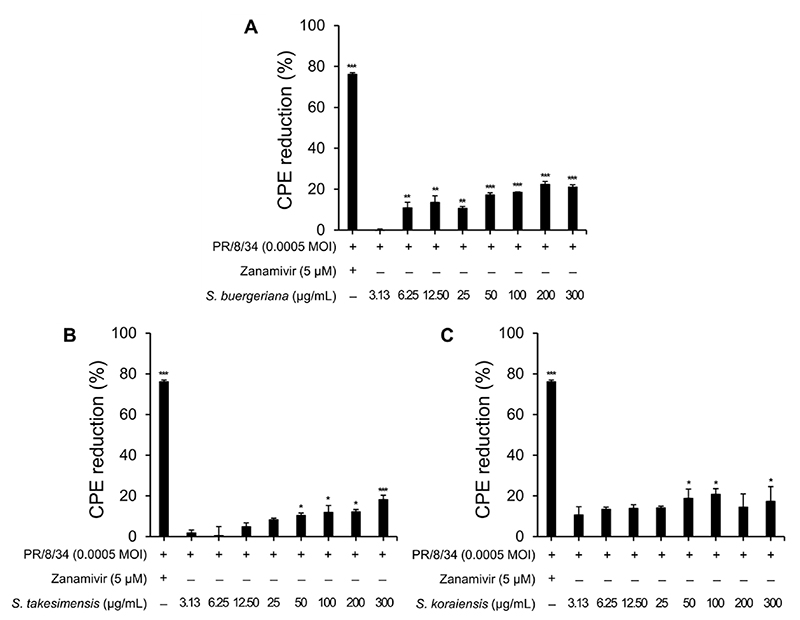
Anti-influenza effects of ethanol extracts of the three Scrophularia species in MDCK cells. A, S. buergeriana; B, S. takesimensis; C, S. koraiensis. MDCK cells were infected with A/PR/8/34 at an MOI of 0.0005 and treated with the indicated concentrations of each extract. At 48 hpi, IAV-induced cytopathic effects (CPE) under different treatments were evaluated using an MTT assay. Data are presented as the mean ± SEM. Statistical significance was analyzed using one-way ANOVA followed by Tukey’s multiple comparisons test. * p < 0.05; ** p < 0.01; *** p < 0.001 vs. virus control.
When comparing the efficacy among the tested species, the extract derived from S. buergeriana demonstrated the most potent antiviral activity. This was followed by S. koraiensis, which showed moderate effectiveness. In contrast, S. takesimensis exhibited the least antiviral activity among the three, although it still provided a measurable protective effect compared to the untreated control.
Moreover, chemiluminescence-based NA inhibition assays showed little inhibitory activity for each extract against influenza viruses. While S. takesimensis and S. koraiensis showed weak dose-dependent inhibition, S. buergeriana did not exhibit significant inhibitory activity (Fig. 4).
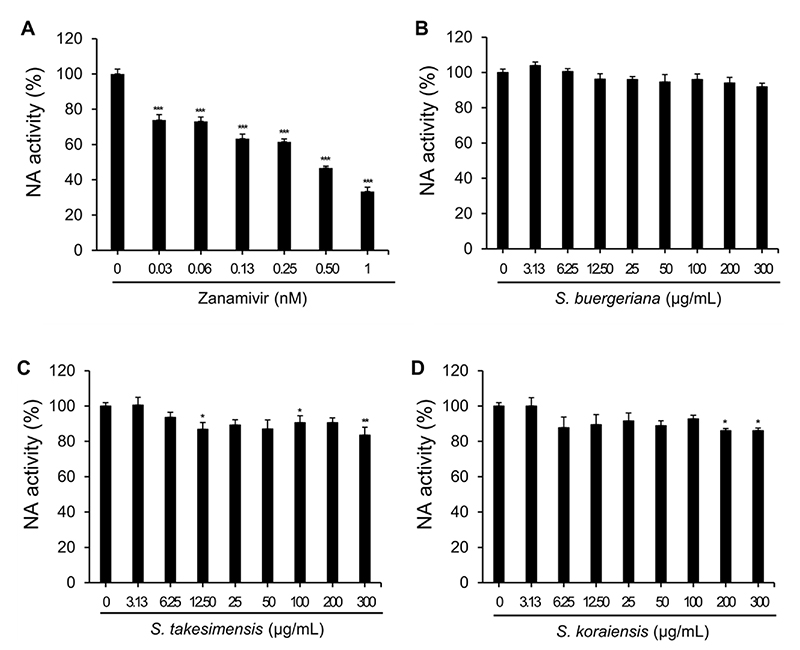
Inhibitory activity of ethanol extracts of the three Scrophularia species on neuraminidase from influenza A viruses. A, Zanamivir; B, S. buergeriana; C, S. takesimensis; D, S. koraiensis. Neuraminidase inhibitory activity was assessed using the NA-StarTM kit according to the manufacturer's instructions. Each extract (3.13–300 μg/mL) or zanamivir (0.03–1 nM; positive control) was reacted with A/PR/8/34 for 30 minutes. Data are presented as the mean ± SEM. Statistical significance was analyzed using one-way ANOVA followed by Tukey’s multiple comparisons test. * p < 0.05; ** p < 0.01; *** p < 0.001 vs. virus control.
DISCUSSION
IAV infection remains a global health concern, and currently available antiviral drugs primarily target viral proteins such as NA. However, the widespread emergence of drug-resistant viral strains has reduced the effectiveness of conventional antiviral therapies (Moscona, 2005). Therefore, natural products with alternative mechanisms of action have been increasingly explored as complementary or alternative antiviral strategies (Musarra-Pizzo et al., 2021).
In the present study, ethanol extracts from three Scrophularia species (S. buergeriana, S. koraiensis, and S. takesimensis) exhibited antiviral activity against IAV in MDCK cells without significant cytotoxicity. Notably, all extracts showed dose-dependent inhibition of virus-induced CPE, suggesting their potential as natural antiviral agents. Among the three, S. buergeriana exhibited the strongest activity, with a 22.36% CPE reduction at 200 μg/mL, followed by S. koraiensis and S. takesimensis, which showed moderate and weaker protection, respectively. This potency order contrasts with the NA inhibition results: S. takesimensis and S. koraiensis demonstrated weak but measurable dose-dependent NA inhibition, whereas S. buergeriana showed no detectable NA inhibition.
NA plays a critical role in viral release from infected cells, and its inhibition is a well-established antiviral strategy (Colman, 1994). The species-specific pattern of NA inhibitory activity observed in this study may be related to differences in harpagoside content among the three species. A previous study using HPLC/MS quantification reported harpagoside contents of 1.94 ± 0.24, 6.47 ± 0.02, and 5.50 ± 0.02 mg/g in S. buergeriana, S. koraiensis, and S. takesimensis, respectively (Nam et al., 2020). The two species with higher harpagoside content (S. koraiensis and S. takesimensis) exhibited weak NA inhibitory activity, whereas S. buergeriana, with the lowest harpagoside level, showed no inhibition. This raises the possibility that harpagoside or co-occurring iridoid glycosides may contribute, at least in part, to the NA-inhibitory activity of Scrophularia extracts. However, harpagoside itself has not been established as an NA inhibitor, and the actual NA inhibitory constituents remain to be identified. Direct compound-level validation, including testing of isolated harpagoside against NA activity, is warranted to confirm this association. Conversely, the more potent CPE-reducing activity of S. buergeriana despite its low harpagoside content suggests that its overall antiviral effect is likely driven by other constituents, such as phenylpropanoid glycosides, acting through NA-independent mechanisms.
In this study, S. buergeriana exhibited the strongest antiviral activity among the tested species, achieving the highest reduction in CPE despite showing no significant NA inhibitory activity. This finding suggests that the antiviral mechanism of S. buergeriana is likely independent of NA inhibition. Since the antiviral effects of Scrophularia extracts could not be fully explained by direct NA inhibition alone, alternative mechanisms may be involved. Antiviral effects may occur at various stages of the viral life cycle, including viral attachment and entry, intracellular genome replication, viral RNA polymerase activity, viral protein synthesis, virion assembly, and viral release, as well as through modulation of host antiviral signaling pathways (Ponticelli et al., 2023; Arumugam et al., 2025). The pharmacological activities of Scrophularia species are known to be associated with bioactive secondary metabolites, particularly iridoid glycosides such as harpagoside and various phenylpropanoids (De Santos Galíndez et al., 2002). These compounds have been reported to exhibit anti-inflammatory, antioxidant, and immunomodulatory effects (Chaibeddra et al., 2020; Thabet et al., 2022), which may contribute to antiviral activity by enhancing host defense mechanisms. For instance, iridoid glycosides have been shown to regulate NF-κB signaling pathways and cytokine production, which are closely involved in antiviral immune responses (Mihaylova et al., 2025). In addition, a recent study on 8-O-(E-p-methoxycinnamoyl)harpagide (MCH), an iridoid glycoside isolated from S. buergeriana roots, reported that MCH inhibited IAV infection in human lung epithelial cells by lowering intracellular Ca2+ and mitochondrial Ca2+/ROS levels, restoring mitochondrial membrane potential, and suppressing viral proteins such as M1, M2, PA, and NS1 (Kwon et al., 2021). The discrepancy between antiviral activity and NA inhibition observed in this study, together with previous evidence that plant extracts can show pronounced antiviral effects despite weak inhibition of viral enzymes, suggests that CPE reduction may involve alternative targets such as viral RNA polymerase or host cell pathways (Lin et al., 2014), rather than NA inhibition alone. However, viral RNA quantification by qRT-PCR and viral protein expression analysis by western blotting or immunofluorescence were not performed in the present study. Further studies, including viral RNA and protein assays and time-of-addition experiments, are required to clarify the precise antiviral mechanisms of the Scrophularia extracts.
Another important finding of this study is the low cytotoxicity of all three Scrophularia extracts in MDCK cells. The maintenance of high cell viability (> 93.40%) across a wide concentration range suggests a favorable safety profile, which is a critical factor in the development of antiviral agents. Natural compounds with low toxicity and multi-target effects are particularly attractive candidates for further drug development (Newman and Cragg, 2020).
Despite these promising findings, several limitations should be considered. First, although zanamivir was included as a positive control, a direct quantitative comparison of antiviral potency (e.g., IC50 values) between the Scrophularia extracts and zanamivir was not performed, limiting objective assessment of their relative efficacy. Second, the exact molecular mechanisms underlying the antiviral effects were not elucidated and require further investigation using molecular and biochemical approaches. Third, in vivo validation is needed to confirm the therapeutic potential of these extracts.
It should also be noted that the harpagoside content values discussed above were derived from a previously published study (Nam et al., 2020) rather than from direct phytochemical analysis of the extracts used in the present study. Since the chemical composition of plant materials can vary depending on cultivation conditions, harvest timing, and processing methods, the extracts used in this study were not subjected to direct chemical characterization (e.g., HPLC-based quantification of harpagoside or other marker compounds). This lack of direct phytochemical analysis is a limitation of the present study, and future studies should include quantitative analysis of the bioactive constituents in the same extract batches used for antiviral evaluation.
This study is the first to compare antiviral activity among three Korean Scrophularia species against IAV. All extracts showed dose-dependent, low-toxicity protective effects, with S. buergeriana demonstrating the strongest activity despite minimal NA inhibition, suggesting an NA-independent mechanism distinct from conventional antivirals such as zanamivir. However, the absence of mechanistic data (viral RNA/protein assays), reliance on a single viral strain, and lack of in vivo validation limit these conclusions. Future studies should focus on isolating the active constituents (e.g., harpagoside and related iridoids), elucidating their mechanism of action, and validating efficacy in vivo to establish Scrophularia species as viable natural antiviral candidates.
Acknowledgments
This study was supported by the Korea Research Institute of Bioscience and Biotechnology (KRIBB) Research Initiative Program (KGM1052612) and the project “Development of Innovative Technologies for the Future Value of Herbal Medicine Resources (KSN2512030)” from the Korea Institute of Oriental Medicine (KIOM), Republic of Korea.
References
-
Arumugam H, Wong KH, Low ZY, Lal S and Choo WS. (2025). Plant extracts as a source of antiviral agents against influenza A virus. Journal of Applied Microbiology. 136: lxaf056.
[https://doi.org/10.1093/jambio/lxaf056]

-
Bermejo P, Abad MJ, Diaz AM, Fernandez L, De Santos J, Sanchez S, Villaescusa L, Carrasco L and Irurzun A. (2002). Antiviral activity of seven iridoids, three saikosaponins and one phenylpropanoid glycoside extracted from Bupleurum rigidum and Scrophularia scorodonia. Planta Medica. 68:106-110.
[https://doi.org/10.1055/s-2002-20238]
-
Chaibeddra Z, Akkal S, Ouled-Haddar H, Silva AMS, Zellagui A, Sebti M and Cardoso SM. (2020). Scrophularia tenuipes Coss and Durieu: Phytochemical composition and biological activities. Molecules. 25:1647. https://www.mdpi.com/1420-3049/25/7/1647, (cited by 2026 Jul 31).
[https://doi.org/10.3390/molecules25071647]
- Choi BH, Moon HK, Oh SH, Im HT, Park CW, Song JH, Kim ST and Ko SC. (2018). Scrophulariaceae. In Flora of Korea Editorial Committee (eds.). Flora of Korea. Volume 6b (Asteridae: Scrophulariaceae to Dipsacaceae). National Institute of Biological Resources. Incheon, Republic of Korea. p.1-44.
-
Colman PM. (1994). Influenza virus neuraminidase: Structure, antibodies, and inhibitors. Protein Science. 3:1687-1696.
[https://doi.org/10.1002/pro.5560031007]
-
De Santos Galíndez J, Díaz Lanza AMa and Fernández Matellano L. (2002). Biologically active substances from the genus Scrophularia. Pharmaceutical Biology. 40:45-59.
[https://doi.org/10.1076/phbi.40.1.45.5864]
-
Han KS, So SK, Lee CH and Kim MY. (2009). Taxonomy of the genus Scrophularia(Scrophulariaceae) in Korea. Korean Journal of Plant Taxonomy. 39:237-246.
[https://doi.org/10.11110/kjpt.2009.39.4.237]
- Iuliano AD, Roguski KM, Chang HH, Muscatello DJ, Palekar R, Tempia S, Cohen C, Gran JM, Schanzer D, Cowling BJ, Wu P, Kyncl J, Ang LW, Park M, Redlberger-Fritz M, Yu H, Espenhain L, Krishnan A, Emukule G, van Asten L, Pereira da Silva S, Aungkulanon S, Buchholz U, Widdowson MA, Bresee JS and Global Seasonal Influenza-associated Mortality Collaborator Network. (2018). Estimates of global seasonal influenza-associated respiratory mortality: A modelling study. The Lancet. 391:1285-1300.
-
Jang HD and Oh BU. (2013). A taxonomic study of Korean Scrophularia L.(Scrophulariaceae) based on morphological characters. Korean Journal of Plant Resources. 26:271-283.
[https://doi.org/10.7732/kjpr.2013.26.2.271]
-
Jeong EJ, Ma CJ, Lee KY, Kim SH, Sung SH and Kim YC. (2009). KD-501, a standardized extract of Scrophularia buergeriana has both cognitive-enhancing and antioxidant activities in mice given scopolamine. Journal of Ethnopharmacology. 121:98-105.
[https://doi.org/10.1016/j.jep.2008.10.006]
-
Jung TY, Lee AY, Song JH, Lee MY, Lim JO, Lee SJ, Ko JW, Shin NR, Kim JC, Shin IS, Kim JS. (2020). Scrophularia koraiensis Nakai attenuates allergic airway inflammation via suppression of NF-κB and enhancement of Nrf2/HO-1 signaling. Antioxidants. 9:99. https://www.mdpi.com/2076-3921/9/2/99, (cited by 2026 Jul 31).
[https://doi.org/10.3390/antiox9020099]
-
Kaur H, Kumar D, Gauttam VK, Suttee A, Kaur R, Tanwar R, Kondaveeti SB and Choudhary N. (2026). Decoding the mechanistic landscape of harpagoside: From molecular targets to translational pharmacology. Fitoterapia. 188:107029.
[https://doi.org/10.1016/j.fitote.2025.107029]
-
Kwon EB, Yang HJ, Kim YS, Li W and Choi JG. (2021). 8-O-(E-p-methoxycinnamoyl)harpagide inhibits influenza A virus infection by suppressing intracellular calcium. Molecules. 26:1029. https://www.mdpi.com/1420-3049/26/4/1029, (cited by 2026 Aug 18).
[https://doi.org/10.3390/molecules26041029]
-
Lee HJ, Spandidos DA, Tsatsakis A, Margina D, Izotov BN and Yang SH. (2019). Neuroprotective effects of Scrophularia buergeriana extract against glutamate-induced toxicity in SH-SY5Y cells. International Journal of Molecular Medicine. 43:2144-2152.
[https://doi.org/10.3892/ijmm.2019.4139]
-
Lin LT, Hsu WC and Lin CC. (2014). Antiviral natural products and herbal medicines. Journal of Traditional and Complementary Medicine. 4:24-35.
[https://doi.org/10.4103/2225-4110.124335]
-
Mihaylova R, Elincheva V, Gevrenova R, Zheleva-Dimitrova D, Momekov G and Simeonova R. (2025). Targeting inflammation with natural products: A mechanistic review of iridoids from Bulgarian medicinal plants. Molecules. 30:3456.
[https://doi.org/10.3390/molecules30173456]
-
Moscona A. (2005). Neuraminidase inhibitors for influenza. New England Journal of Medicine. 353:1363-1373.
[https://doi.org/10.1056/NEJMra050740]
-
Musarra-Pizzo M, Pennisi R, Ben-Amor I, Mandalari G and Sciortino MT. (2021). Antiviral activity exerted by natural products against human viruses. Viruses. 13:828. https://www.mdpi.com/1999-4915/13/5/828, (cited by 2026 Jul 31).
[https://doi.org/10.3390/v13050828]
-
Nam HH, Lee AY, Seo YS, Park I, Yang S, Chun JM, Moon BC, Song JH and Kim JS. (2020). Three Scrophularia species (Scrophularia buergeriana, S. koraiensis, and S. takesimensis) inhibit RANKL-induced osteoclast differentiation in bone marrow-derived macrophages. Plants. 9:1656.
[https://doi.org/10.3390/plants9121656]
-
Newman DJ and Cragg GM. (2020). Natural products as sources of new drugs over the nearly four decades from 01/1981 to 09/2019. Journal of Natural Products. 83:770-803.
[https://doi.org/10.1021/acs.jnatprod.9b01285]
-
O'Hanlon R and Shaw ML. (2019). Baloxavir marboxil: The new influenza drug on the market. Current Opinion in Virology. 35:14-18.
[https://doi.org/10.1016/j.coviro.2019.01.006]
-
Pasdaran A and Hamedi A. (2017). The genus Scrophularia: A source of iridoids and terpenoids with a diverse biological activity. Pharmaceutical Biology. 55:2211-2233.
[https://doi.org/10.1080/13880209.2017.1397178]
-
Ponticelli M, Bellone ML, Parisi V, Iannuzzi A, Braca A, de Tommasi N, Russo D, Sileo A, Quaranta P, Freer G, Pistello M and Milella L. (2023). Specialized metabolites from plants as a source of new multi-target antiviral drugs: A systematic review. Phytochemistry Reviews. 22:615-693.
[https://doi.org/10.1007/s11101-023-09855-2]
-
Seo YS, Song JH, Kim HS, Nam HH, Yang S, Choi G, Chae SW, Lee J, Jung B, Kim JS, Park I. (2024). An integrative study of Scrophularia takesimensis Nakai in an ovalbumin-induced murine model of asthma: The effect on T helper 2 cell activation. Pharmaceutics. 16:529. https://www.mdpi.com/1999-4923/16/4/529, (cited by 2026 Jul 31).
[https://doi.org/10.3390/pharmaceutics16040529]
-
Shin NR, Lee AY, Song JH, Yang S, Park I, Lim JO, Jung TY, Ko JW, Kim JC, Lim KS, Lee MY, Shin IS and Kim JS. (2020). Scrophularia buergeriana attenuates allergic inflammation by reducing NF-κB activation. Phytomedicine. 67:153159.
[https://doi.org/10.1016/j.phymed.2019.153159]
-
Taubenberger JK and Morens DM. (2008). The pathology of influenza virus infections. Annual Review of Pathology: Mechanisms of Disease. 3:499-522.
[https://doi.org/10.1146/annurev.pathmechdis.3.121806.154316]
-
Thabet AA, Ayoub IM, Youssef FS, Al-Sayed E, Efferth T and Singab ANB. (2022). Phytochemistry, structural diversity, biological activities and pharmacokinetics of iridoids isolated from various genera of the family Scrophulariaceae Juss. Phytomedicine Plus. 2:100287.
[https://doi.org/10.1016/j.phyplu.2022.100287]