
Characterization and Bioactive Compound Analysis of 30 Jujube (Ziziphus jujuba Mill.) Accessions for Breeding Resource Development
This is an open access article distributed under the terms of the Creative Commons Attribution Non-Commercial License (http://creativecommons.org/licenses/by-nc/3.0/) which permits unrestricted non-commercial use, distribution, and reproduction in any medium, provided the original work is properly cited.
Abstract
Jujube (Ziziphus jujuba Mill.) is a premier medicinal crop with a long history in traditional medicine, valued for its diverse pharmacological properties. Although the industrial demand for high-value bioactive materials is rising, the Korean jujube industry remains vulnerable because of its narrow genetic base. In this study, we evaluated 30 jujube accessions to identify superior genetic resources for the development of medicinal and functional cultivars.
Morphological traits, fruit quality, and antioxidant compounds were assessed over two consecutive years (2022 and 2023). ‘Gwangam’ produced the heaviest fruit (29.5 g), whereas ‘Wolchul-60’ exhibited the highest total soluble solids (29.4 °Brix). Physicochemically, ‘Sanjo’ recorded the highest vitamin C (1,472.5 mg/100 g DW) and total phenolic contents (TPC; 1,325.3 mg GAE/100 g DW), consequently displaying the strongest DPPH and ABTS radical-scavenging activities. Antioxidant capacity highly correlated with vitamin C content (p < 0.001). Fruit weight was negatively associated with antioxidant-related traits (r = −0.61 to −0.64, p < 0.001).
The large-fruited ‘Gwangam,’ high-sugar ‘Wolchul-60,’ and vitamin C- and TPC-rich ‘Sanjo’ represent promising breeding materials for developing high-value jujube cultivars with enhanced functional quality.
Keywords:
Jujube, Antioxidant Activity, Functional Compound, Genetic Resources, Titratable Acidity, Vitamin CINTRODUCTION
Chinese jujube (Ziziphus jujuba Mill.; Rhamnaceae) is a deciduous broadleaf fruit tree native to Asia, including China and Korea, with a cultivation history of more than 4,000 years. Owing to its strong environmental adaptability and high nutritional value, jujube has long been utilized as an important food and medicinal resource, and its production and consumption have recently expanded worldwide, including to Turkey, Romania, and Australia (Liu et al., 2020). With increasing consumer demand for natural antioxidants and functional foods, jujube is now gaining renewed attention as a high-value crop beyond conventional fresh-fruit use (Kim et al., 2021a; Park et al., 2023; Lee et al., 2025).
Jujube contains diverse bioactive constituents not only in fruit but also in other plant parts, including leaves, seeds, and bark. Jujube leaves have been reported to contain functional compounds such as vitamin C, rutin, and quercetin (Jin et al., 1999; Kim et al., 2011; Zhang et al., 2019), while the seeds within the stone are known to accumulate bioactives including saponin-related constituents (jujuboside A and B) and spinosin (Hua et al., 2022; Ruan et al., 2024). Bioactivities of bark-derived betulinic acid, including antiviral effects, have also been reported (Lee et al., 2008). In addition, previous studies have shown that jujube pulp is rich in sugars and organic acids as well as various functional constituents such as vitamin C, polyphenols, flavonoids, and cyclic AMP (cAMP) (Han et al., 2015; Ko et al., 2021; Park et al., 2021; Lee et al., 2025; Oh et al., 2025b).
Accordingly, the industrial importance of jujube has continued to increase alongside the rapidly growing demand for health functional foods. In the past, jujube was used mainly as a raw material for simple processed products such as dried jujube, chips, and juice (Bang et al., 2020). More recently, however, consumer perceptions have shifted positively toward fresh jujube with high sweetness and desirable texture, and jujube has gained attention as a high-income crop (Lee et al., 2018; Park et al., 2023). Consistent with this trend, new growers have continued to enter production; over the past five years (2020–2024), the number of farm households reached 52,145, increasing by approximately 9,700, and the cultivation area approached 6,487.2 ha (MAFRA, 2024). As of 2024, production totaled 7,666 tons, establishing jujube as a major forest product in Korea (KFS, 2025).
Despite this quantitative growth, the Korean jujube industry remains vulnerable due to its narrow genetic base. Commercial production is currently concentrated on a limited number of cultivars, including the standard jujube cultivar ‘Bokjo’ and several large-fruited cultivars such as ‘Hwangsil’ and ‘Cheonhwang’ (Oh et al., 2020; Kim et al., 2021a). This cultivar dependence has raised concerns regarding reduced resilience to emerging pests and diseases and to weather-related disasters under climate change (Lee et al., 2025; Oh et al., 2025b).
To mitigate this cultivar bias, the development of new cultivars using diverse genetic resources is essential. However, jujube exhibits a strong tendency toward parthenocarpy, which limits seed set and makes it difficult to obtain sufficient seeds through controlled hybridization (Ackerman, 1961). In Korea, several major registered cultivars, including ‘Cheonsang’ and ‘Cheonhwang’, have been reported to originate largely from bud-sport mutations rather than from conventional cross breeding (NFSVC, 2024). Moreover, past breeding efforts have mainly focused on improving external market traits such as large fruit size and high soluble solids content in cultivars such as ‘Mudeung’ and ‘Geumseong’ (Oh et al., 2020), which has constrained the development of cultivars optimized for medicinal and functional attributes. Although molecular marker studies aimed at characterizing genetic diversity have recently expanded (Nam, 2016; Oh, 2019; Kim et al., 2021b; Kim et al., 2024), studies directly supporting practical crossing programs—particularly parental selection and trait–trait relationship analyses—remain limited.
Therefore, to improve crossing efficiency and to develop high-functionality cultivars, it is necessary to conduct detailed evaluations of seed formation capacity (kernel presence rate), growth traits, and functional constituents across diverse jujube accessions collected from domestic and international sources (Oh et al., 2020; Lee et al., 2025; Oh et al., 2025b). Broad trait evaluation and the selection of superior accessions while maintaining genetic diversity will provide a foundation for developing high-value materials and enhancing resilience under future climatic conditions (Gao et al., 2012; Liu et al., 2020; Oh et al., 2020).
Accordingly, this study compared fruit quality traits and antioxidant activities among 30 jujube accessions and examined correlations among key traits relevant to breeding, thereby providing baseline information for future cultivar development and functional utilization of jujube.
MATERIALS AND METHODS
1. Plant materials
Thirty jujube genetic resources were evaluated over two consecutive years (2022-2023) (Table 1). The materials consisted of 8–10-year-old trees maintained in the resource preservation orchard of the Jujube Research Institute, Chungcheongbuk-do Agricultural Research and Extension Services (36°34′38.7″ N, 127°44′44.9″ E). Trees were spaced at 4 m × 2 m and managed under standard commercial practices for fertilization and pest and disease control in Korea. The 30 accessions were selected based on prior field observations and published reports describing diversity in growth vigor, fruit size, and yield-related traits, to represent genetically and agronomically diverse materials.
Phenological and morphological traits were assessed according to the Research Standards for Agricultural Science and Technology Investigation and Analysis (RDA, 2012) and the Jujube Tree Characteristic Survey Guidelines (NFSVC, 2009). Flowering type was classified as morning- or afternoon-flowering based on the timing of sepal opening (Nam et al., 2015; Yao et al., 2015). In each year, three trees per accession were used as biological replicates (n = 3 per year). Different trees were sampled in 2022 and 2023, and tree-year means were used as analytical units for pooled comparisons, as described in the Statistical analysis section.

General information and phenological traits of 30 jujube genetic resources evaluated over two years (2022–2023).
Leaves were collected in mid-July from fully expanded mature leaves at the middle portion of fruiting shoots (3rd–5th nodes). Fruits and stones were harvested in early October at commercial maturity (≥ 70% skin coloration). Leaf length and width were measured using a ruler, and petiole length was measured using a digital caliper (CD-15 CPX, Mitutoyo, Kawasaki, Japan). Leaf greenness (SPAD value) was recorded using a portable chlorophyll meter (SPAD-502 Plus, Konica Minolta, Tokyo, Japan). Fruit and stone dimensions were measured using a digital caliper, and weights were recorded using an electronic balance (XT 4200C, Precisa, Dietikon, Switzerland). Fruit firmness was determined using a hardness tester (KM-5, Fujiwara, Tokyo, Japan) equipped with a 5-mm probe. Total soluble solids (TSS) (°Brix) were measured using a portable digital refractometer (PAL-1, ATAGO Co., Ltd., Tokyo, Japan). Kernel formation was evaluated by manually cracking stones and recording the presence of a fully developed kernel.
2. Sample preparation and extraction
For functional component analyses, fruit pulp samples were prepared by removing the seeds immediately after harvest, slicing the pulp, and storing the samples in a deep freezer at -80°C. The frozen pulp samples were then freeze-dried using a freeze dryer (MP-9015, Malda, Korea) by gradually increasing the temperature from -40°C to 20°C at 5°C intervals every 4 h for a total duration of 60 h (Oh, 2019; Oh et al., 2020). The dried samples were finely ground and passed through a 50-mesh sieve prior to extraction. Two grams of powdered sample were extracted with 18 mL of distilled water by shaking extraction for 2 h. The extracts were centrifuged at 4°C and 8,000 rpm for 20 min, and the supernatants were vacuum filtered through filter paper (No. 2, Advantec, Tokyo, Japan) to obtain analytical solutions (Park and Kim, 2016; Oh, 2019). In this study, a water-based extraction method was employed to evaluate the functional potential of jujube under conditions similar to food utilization environments. Vitamin C, a major functional indicator in jujube pulp, is water-soluble and can be rapidly oxidized in organic solvents; therefore, aqueous extraction is considered the most suitable method for maintaining compound stability. In addition, all resources were extracted under identical conditions to accurately compare functional differences among accessions (Adjdir et al., 2019; Ko et al., 2021).
3. Determination of pH and titratable acidity
Fruits exhibiting more than 70% skin coloration were harvested, and the pulp was juiced to obtain samples for pH and titratable acidity analyses. The pH of the juice was measured using a pH meter (Thermo Scientific Orion, Waltham, MA, USA), and calibration was performed to ensure that the electrode slope exceeded 96% prior to measurement. Titratable acidity was determined by diluting 5 mL of fruit juice with 5 mL of distilled water and titrating the mixture with 0.1 N NaOH solution to an endpoint of pH 8.2 (Shin et al., 2023). Titratable acidity was calculated as malic acid equivalents (Tepe et al., 2022), based on the predominant organic acid reported in jujube, using the following equation:
[V= volume of 0.1 N NaOH used for titration (mL); f= standardization factor of 0.1 N NaOH (1.001); F= organic acid conversion factor equivalent to 1 mL of 0.1 N NaOH (malic acid = 0.0067); S= sample volume (mL)]
4. Analysis of bioactive compounds
DPPH radical scavenging activity was determined using a modified method of Blois (1958). A 0.2 mM DPPH reagent (DPPH from Sigma-Aldrich Co., St. Louis, MO, USA) was freshly dissolved in ethanol and kept in the dark during analysis. Prior to reaction, the jujube extract was diluted 400-fold with distilled water, and 0.2 mL of the diluted extract was mixed with 0.8 mL of the DPPH reagent in the dark and incubated for 30 min. The control consisted of distilled water mixed with the DPPH reagent under the same conditions. Absorbance of the reaction solution was measured at 525 nm using a UV–Vis spectrophotometer (Cary 100 UV–Vis, Agilent Technologies, Santa Clara, CA, USA), according to previously reported conditions (Kim et al., 2011; Oh, 2019; Oh et al., 2020; Jeong et al., 2023b; Kim et al., 2025).
DPPH radical scavenging activity was calculated using the following equation:
ABTS radical scavenging activity was measured following the method described by Re et al. (1999). ABTS (7.4 mM, Sigma-Aldrich Co., St. Louis, MO, USA) and potassium persulfate (2.6 mM, Sigma-Aldrich Co., St. Louis, MO, USA) were dissolved in methanol and reacted in the dark for 24 h to generate ABTS radical cations. Prior to analysis, the jujube extract was diluted 100-fold with distilled water, and 50 μL of the diluted extract was mixed with 1 mL of the ABTS reagent in the dark and incubated for 30 min. The control consisted of distilled water mixed with the ABTS reagent under the same conditions. Absorbance was then recorded at 735 nm using a UV-Vis spectrophotometer, according to previously reported analytical procedures (Kim et al., 2011; Park and Kim, 2016; Park et al., 2017; Oh et al., 2025a).
ABTS radical scavenging activity was calculated using the following equation:
The contents of vitamin C, total phenolics (TPC), and total flavonoids (TFC) were determined using freeze-dried fruit pulp samples submitted to the Comprehensive Analytical Testing Service of the Korea Agriculture Technology Promotion Agency (KOAT, Iksan, Korea). Analyses were conducted according to the official analytical methods of the Ministry of Food and Drug Safety (MFDS, 2023a; 2023b). Vitamin C was expressed as mg ascorbic acid per 100 g dry weight (DW), TPC as mg gallic acid equivalents (GAE) per 100 g DW, and TFC as mg quercetin equivalents (QE) per 100 g DW.
5. Statistical analysis
All statistical analyses were conducted using IBM SPSS Statistics (Version 24.0; IBM Corp., Armonk, NY, USA). For pooled comparisons shown in the main tables, tree-year means from both years were used as analytical units (n = 6 per accession; 3 trees per year × 2 years), and differences among accessions were evaluated by one-way analysis of variance (ANOVA) followed by Tukey’s HSD test at p < 0.05. Prior to ANOVA, residual normality and homogeneity of variance were assessed using the Shapiro–Wilk test and Levene’s test, respectively. In addition, two-way ANOVA was conducted to evaluate the effects of accession, year, and accession × year interaction. To avoid pseudoreplication, subsample measurements within each tree were averaged to obtain tree-level means before statistical analysis. Pearson’s correlation coefficients were calculated using accession-level mean values averaged over the two years (n = 30). Because the same accessions were evaluated across years, the pooled results were interpreted with consideration of annual variation.
RESULTS AND DISCUSSION
1. Growth and phenological characteristics of jujube accessions
Phenological stages are important indicators for selecting suitable cultivation areas and mitigating weather-related risks (Table 1). All phenological traits reported here were evaluated over two consecutive growing seasons (2022–2023), and the presented values are the two-year averages. Bud burst ranged from 16 April (‘Uiseong-5’) to 22 April (‘Jc-28a’), representing an approximately 6-day variation among accessions. Flowering ranged from 5 June (‘Sanjo’) to 19 June (‘6wolseonjo’). Compared with temperate fruit trees such as apple and peach, which typically bloom in mid- to late April and can be vulnerable to late frost damage (Yun et al., 2012; Han et al., 2016; Kweon and Sagong, 2022; Jeong et al., 2023a), the later flowering of jujube may reduce exposure to frost risk and thereby contribute to more stable fruit set under Korean conditions. Harvest timing also varied widely, from 24 September (‘Sanjo’, very early-maturing) to 15 October (‘Gwangam’, late-maturing), highlighting the value of these accessions for maturity diversification. Such variation may help reduce market oversupply during peak harvest and facilitate labor distribution in orchard operations (Yu and Kim, 2017). Blooming type classification showed that six accessions (including ‘Sanjo’) were morning-flowering, whereas 24 accessions (including ‘Bokjo’) were afternoon-flowering, consistent with previous reports that Korean-collected accessions predominantly exhibit the afternoon-flowering type (Nam et al., 2015; Oh, 2019; Oh et al., 2020). Although phenological traits were monitored over two years in this study, continued long-term monitoring will be valuable to further confirm the stability of accession differences under varying weather conditions.
2. Leaf traits of jujube accessions
Morphological and physiological characteristics of leaves, the primary photosynthetic organs, varied significantly among accessions (Table 2; Fig. 1). ‘Cheonsang’ exhibited the largest leaves (7.66 × 5.37 cm), representing a typical large-leaf type (Fig. 1A), whereas ‘Sanjo’ was classified as a small-leaf type (Fig. 1C). The leaf morphology index (LMI) ranged from 1.43 (ovate type) to 2.44 (lanceolate type), consistent with previous eports (Jang et al., 2006; Li et al., 2015; Nam, 2016; Oh, 2019; Oh et al., 2020). Notably, ‘Sanjo’ showed the highest SPAD value (48.70), despite its small leaf size, indicating a relatively high leaf-greenness or chlorophyll-related index. Previous studies have reported nutritional and bioactive compounds in jujube leaves (Jin et al., 1999; Zhang et al., 2019). However, because SPAD is an indirect chlorophyll-related index and leaf bioactive compounds were not analyzed in this study, this result should not be interpreted as direct evidence of functional material potential. Further studies involving chlorophyll quantification, photosynthetic measurements, and leaf antioxidant profiling are needed to evaluate the functional value of jujube leaves.
Leaf morphological traits and SPAD values of 30 jujube accessions.
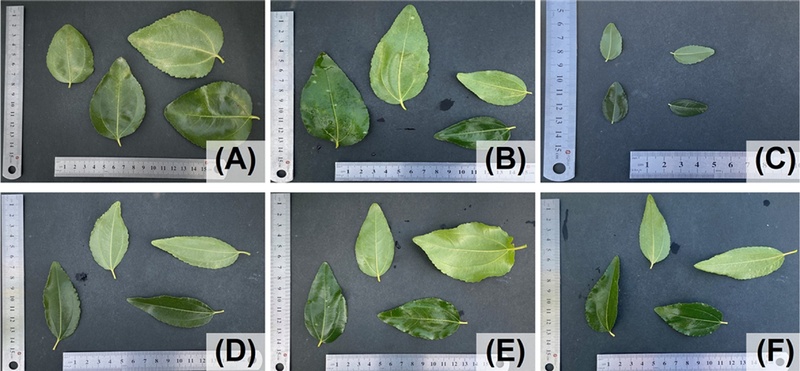
Morphological characteristics of leaves in selected jujube accessions.Representative leaves showing variation in shape and size: (A) CBJ0038 (Cheonsang), (B) CBJ0047 (Bokjo-60), (C) CBJ0092 (Sanjo), (D) CBJ0104 (Geumchang1ho), (E) CBJ0115 (Bokjo), and (F) CBJ0136 (Bongmilgwanjo). A ruler in each photograph indicates scale (cm).
3. Fruit morphological and quality traits of jujube accessions
Fruit appearance and quality traits, which are closely associated with consumer preference, differed markedly among accessions (Table 3; Fig. 2). ‘Uiseong-B’ had the greatest fruit length (45.2 mm; Fig. 2B), whereas ‘Hwangsil’ showed the greatest fruit width (38.5 mm; Fig. 2A), representing large-fruit phenotypes. In contrast, ‘Sanjo’ had the smallest fruit dimensions (16.6 × 16.6 mm; Fig. 2C). These differences were reflected in fruit weight: ‘Gwangam’ produced the heaviest fruits (29.5 g; Fig. 2F), whereas ‘Sanjo’ averaged 2.4 g, indicating an approximately 12.3-fold difference among accessions. This pattern is consistent with the concept that fruit enlargement has been a key target trait during domestication and improvement of jujube (Liu et al., 2020; Hua et al., 2022). The fruit morphology index (FMI) ranged from 1.01 (round type) to 1.90 (conical type). Fruit firmness also differed among accessions, with ‘Wangdaechu’ showing the lowest firmness (2.3 kg/5 mm). Regarding internal quality, total soluble solids (TSS) were highest in ‘Wolchul-60’ (29.4 °Brix) and ‘Bongmilgwanjo’ (29.3 °Brix). Overall trends in major fruit traits were generally consistent with previous reports; however, differences in reported TSS values among studies may reflect seasonal conditions and harvest maturity at sampling (Jang et al., 2006; Lee et al., 2017; Lee et al., 2018; Oh et al., 2020; Park et al., 2023). Collectively, several accessions compared favorably with major commercial cultivars in Korea, including ‘Bokjo’ (Fig. 2E) and ‘Hwangsil’ (Fig. 2A), suggesting their potential to broaden the genetic base and support breeding programs targeting diverse market preferences (Liu et al., 2020; Oh et al., 2020; Kim et al., 2021a).
Fruit morphological and quality traits of 30 jujube accessions.
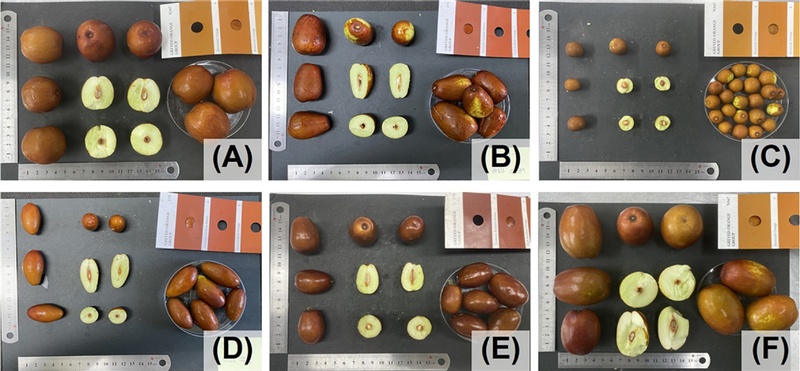
Morphological characteristics of fruits in selected jujube accessions.Representative fruits showing variation in external shape, size, skin coloration, and internal structure: (A) CBJ0075 (Hwangsil), (B) CBJ0089 (Uiseong-B), (C) CBJ0092 (Sanjo), (D) CBJ0102 (Wolgwang), (E) CBJ0115 (Bokjo), and (F) CBJ0166 (Gwangam). A ruler in each photograph indicates scale (cm).
4. Stone traits and kernel formation rate of jujube accessions
Stone traits, particularly kernel formation, are summarized in Table 4 and Fig. 3. Quantitative stone traits (weight and size) were positively associated with fruit enlargement, consistent with previous findings (Oh et al., 2020). ‘Gwangam’ had the greatest stone weight (0.94 g), followed by ‘Hwangsil’ (0.87 g; Fig. 3A), whereas small-fruited accessions such as ‘Sanjo’ and ‘Hongjinjujo’ showed markedly lower stone weights (0.36 and 0.35 g, respectively). The stone morphology index (SMI) anged widely, with ‘Wolgwang’ showing the highest SMI (3.86; Fig. 3E) and ‘Sanjo’ the lowest (1.37; Fig. 3C), consistent with reported diversity in stone shape among accessions (Oh et al., 2020; Oh et al., 2025b). Kernel formation differed substantially among the 30 accessions. Representative cultivars such as ‘Bokjo’ (25.4%; Fig. 3F), ‘Cheonhwang’ (2.2%), and ‘Gwangam’ (0.0%) showed low kernel formation rates, and their stones were frequently empty, consistent with the predominantly parthenocarpic tendency reported in cultivated jujube (Ackerman, 1961). In contrast, ‘Sanjo’, ‘Jc-28a’, and ‘6wolseonjo’ showed high kernel formation rates of 99.4%, 98.3%, and 94.3%, respectively. These results indicate that kernel formation varies widely among jujube accessions and that high-kernel-forming accessions may be useful as potential seed-parent candidates in breeding programs (Asatryan and Tel-Zur, 2013; Oh et al., 2020; Oh et al., 2025b).
Stone morphological traits and kernel formation rate of 30 jujube accessions.
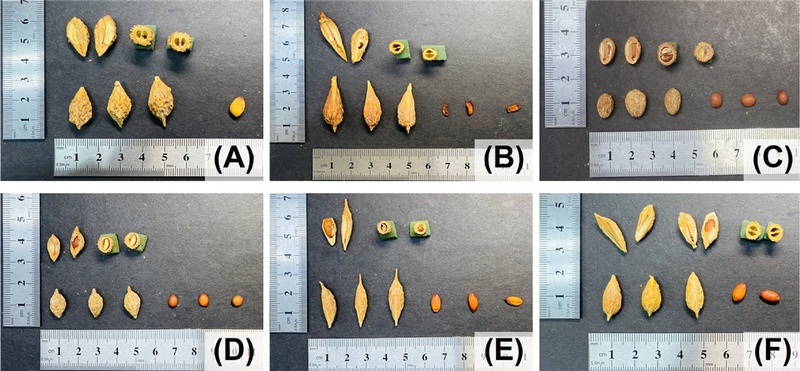
Morphological characteristics of stones and kernels in selected jujube accessions.Representative stones and kernels showing variation in shape, size, and kernel filling level: (A) CBJ0075 (Hwangsil), (B) CBJ0089 (Uiseong-B), (C) CBJ0092 (Sanjo), (D) CBJ0101 (6wolseonjo), (E) CBJ0102 (Wolgwang), and (F) CBJ0115 (Bokjo). A ruler in each photograph indicates scale (cm).
5. Physicochemical characteristics of jujube juice
Results of juice pH and titratable acidity (TA), which influence perceived flavor and processing suitability, are presented in Table 5. TA (expressed as malic acid equivalents) ranged from 0.27% to 2.33% across accessions. Most accessions showed low-to-moderate acidity (generally ≤ 0.8%), whereas a few accessions exhibited higher TA values. Notably, ‘Sanjo’ showed distinctly high TA (2.33%), indicating that this accession has a markedly acidic juice profile compared with the other evaluated accessions. Juice pH ranged from 3.60 (‘Sanjo’) to 5.14 (‘Cheonsang’) and tended to decrease as TA increased, consistent with the expected pH–acidity relationship (Choi and Choi, 2023; Lee et al., 2025). From an application perspective, high-acidity accessions (‘Sanjo’) may be useful as blending materials for processed products, whereas low-acidity accessions may be preferable for fresh consumption where a milder acid profile is desired. Collectively, these results indicate substantial among-accession variation in acidity-related juice traits (pH and TA) (Kang et al., 2006; Jo et al., 2015; Park et al., 2018; Park et al., 2021).
Juice pH and titratable acidity of 30 jujube accessions.
6. Bioactive compounds and antioxidant activity in jujube fruits
The concentrations of vitamin C, TPC, and TFC in the fruit pulp of the 30 jujube accessions are summarized in Table 6. Vitamin C, a major antioxidant constituent in jujube fruit, varied widely across the 30 accessions (535.9–1,472.5 mg/100 g). ‘Sanjo’ showed the highest vitamin C content (1,472.5 mg/100 g), which was approximately 2.7-fold higher than that of ‘Sahongdaejo’ (535.9 mg/100 g), the lowest among the evaluated accessions. In addition, ‘Bokjo-60’ (1,006.0 mg/100 g) and ‘Wolchul-80’ (973.9 mg/100 g) also exhibited high vitamin C contents, suggesting that these accessions may serve as promising materials for breeding high-functionality cultivars. Overall, these patterns were broadly consistent with previous reports on bioactive constituents in jujube fruit (Park and Kim, 2016; Wojdyło et al., 2016b; Lee et al., 2025).
Antioxidant activities and bioactive compound contents in the fruit pulp of 30 jujube accessions.
TPC, representing major secondary metabolites associated with antioxidant and anti-inflammatory effects (Kim et al., 2017), ranged from 523.5 to 1,325.3 mg/100 g. ‘Sanjo’ showed the highest TPC (1,325.3 mg/100 g), followed by ‘Uiseong-5’ (1,172.4 mg/100 g) and ‘Uiseong-15’ (1,140.3 mg/100 g). TFC also varied substantially among accessions: ‘Bokjo-80’ recorded the highest TFC (461.3 mg/100 g), and ‘Mudeung-60’ (334.7 mg/100 g) and ‘Sanjo’ (319.6 mg/100 g) were among the accessions with higher TFC values. The overall patterns in TPC and TFC were comparable to those reported previously (Han et al., 2015; Wojdyło et al., 2016a; Lee et al., 2025).
Some accessions exhibited relatively large standard deviations in the present study, which may be attributable to within-accession biological variability among trees and microenvironmental heterogeneity within the orchard, even under uniform management. In addition, although a uniform harvest criterion (≥ 70% skin coloration) was applied to all accessions, physiological maturity may not have been fully synchronized because of differences in maturity traits among accessions, which could partly contribute to variation in the accumulation of bioactive compounds. This interpretation is consistent with previous reports indicating that measured contents can vary depending on sample pretreatment and harvest timing (Kim et al., 2011; Choi et al., 2016).
To assess overall antioxidant capacity, DPPH and ABTS radical-scavenging activities were determined. In the present dataset, accessions with higher bioactive compound contents tended to show higher radical-scavenging activity. DPPH scavenging activity ranged from 13.4% to 90.3%, with ‘Sanjo’ showing the highest activity (90.3%). ABTS scavenging activity likewise reached its maximum in ‘Sanjo’ (96.6%), and ‘Bokjo-60’ (91.3%) also exhibited strong activity. Collectively, ‘Sanjo’ combined high vitamin C and TPC with correspondingly strong antioxidant activities, suggesting that it may serve as a promising resource for developing natural antioxidants and functional food materials (Kim and Joo, 2005; Oh et al., 2020; Lee et al., 2025).
To support the interpretation of the two-year pooled results, two-way ANOVA was conducted to evaluate the effects of accession, year, and accession × year interaction. Accession effects were detected for most evaluated traits, confirming substantial variation among the genetic resources. Year effects and accession × year interactions were also observed for some traits, indicating that annual variation should be considered when interpreting the pooled results. Therefore, the main tables were used to summarize overall accession-dependent differences, while the results were interpreted with caution regarding year-to-year variability.
7. Correlation analysis among traits
Correlation analysis was performed to evaluate relationships among growth traits, fruit quality attributes, and bioactive compound contents across the 30 accessions based on the two-year pooled averages; results are presented as a heatmap (Fig. 4). ABTS radical-scavenging activity showed strong positive correlations with vitamin C content (r = 0.80, p < 0.001) and DPPH activity (r = 0.90, p < 0.001), indicating that variation in antioxidant activity was closely aligned with vitamin C levels in this dataset. In comparison, total phenolic content (TPC; r = 0.27, ns) and total flavonoid content (TFC; r = 0.32, ns) exhibited relatively weak associations with ABTS activity, suggesting that vitamin C contributed more strongly to the observed variation in radical-scavenging capacity among these accessions (Gao et al., 2012).
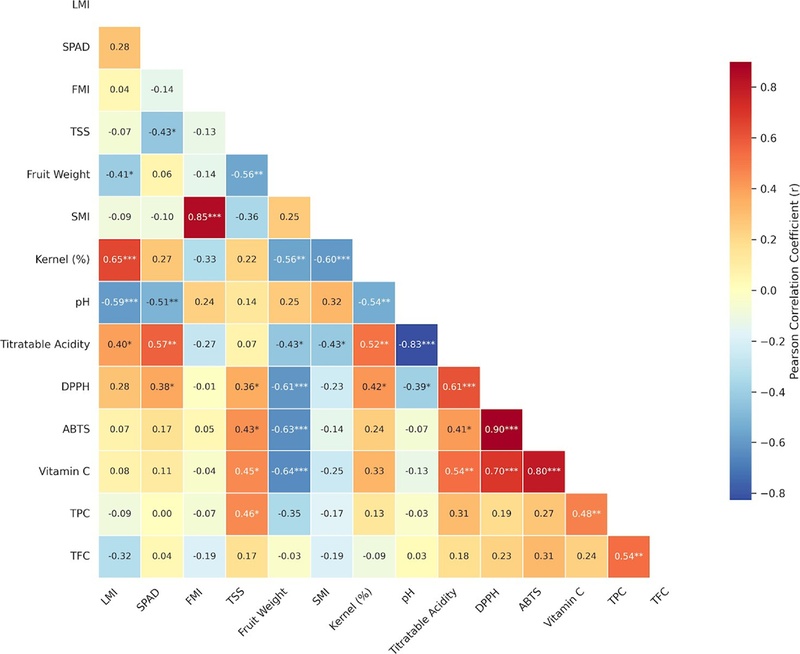
Heatmap of Pearson’s correlation coefficients among physicochemical traits, bioactive compounds, and morphological traits in 30 jujube accessions.Positive and negative correlations are represented in red and blue, respectively, and color intensity corresponds to the absolute magnitude of the correlation coefficient. Correlation coefficients were calculated across 30 accessions (n = 30). *, **, and *** indicate significance at p < 0.05, p < 0.01, and p < 0.001, respectively.
Fruit weight showed a significant negative correlation with TSS (r = -0.56, p < 0.01), consistent with the trade-off between fruit size and sweetness reported in other fruit crops such as peach (Buendía et al., 2008). Furthermore, fruit weight was strongly negatively correlated with functional attributes, including vitamin C (r = -0.64, p < 0.001), DPPH activity (r = -0.61, p < 0.001), and ABTS activity (r = -0.63, p < 0.001). This indicates a negative association between fruit enlargement and antioxidant-related traits in the present dataset. This suggests that simultaneous improvement of fruit size, sweetness, and functional quality may require careful selection of parental combinations to mitigate these negative associations.
Furthermore, kernel formation rate was positively correlated with the leaf morphology index (LMI; r = 0.65, p < 0.001), titratable acidity (r = 0.52, p < 0.01), and DPPH activity (r = 0.42, p < 0.05). In contrast, kernel formation rate was negatively correlated with fruit weight (r = -0.56, p < 0.01), the stone morphology index (SMI; r = -0.60, p < 0.001), and pH (r = -0.54, p < 0.01). These correlations indicate that accessions with higher kernel formation, such as ‘Sanjo’, tended to show narrower leaves, smaller fruits, and a more acidic juice profile (Oh et al., 2025b). Overall, these findings suggest that breeding for high-functionality cultivars may benefit from prioritizing accessions with high vitamin C content and favorable seed traits as potential seed parents, while selecting pollen parents with a balanced combination of fruit weight and TSS to improve sweetness without substantially reducing fruit size (Oh et al., 2020).
CONCLUSION
This study evaluated the potential of 30 jujube accessions preserved in Korea as breeding resources by comparing fruit morphological traits, physicochemical properties, and bioactive compound profiles over two consecutive years (2022–2023). The evaluated accessions exhibited substantial variation in key traits, including fruit size, total soluble solids (TSS), titratable acidity, and bioactive compound contents, indicating considerable potential for breeding material selection.
Marked accession-dependent differences were observed in major market-related traits. In particular, ‘Wolchul-60’ showed the highest TSS (29.4 °Brix), whereas ‘Gwangam’ produced the largest fruit (29.5 g), highlighting their potential as parental materials for improving sweetness and fruit size, respectively. Bioactive compound analyses also revealed pronounced diversity among accessions. Notably, ‘Sanjo’ recorded the highest vitamin C content (1,472.5 mg ascorbic acid/100 g DW) and total phenolic content (TPC; 1,325.3 mg GAE/100 g DW), and exhibited the strongest DPPH and ABTS radical-scavenging activities, suggesting its potential as a valuable resource for developing jujube cultivars and functional products with enhanced bioactive properties.
Correlation analysis indicated that antioxidant capacity was closely associated with vitamin C content across the evaluated accessions, suggesting that vitamin C may be a useful selection trait for improving functional quality in jujube breeding. Fruit weight was negatively associated with antioxidant-related traits, indicating that simultaneous improvement of fruit size and bioactive compound accumulation may require careful selection of parental combinations. In addition, kernel formation rate was positively associated with the leaf morphology index, titratable acidity, and antioxidant-related traits, but negatively associated with fruit weight and pH. These results suggest that high-kernel-forming accessions may provide useful variation for breeding, particularly in relation to acidity, fruit size, and antioxidant-related traits.
Collectively, the high-TSS accession ‘Wolchul-60’, the large-fruited accession ‘Gwangam’, and the vitamin C- and TPC-rich accession ‘Sanjo’ represent promising breeding resources for developing new jujube cultivars and high-value functional products that meet diverse consumer demands.
References
- Ackerman WL. (1961). Flowering, pollination, self-sterility and seed development of Chinese jujube. Proceedings of the American Society for Horticultural Science. 77:265-269.
-
Adjdir S, Benariba N, Laoufi H and Djaziri R. (2019). Phenolic content and antioxidant activity of Ziziphus jujuba Mill. fruit extracts. Phytothérapie. 17:74-82.
[https://doi.org/10.3166/phyto-2018-0033]

-
Asatryan A and Tel-Zur N. (2013). Pollen tube growth and self-incompatibility in three Ziziphus species(Rhamnaceae). Flora. 208:390-399.
[https://doi.org/10.1016/j.flora.2013.04.010]
-
Bang MH, Yu HY, Bae BS, Park CS and Han MW. (2020). Studies on physicochemical characteristics for quality control of Zizyphi Fructus by appearance grade. Korean Journal of Medicinal Crop Science. 28:455-462.
[https://doi.org/10.7783/KJMCS.2020.28.6.455]
-
Blois MS. (1958). Antioxidant determinations by the use of a stable free radical. Nature. 181:1199-1200.
[https://doi.org/10.1038/1811199a0]
-
Buendía B, Allende A, Nicolás E, Alarcón JJ and Gil MI. (2008). Effect of regulated deficit irrigation and crop load on the antioxidant compounds of peaches. Journal of Agricultural and Food Chemistry. 56:3601-3608.
[https://doi.org/10.1021/jf800190f]
-
Choi SY, Yoon BR and Kim SS. (2016). Characteristics and nutritional compositions of two jujube varieties cultivated in Korea. Korean Journal of Food Preservation. 23:127-130.
[https://doi.org/10.11002/kjfp.2016.23.1.127]
-
Choi YM and Choi DG. (2023). Relationship between cracking occurrence and growth or fruit characteristics in ‘Jinok’ and ‘Campbell Early’ grapes. Horticultural Science and Technology. 41:656-665.
[https://doi.org/10.7235/HORT.20230056]
-
Gao QH, Wu CS, Yu JG, Wang M, Ma YJ and Li CL. (2012). Textural characteristic, antioxidant activity, sugar, organic acid, and phenolic profiles of 10 promising jujube(Ziziphus jujuba Mill.) selections. Journal of Food Science. 77:C1218-C1225.
[https://doi.org/10.1111/j.1750-3841.2012.02946.x]
-
Han HH, Han JH, Jeong JH, Ryu SH and Kwan YH. (2016). Analysis of environmental factors for full bloom stage and fruit growth in peach. Journal of Climate Change Research. 7:493-498.
[https://doi.org/10.15531/ksccr.2016.7.4.493]
-
Han HJ, Lee JS, Park SA, Ahn JB and Lee HG. (2015). Extraction optimization and nanoencapsulation of jujube pulp and seed for enhancing antioxidant activity. Colloids and Surfaces B: Biointerfaces. 130:93-100.
[https://doi.org/10.1016/j.colsurfb.2015.03.050]
-
Hua Y, Xu XX, Guo S, Xie H, Yan H, Ma XF, Niu Y and Duan JA. (2022). Wild jujube(Ziziphus jujuba var. spinosa): A review of its phytonutrients, health benefits, metabolism, and applications. Journal of Agricultural and Food Chemistry. 70:7871-7886.
[https://doi.org/10.1021/acs.jafc.2c01905]
- Jang YS, Lee MH and Hwang SI. (2006). Morphological characteristics and classification of Zizyphus cultivars in Korea by multivariative analysis. Korean Journal of Plant Research. 19:105-111.
-
Jeong JH, Han JH, Cho JG, Lee DY, Lee SK, Jang SH and Ryu S. (2023a). Model evaluation for predicting the full bloom date of apples based on air temperature variations in South Korea’s major production regions. Journal of Bio-Environment Control. 32:501-512.
[https://doi.org/10.12791/KSBEC.2023.32.4.501]
-
Jeong YS, Yang CY, Jeon JS, Lee YS, Kim KW, Kang YG, Lee MS and Lee YJ. (2023b). Evaluation of antioxidative activity of sicklepod sprouts produced by harvest times and cultivation methods. Korean Journal of Medicinal Crop Science. 31:388-395.
[https://doi.org/10.7783/KJMCS.2023.31.6.388]
- Jin Q, Park JR, Kim JB and Cha MH. (1999). Changes in chemical composition of jujuba leaf during growth. Journal of the Korean Society of Food Science and Nutrition. 28:505-510.
-
Jo Y, Han JW, Min DL, Lee YE, Choi YJ and Lim S. (2015). Optimization of acetic acid fermentation for producing vinegar from extract of jujube(Zizyphus jujuba Mill.) fruits. Korean Journal of Food Science and Technology. 47:711-718.
[https://doi.org/10.9721/KJFST.2015.47.6.711]
-
Kang TS, Woo KS, Lee JS and Jeong HS. (2006). Fermentation characteristics of wine using fresh jujube. Food Engineering Progress. 10:164-171.
[https://doi.org/10.13050/foodengprog.2006.10.3.164]
- Kim CW, Na MH, Park H and Lee U. (2021a). Fructification, fruit characteristics, and yield according to tree age of jujube tree(Zizyphus jujuba var. inermis) ‘Hwangsil’. Journal of Korean Society of Forest Science. 110:601-609.
-
Kim HK and Joo KJ. (2005). Antioxidative capacity and total phenolic compounds of methanol extract from Zizyphus jujuba. Journal of the Korean Society of Food Science and Nutrition. 34:750-754.
[https://doi.org/10.3746/jkfn.2005.34.6.750]
-
Kim IH, Jeong CH, Park SJ and Shim KH. (2011). Nutritional components and antioxidative activities of jujube(Zizyphus jujuba) fruit and leaf. Korean Journal of Food Preservation. 18:341-348.
[https://doi.org/10.11002/kjfp.2011.18.3.341]
-
Kim JK, Kim HM, Park JY, Kim HK, Nam KB, Che SH, Na CS and Kim HJ. (2025). Quality and antioxidant activity of 10 Polygonaceae plant seed. Korean Journal of Medicinal Crop Science. 33:281-290.
[https://doi.org/10.7783/KJMCS.2025.33.5.281]
-
Kim M, Yeruult E, Lee DG, Oh HK, Lee MS, Kim J, Park SI, Gil J, Lee KH, Lee MS and Lee Y. (2024). Development of InDel markers based on chloroplast DNA for the identification of Ziziphus jujuba Mill. cultivars. Horticulture, Environment, and Biotechnology. 65:391-401.
[https://doi.org/10.1007/s13580-023-00573-4]
-
Kim MK, Kim JH, Lee MS, Jo NS, Park SI, Gil JS, Yeruult E, Oh HK, Lee KH, Kim HB, Lee MS and Lee Y. (2021b). Development of insertion or deletion markers to distinguish Korean jujube cultivars. Korean Journal of Medicinal Crop Science. 29:282-292.
[https://doi.org/10.7783/KJMCS.2021.29.4.282]
-
Kim SS, Park KJ, Lee SE, Lee JH and Choi YH. (2017). Antioxidant and anti-inflammatory effects of phenolic rich Hylotelephium erythrostictum extracts. Korean Journal of Food Preservation. 24:842-848.
[https://doi.org/10.11002/kjfp.2017.24.6.842]
- Ko MJ, Kwon MR and Chung MS. (2021). Antioxidant activities of phenolic compounds from Ziziphus jujuba Mill extract using subcritical water. Korean Journal of Food Science and Technology. 53:329-333.
- Korea Forest Service(KFS). (2025). 2024 Forest products production survey report. Korea Forest Service. Daejeon, Korea.
-
Kweon HJ and Sagong DH. (2022). Influence of summer pruning time on shoot growth and fruit quality of ‘Fuji’/M.9 apple tree damaged by the low air temperature at flowering period. Korean Journal of Environmental Agriculture. 41:328-334.
[https://doi.org/10.5338/KJEA.2022.41.4.38]
-
Lee D, Lee C, Park H, Kang H, Park J and Shin H. (2025). Characteristics of jujube fruit and its functional substance in South Korea. Acta Horticulturae. 1436:27-34.
[https://doi.org/10.17660/ActaHortic.2025.1436.4]
-
Lee JW, Kim CW, Oh HK, Lee KH, Lee SK, Kim SH and Hong EY. (2017). Effect of root pruning on growth and fruit setting in Zizyphus jujuba var. inermis(Bunge) Rehder. Korean Journal of Medicinal Crop Science. 25:160-164.
[https://doi.org/10.7783/KJMCS.2017.25.3.160]
- Lee KH, Rhee KH and Cho CH. (2008). Effect of betulinic acid isolated from Ziziphus jujuba Lam on infection of rotavirus in MA-104 cell. Korean Journal of Pharmacognosy. 39:118-122.
-
Lee KH, Park HS, Oh HK, Lee JW, Kang HJ, Lee SK and Shin HM. (2018). Growth and fruit characteristics of Zyziphus jujuba Mill. by the types of rain shelter house. Korean Journal of Medicinal Crop Science. 26:477-481.
[https://doi.org/10.7783/KJMCS.2018.26.6.477]
-
Li X, Li Y, Zhang Z and Li X. (2015). Influences of environmental factors on leaf morphology of Chinese jujubes. PLoS One. 10:e0127825.
[https://doi.org/10.1371/journal.pone.0127825]
-
Liu M, Wang J, Wang L, Liu P, Zhao J, Zhao Z, Yao S, Stănică F, Liu Z, Wang L, Ao C, Dai L, Li X, Zhao X and Jia C. (2020). The historical and current research progress on jujube-a superfruit for the future. Horticulture Research. 7:119.
[https://doi.org/10.1038/s41438-020-00346-5]
- Ministry of Agriculture, Food and Rural Affairs(MAFRA). (2024). AGRIX agricultural business information system: Crop-specific cultivation area and farm households(jujube). Ministry of Agriculture, Food and Rural Affairs. Sejong, Korea. Retrieved May 30, 2026, from https://uni.agrix.go.kr/, .
- Ministry of Food and Drug Safety(MFDS). (2023a). Food Code. Ministry of Food and Drug Safety. Cheongju, Korea.
- Ministry of Food and Drug Safety(MFDS). (2023b). Health Functional Food Code. Ministry of Food and Drug Safety. Cheongju, Korea.
- Nam JI. (2016). Development of genetic markers for identification of jujube(Ziziphus jujuba Mill.) cultivars. PhD Thesis. Chungbuk National University. Cheongju, Korea.
-
Nam JI, Kwon HY, Kim MS and Kim SH. (2015). Flowering characteristics and honeybee visiting of jujube(Ziziphus jujuba Mill). Korean Journal of Apiculture. 30:343-348.
[https://doi.org/10.17519/apiculture.2015.11.30.4.343]
- National Forest Seed and Variety Center(NFSVC). (2009). Guidelines for the conduct of tests for distinctness, uniformity and stability of jujube(Zizyphus jujuba var. inermis). Korea Forest Service. Chungju, Korea.
- National Forest Seed and Variety Center(NFSVC). (2024). 2024 Guidebook of new forest varieties. Korea Forest Service. Chungju, Korea.
-
Oh EC, Gu MK, Hong EA, Jung YJ, Jo YJ, Lee J and Jeong HS. (2025a). Effect of heat treatment on the physicochemical characteristics and antioxidant activity of jujube(Zizyphus jujuba Miller). Journal of the Korean Society of Food Science and Nutrition. 54:260-266.
[https://doi.org/10.3746/jkfn.2025.54.3.260]
- Oh HK. (2019). Characteristics of major germplasm of jujube using morphological traits and next-generation sequencing-based SSRs. Master Thesis. Chungbuk National University. Cheongju, Korea.
- Oh HK, Oh S, Han H, Park H, Lee KH, Shin H and Kim D. (2020). Morphological characteristics of ‘Ilbon’(Ziziphus jujuba) with higher seed productivity and functional component. Korean Journal of Plant Research. 33:293-302.
- Oh HK, Lee DG, Lee CY, Park H, Oh HG, Lee JW and Kim D. (2025b). Morphology and germination characteristics of seeds in jujube(Ziziphus jujuba) accessions. Korean Journal of Plant Research. 38:387-394.
-
Park H, Lee CY, Lee D, Kang HJ, Oh HK and Lee JW. (2023). Effect of soil moisture conditions on growth and fruit characteristics of ‘Bokjo’ jujube(Ziziphus jujuba Mill.). Korean Journal of Soil Science and Fertilizer. 56:478-487.
[https://doi.org/10.7745/KJSSF.2023.56.4.478]
-
Park HJ, Jeon SH, Kim SY, Yeo SH and Gwon HM. (2021). Improvement in the manufacturing process and quality of jujube vinegar in the ancient literature 『Sangayorok』. Korean Journal of Food Preservation. 28:107-116.
[https://doi.org/10.11002/kjfp.2021.28.1.107]
- Park JH, Chung JE, Kang HJ, Oh HK, Lee KH, Kim YH, Yoon GM and Eom HJ. (2017). Nutritional compositions and physiochemical properties of domestic jujube(Zizyphus jujube Miller) varieties. Journal of the Korean Society of Food Science and Nutrition. 30:841-846.
- Park JM, Choi W, Park H, Han B and Noh J. (2018). Quality characteristics of jujube wines produced from various fruits. Korean Journal of Food and Nutrition. 31:696-702.
-
Park Y and Kim JH. (2016). Antioxidant activity, total phenolics, vitamin C and sugar content during fruit ripening of five different jujube cultivars. Korean Journal of Plant Research. 29:539-546.
[https://doi.org/10.7732/kjpr.2016.29.5.539]
-
Re R, Pellegrini N, Proteggente A, Pannala A, Yang M and Rice-Evans C. (1999). Antioxidant activity applying an improved ABTS radical cation decolorization assay. Free Radical Biology and Medicine. 26:1231-1237.
[https://doi.org/10.1016/S0891-5849(98)00315-3]
-
Ruan W, Liu J, Zhang S, Huang Y, Zhang Y and Wang Z. (2024). Sour jujube(Ziziphus jujuba var. spinosa): A bibliometric review of its bioactive profile, health benefits and trends in food and medicine applications. Foods. 13:636.
[https://doi.org/10.3390/foods13050636]
- Rural Development Administration(RDA). (2012). Agricultural science technology research & survey analysis standard. Rural Development Administration. Suwon, Korea.
- Shin H, Lee YJ, Hwang OB, Park EK, Choi S, Yoon DK and Yoon HS. (2023). Quality characteristics and functionality of rose sparkling wines by secondary fermentation. Korean Journal of Food and Nutrition. 36:425-435.
-
Tepe FB, Ekinci R and Ekinci A. (2022). The physical and chemical properties of the jujube fruits at different maturation stages. Journal of Microbiology, Biotechnology and Food Sciences. 11:e4370.
[https://doi.org/10.55251/jmbfs.4370]
-
Wojdyło A, Carbonell-Barrachina ÁA, Legua P and Hernández F. (2016a). Phenolic composition, ascorbic acid content, and antioxidant capacity of Spanish jujube(Ziziphus jujuba Mill.) fruits. Food Chemistry. 201:307-314.
[https://doi.org/10.1016/j.foodchem.2016.01.090]
-
Wojdyło A, Figiel A, Legua P, Lech K, Carbonell-Barrachina ÁA and Hernández F. (2016b). Chemical composition, antioxidant capacity, and sensory quality of dried jujube fruits as affected by cultivar and drying method. Food Chemistry. 207:170-179.
[https://doi.org/10.1016/j.foodchem.2016.03.099]
-
Yao S, Huang J and Heyduck R. (2015). Jujube flowering and fruiting in the southwestern United States. HortScience. 50:839-846.
[https://doi.org/10.21273/HORTSCI.50.6.839]
- Yu CH and Kim YH. (2017). Study on shipment time of low-temperature stored apple. Journal of the Korea Academia-Industrial Cooperation Society. 18:554-564.
-
Yun SK, Chung KH, Yoon IK, Nam EY, Han JH, Yu DJ and Lee HJ. (2012). Developmental rate equations for predicting blooming date of 'Yumyeong'(Prunus persica) peach trees. Korean Journal of Agricultural and Forest Meteorology. 14:189-195.
[https://doi.org/10.5532/KJAFM.2012.14.4.189]
-
Zhang L, Liu P, Li L, Huang Y, Pu Y, Hou X and Song L. (2019). Identification and antioxidant activity of flavonoids extracted from Xinjiang jujube(Ziziphus jujuba Mill.) leaves with ultra-high pressure extraction technology. Molecules. 24:122.
[https://doi.org/10.3390/molecules24010122]