
Marker Compound Analysis and Effects of Pueraria lobata New Vine Extract on Alcohol Metabolism and Liver Function
This is an open access article distributed under the terms of the Creative Commons Attribution Non-Commercial License (http://creativecommons.org/licenses/by-nc/3.0/) which permits unrestricted non-commercial use, distribution, and reproduction in any medium, provided the original work is properly cited.
Abstract
This study aimed to characterize the marker compounds of Pueraria lobata new vines (PLNV) and evaluate their effects on alcohol metabolism and liver function in alcohol-treated rats.
Marker compounds in PLNV were analyzed using HPLC-MS/MS, and the effects of PLNV were evaluated in alcohol-treated rats administered with PLNV at 100 or 300 mg/kg. Puerarin, daidzin, and genistin were identified as marker compounds. Serum ethanol concentrations were significantly lower in the PLNV-300 group at 1 h and in both PLNV groups at 3 and 5 h, while serum acetaldehyde concentrations were significantly lower in both groups at all sampling times. Both PLNV groups showed significantly higher hepatic ADH and ALDH activities and lower serum ALT and AST activities than those of the EtOH group (control).
PLNV administration was associated with lower serum ethanol and acetaldehyde concentrations, higher hepatic ADH and ALDH activities, and lower serum ALT and AST activities following alcohol administration.
Keywords:
Pueraria lobata, Alcohol Dehydrogenase, Alcohol Metabolism, Aldehyde Dehydrogenase, HPLC-MS/MS, Liver FunctionINTRODUCTION
Pueraria lobata (Willd.) Ohwi, a perennial climbing plant of the family Leguminosae, is widely distributed throughout East Asia, including Korea. Its root, known as Puerariae Radix, has traditionally been used as a medicinal and food resource. Although various parts of P. lobata have been investigated for their bioactive constituents and physiological activities, relatively limited information is available on the chemical characteristics and biological activities of its new vines (Park, 2011).
Previous studies have identified various isoflavonoids in P. lobata. Among these, daidzin has been reported to selectively inhibit mitochondrial aldehyde dehydrogenase (Keung and Vallee, 1993), while puerarin has been reported to exhibit various biological activities, including antihyperglycemic, hepatopro-tective, and neuroprotective effects (Hsu et al., 2003; Hwang et al., 2007; Gu et al., 2010). Puerariae Flos has also been reported to affect alcohol metabolism and alcohol-induced liver injury in experimental animals (Niiho et al., 1989; Niiho et al., 1990). These findings provide a basis for investigating the marker compounds and alcohol-related effects of the less-studied new vines of P. lobata.
Ethanol is primarily oxidized to acetaldehyde by alcohol dehydrogenase (ADH) and subsequently metabolized to acetate by aldehyde dehydrogenase (ALDH). Acetaldehyde is a reactive and toxic intermediate associated with alcohol-related cellular and tissue damage (Tuma and Casey, 2003; Lieber, 2005), while excessive alcohol exposure is associated with hepatic injury (Lieber, 1994; Lieber, 2003). Accordingly, natural products affecting alcohol metabolism and related changes in liver function have been investigated as potential functional materials (Lee et al., 2004; Lee et al., 2012; Seo et al., 2022; Han et al., 2024).
In the present study, marker compounds of P. lobata new vines (PLNV) extract were identified and quantified by HPLC-MS/MS. The effects of PLNV were evaluated in an acute alcohol-treated rat model by measuring serum ethanol and acetaldehyde concentrations, hepatic ADH and ALDH activities, and serum ALT and AST activities. This study aimed to provide basic information on the chemical characteristics of PLNV and its effects on alcohol metabolism and liver function.
MATERIALS AND METHODS
1. Preparation of PLNV extract
PLNV cultivated in Yeongcheon, Gyeongsangbuk-do, Korea, was purchased from a local supplier. The plant material was pulverized, and 100 g of the powder was extracted three times with 70% ethanol at a solvent-to-sample ratio of 20:1 (v/w) for 8 h at room temperature. The combined extracts were filtered through Whatman No. 2 filter paper (Cytiva, Little Chalfont, UK) under vacuum and concentrated at 50 ± 1℃ using a rotary evaporator (N-1110, EYELA, Tokyo, Japan). The concentrate was frozen at −70 ± 1℃ for 24 h, freeze-dried (FDU-2100, EYELA, Tokyo, Japan), and stored at 2 ± 1℃ until use. The extraction yield was 18.7%.
2. HPLC-MS/MS identification and quantification of marker compounds
The marker compounds in the PLNV extract were identified and quantified using a 1290 Infinity II LC coupled to a 6470 Triple Quadrupole LC/MS system (Agilent Technologies, Santa Clara, CA, USA) with an InfinityLab Poroshell 120 EC-C18 column (2.1 × 150 mm, 2.7 μm). The mobile phases were 0.1% formic acid in water (A) and acetonitrile (B), with the following gradient: 10% B (0–3 min), 10–50% B (3–8 min), 50% B (8–9 min), and 10% B (9.1–12 min). The column temperature, flow rate, and injection volume were 40℃, 0.4 mL/min, and 2 μL, respectively. Detection was performed in positive AJS-ESI mode using dMRM, with a nozzle voltage of 500 V, capillary voltage of 3,500 V, source temperature of 300℃, sheath gas temperature of 350℃, sheath gas flow of 11 L/min, and nebulizer pressure of 45 psi. Retention times and dMRM parameters are shown in Table 1. Quantification was performed using calibration curves of the respective standards, and the results were expressed as mg/kg of dried PLNV extract.

Optimized dMRM parameters for HPLC-MS/MS analysis of marker compounds in PLNV.
3. Experimental animals and experimental design
Six-week-old male Sprague-Dawley rats (80–100 g) were obtained from Raon Bio Co., Ltd. (Yongin, Korea) and housed at 22 ± 2℃ and 50 ± 10% relative humidity under a 12-h light/dark schedule, with ad libitum access to food and water. After 2 weeks of acclimatization, the rats were randomly assigned to four groups (n = 5 per group): NC, EtOH, PLNV-100, and PLNV-300 (Table 2). Blood samples were collected from the lateral tail vein at 1, 3, and 5 h after ethanol administration, and serum was separated by centrifugation at 10,000 × g for 10 min for ethanol and acetaldehyde analyses. At 24 h, blood was collected for serum ALT and AST analyses, and liver tissues were collected and stored at -80℃ for hepatic ADH and ALDH analyses. All procedures were approved by the Institutional Animal Care and Use Committee of Daejeon University (Approval No. DJUARB-2023-022).
Experimental groups and treatment conditions.
4. Administration of PLNV extract and ethanol
The animals were fasted for 20 h before treatment with free access to water. PLNV extract was orally administered once at doses of 100 and 300 mg/kg body weight to the PLNV-100 and PLNV-300 groups, respectively, whereas the NC and EtOH groups received an equivalent volume of distilled water. Thirty minutes later, the EtOH, PLNV-100, and PLNV-300 groups received 30% (v/v) ethanol at 3 g/kg body weight, whereas the NC group received an equivalent volume of distilled water. All treatments were administered by oral gavage.
5. Measurement of serum ethanol concentration
Serum ethanol concentrations were determined using an Ethanol Assay Kit (BIOMAX Co., Guri, Korea). Serum samples (10 μL) or ethanol standards were added to a 96-well microplate and mixed with 90 μL of the reaction mixture. Following a 30 min incubation at room temperature, the reaction was terminated by the addition of 100 μL of stop solution. The absorbance was then recorded at 450 nm using a microplate reader (VersaMax, Molecular Devices, Sunnyvale, CA, USA). Serum ethanol concentrations were calculated using the resulting calibration curve.
6. Measurement of serum acetaldehyde concentration
Serum acetaldehyde concentrations were determined using an EnzyChrom™ Acetaldehyde Assay Kit (EACT-100; BioAssay Systems, Hayward, CA, USA) according to the manufacturer’s instructions. After centrifugation, 20 μL of serum was added to each well, followed by 80 μL of working reagent or blank working reagent without Enzyme A for sample-blank correction. After incubation for 30 min at room temperature, absorbance was measured at 565 nm using a microplate reader (VersaMax, Molecular Devices, Sunnyvale, CA, USA). Acetaldehyde concentrations were calculated from a standard curve after sample-blank correction.
7. Measurement of hepatic ADH and ALDH activities
Hepatic ADH and ALDH activities were determined using commercial assay kits (ab102533 and ab155893, respectively; Abcam, Cambridge, UK) according to the manufacturer’s instructions. Liver tissues were homogenized in the respective assay buffers and centrifuged at 13,000 × g for 10 min at 4℃. The resulting supernatants were used for the enzyme activity assays. Absorbance was measured at 450 nm using a microplate reader (VersaMax, Molecular Devices, Sunnyvale, CA, USA), and enzyme activities were calculated according to the manufacturer’s instructions.
8. Measurement of serum ALT and AST activities
Serum ALT and AST activities were measured using commercial reagent kits (Thermo Fisher Scientific, Vantaa, Finland) and a blood chemistry analyzer (Konelab 20XT, Thermo Electron Co., Finland).
9. Statistical analysis
Data are presented as the mean ± standard deviation (SD). Statistical analyses were performed using one-way analysis of variance (ANOVA) followed by Tukey’s multiple comparison test with SPSS version 18.0 (SPSS Inc., Chicago, IL, USA). Serum ethanol and acetaldehyde concentrations were analyzed separately at each time point. Differences were considered statistically significant at p < 0.05.
RESULTS
1. Identification and quantification of marker compounds in the PLNV extract by HPLC-MS/MS
The HPLC-MS/MS profiles of the marker compounds in the PLNV extract are presented in Table 3 and Fig. 1. Puerarin, daidzin, and genistin were identified based on their precursor ions, product ions, and retention times. Their contents were 31.18 ± 0.41, 82.61 ± 1.16, and 128.97 ± 0.38 mg/kg of dried PLNV extract, respectively.
HPLC-MS/MS identification and contents of marker compounds in the PLNV extract.
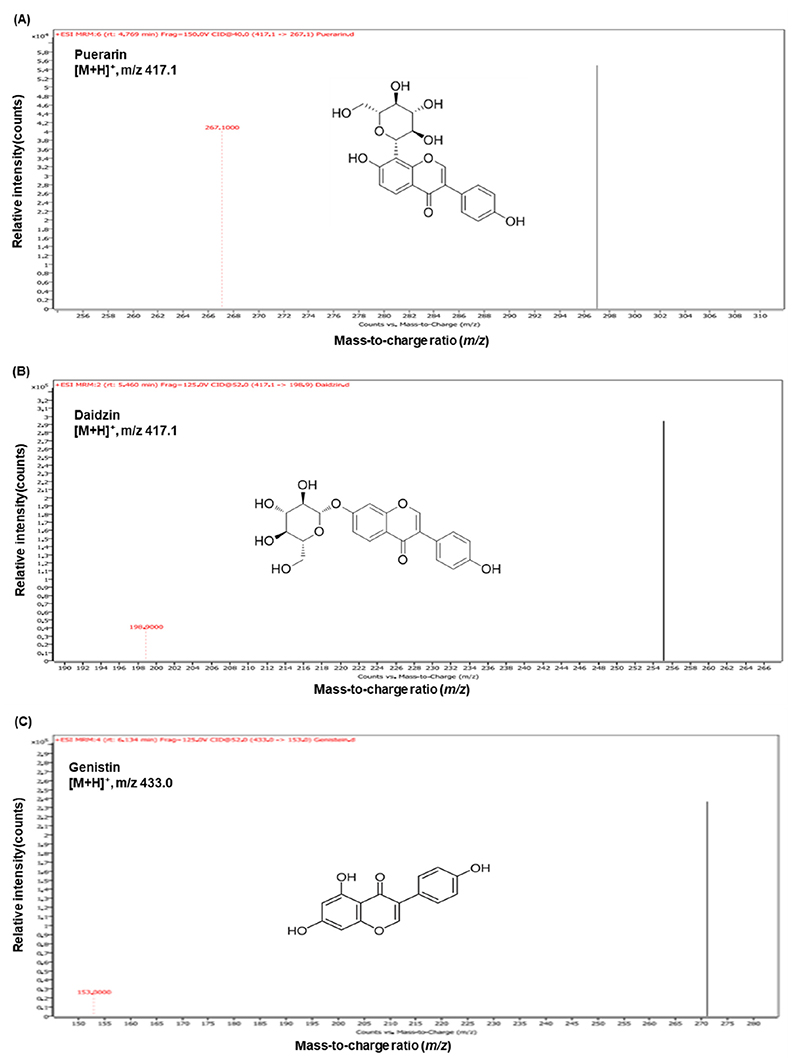
HPLC-MS/MS product ion spectra of marker compounds identified in the PLNV extract. (A) Puerarin (precursor ion [M + H]+, m/z 417.1); (B) daidzin (precursor ion [M + H]+, m/z 417.1); and (C) genistin (precursor ion [M + H]+, m/z 433.0).
2. Effect of PLNV on serum ethanol concentration after acute alcohol administration
Serum ethanol concentrations are shown in Fig. 2. The EtOH group showed significantly higher concentrations than the NC group at all sampling times (p < 0.05). At 1 h, serum ethanol concentrations in the EtOH, PLNV-100, and PLNV-300 groups were 0.14 ± 0.01, 0.13 ± 0.01, and 0.12 ± 0.01%, respectively. At 3 h, the corresponding values were 0.16 ± 0.01, 0.11 ± 0.01, and 0.10 ± 0.01%, respectively. At 5 h, the concentrations were 0.14 ± 0.01, 0.10 ± 0.01, and 0.09 ± 0.01%, respectively. Compared with the EtOH group, the PLNV-300 group showed a significantly lower serum ethanol concentration at 1 h, while both PLNV-100 and PLNV-300 groups showed significantly lower concentrations at 3 and 5 h (p < 0.05).
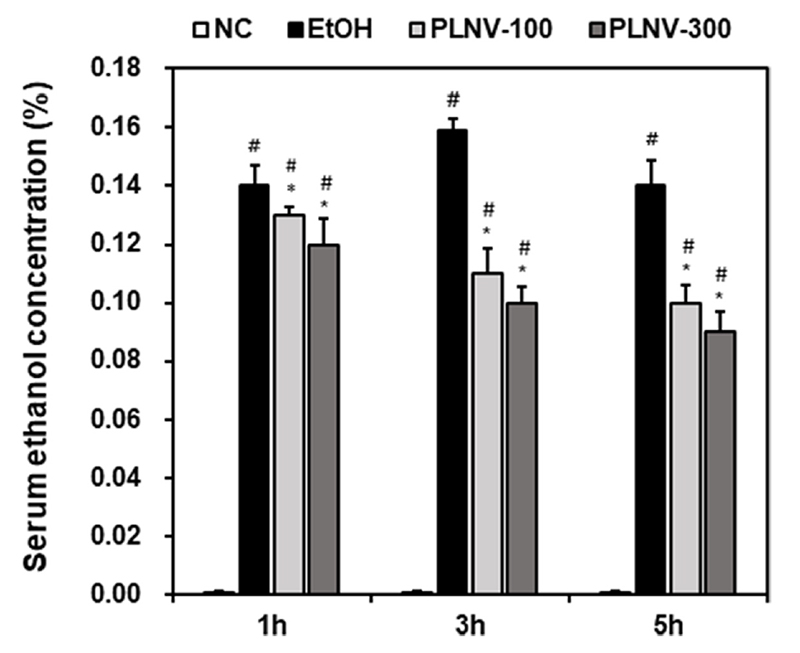
Effects of PLNV on serum ethanol concentrations in acute alcohol-treated rats. Serum ethanol concentrations were measured at 1, 3, and 5 h after alcohol administration. NC, distilled water; EtOH, distilled water + alcohol (3 g/kg); PLNV-100, PLNV (100 mg/kg) + alcohol (3 g/kg); PLNV-300, PLNV (300 mg/kg) + alcohol (3 g/kg). Data are expressed as the mean ± SD (n = 5). Statistical analysis was performed using one-way ANOVA followed by Tukey’s multiple comparison test. #p < 0.05 compared with the NC group; *p < 0.05 compared with the EtOH group.
3. Effect of PLNV on serum acetaldehyde concentration after acute alcohol administration
Serum acetaldehyde concentrations are shown in Fig. 3. The EtOH group showed significantly higher concentrations than the NC group at all sampling times (p < 0.05). At 1 h, the concentrations in the EtOH, PLNV-100, and PLNV-300 groups were 10.90 ± 0.31, 9.66 ± 0.26, and 8.59 ± 0.39 μM, respectively. At 3 h, the corresponding values were 12.16 ± 0.48, 8.59 ± 0.61, and 7.71 ± .63 μM, respectively. At 5 h, the concentrations were 10.01 ± 0.55, 7.54 ± 0.37, and 6.95 ± 0.41 μM, respectively. At each sampling time, both PLNV-treated groups showed significantly lower serum acetaldehyde concentrations than the EtOH group (p < 0.05).
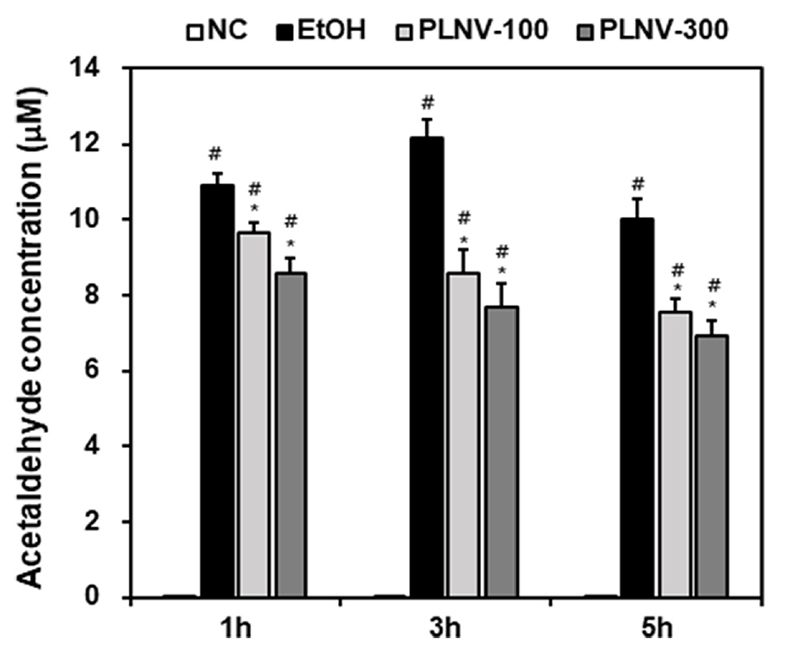
Effects of PLNV on serum acetaldehyde concentrations in acute alcohol-treated rats. Serum acetaldehyde concentrations were measured at 1, 3, and 5 h after alcohol administration. NC, distilled water; EtOH, distilled water + alcohol (3 g/kg); PLNV-100, PLNV (100 mg/kg) + alcohol (3 g/kg); PLNV-300, PLNV (300 mg/kg) + alcohol (3 g/kg). Data are expressed as the mean ± SD (n = 5). Statistical analysis was performed using one-way ANOVA followed by Tukey’s multiple comparison test. #p < 0.05 compared with the NC group; *p < 0.05 compared with the EtOH group.
4. Effect of PLNV on hepatic ADH and ALDH activities after acute alcohol administration
The effects of PLNV on hepatic ADH and ALDH activities are shown in Table 4. Hepatic ADH and ALDH activities were significantly lower in the EtOH group than in the NC group (p < 0.05). Both activities were significantly higher in the PLNV-100 and PLNV-300 groups than in the EtOH group (p < 0.05). ADH activity in both PLNV-treated groups and ALDH activity in the PLNV-100 group remained significantly lower than the corresponding activities in the NC group (p < 0.05), whereas ALDH activity in the PLNV-300 group did not differ significantly from that in the NC group.
Effects of PLNV on hepatic ADH and ALDH activities in acute alcohol-treated rats.
5. Effect of PLNV on serum ALT and AST activities after acute alcohol administration
The effects of PLNV on serum ALT and AST activities are shown in Table 5. Serum ALT and AST activities were significantly higher in the EtOH group than in the NC group (p < 0.05). Both activities were significantly lower in the PLNV-100 and PLNV-300 groups than in the EtOH group (p < 0.05), whereas neither activity differed significantly between the PLNV-treated groups and the NC group.
Effects of PLNV extract on serum ALT and AST activities in acute alcohol-treated rats.
DISCUSSION
In this study, puerarin, daidzin, and genistin were identified and quantified as marker compounds in the dried PLNV extract by HPLC-MS/MS, with contents of 31.18, 82.61, and 128.97 mg/kg, respectively. Genistin was the most abundant among the three compounds, whereas puerarin has been reported as a major isoflavonoid in the roots of P. lobata (Wang et al., 2016; Wang et al., 2021). Differences in isoflavonoid composition among plant parts of P. lobata have been reported previously (Wu et al., 2009; Mun and Mun, 2015), suggesting that the observed profile may reflect differences in plant parts and extraction conditions.
Ethanol is primarily oxidized to acetaldehyde by ADH and subsequently metabolized to acetate by ALDH (Zakhari, 2006; Edenberg, 2007). Serum ethanol concentrations were significantly lower in the PLNV-300 group at 1 h and in both PLNV-treated groups at 3 and 5 h, while serum acetaldehyde concentrations were significantly lower in both PLNV-treated groups at all sampling times. At 5 h, serum ethanol and acetaldehyde concentrations in the PLNV-300 group were approximately 36.5% and 30.6% lower, respectively, than those in the EtOH group. Similar reductions have been reported following administration of other natural products (Kim et al., 2000; Yang, 2010; Sung et al., 2014).
Hepatic ADH and ALDH activities at 24 h were significantly higher in both PLNV-treated groups than in the EtOH group. Similar changes in alcohol-metabolizing enzyme activities have been reported with various natural products (Kim et al., 2002; Lee et al., 2004; Lee et al., 2012; Kim et al., 2018). Although daidzin has been reported to selectively inhibit mitochondrial ALDH (Keung and Vallee, 1993), the present findings were obtained using the whole PLNV extract rather than isolated daidzin. Therefore, the higher hepatic ALDH activity should be interpreted in the context of the overall composition of the extract. Because hepatic ADH and ALDH activities were measured at 24 h, whereas serum ethanol and acetaldehyde concentrations were assessed at 1–5 h, the differences in measurement timing should be considered when interpreting the relationship between these parameters.
Serum ALT and AST activities were significantly lower in the PLNV-treated groups than in the EtOH group. Similarly, aged black garlic has been reported to attenuate alcohol-induced increases in aminotransferase activities in rats (Kim et al., 2011). These findings suggest that PLNV administration attenuated the changes in serum aminotransferase activities following alcohol administration.
Taken together, PLNV administration was associated with lower serum ethanol and acetaldehyde concentrations, higher hepatic ADH and ALDH activities at 24 h, and lower serum ALT and AST activities following alcohol administration. Further studies evaluating these parameters at corresponding time points may help clarify their temporal relationships and the contributions of individual PLNV constituents.
References
- Edenberg HJ. (2007). The genetics of alcohol metabolism: Role of alcohol dehydrogenase and aldehyde dehydrogenase variants. Alcohol Research & Health. 30:5-13.
-
Gu L, Yang Y, Sun Y and Zheng X. (2010). Puerarin inhibits acid-sensing ion channels and protects against neuron death induced by acidosis. Planta Medica. 76:583-588.
[https://doi.org/10.1055/s-0029-1240583]

-
Han JH, Hong M, Khoa HVB, Dung LV, Kwon TH and Lee SU. (2024). Antioxidant and hepatoprotective effects of Kadsura coccinea stem extract against oxidative damage. Korean Journal of Medicinal Crop Science. 32:1-9.
[https://doi.org/10.7783/KJMCS.2024.32.1.1]
-
Hsu FL, Liu IM, Kuo DH, Chen WC, Su HC and Cheng JT. (2003). Antihyperglycemic effect of puerarin in streptozotocin-induced diabetic rats. Journal of Natural Products. 66:788-792.
[https://doi.org/10.1021/np0203887]
-
Hwang YP, Choi CY, Chung YC, Jeon SS and Jeong HG. (2007). Protective effects of puerarin on carbon tetrachloride-induced hepatotoxicity. Archives of Pharmacal Research. 30:1309-1317.
[https://doi.org/10.1007/BF02980272]
-
Keung WM and Vallee BL. (1993). Daidzin: A potent, selective inhibitor of human mitochondrial aldehyde dehydrogenase. Proceedings of the National Academy of Sciences of the United States of America. 90:1247-1251.
[https://doi.org/10.1073/pnas.90.4.1247]
- Kim MH, Chung YT, Lee JH, Park YS, Shin MK, Kim HS, Kim DH and Lee HY. (2000). Hepatic detoxification activity and reduction of serum alcohol concentration of Hovenia dulcis THUNB from Korea and China. Korean Journal of Medicinal Crop Science. 8:225-233.
-
Kim MH, Kim MJ, Lee JH, Han JI, Kim JH, Sok DE and Kim MR. (2011). Hepatoprotective effect of aged black garlic on chronic alcohol-induced liver injury in rats. Journal of Medicinal Food. 14:732-738.
[https://doi.org/10.1089/jmf.2010.1454]
-
Kim MJ, Lee JS, Ha OM, Jang JY and Cho SY. (2002). Effects of Pueraria thunbergiana Bentham water extracts on hepatic alcohol metabolic enzyme system in rats. Journal of the Korean Society of Food Science and Nutrition. 31:92-97.
[https://doi.org/10.3746/jkfn.2002.31.1.092]
- Kim TH, Ahn HY, Kim YW, Sim SY, Seo KI and Cho YS. (2018). Hepatoprotective effect of Bacillus subtilis-fermented silkworm(Bombyx mori L.) extract on an alcoholic fatty liver in rats. Journal of Life Science. 28:697-707.
- Lee SE, Bang JK, An TJ, Yu YJ, Chung HG, Kim GS and Seong NS. (2004). Effect of medicinal plant extracts on alcohol metabolism in rat liver. Korean Journal of Medicinal Crop Science. 12:113-117.
-
Lee SE, Lee JH, Kim GS, Hong YP, Noh HJ, Park CG and Kim SY. (2012). Effect of root extract of Lythrum salicaria L. on liver function of rat acutely administrated with alcohol. Korean Journal of Medicinal Crop Science. 20:345-352.
[https://doi.org/10.7783/KJMCS.2012.20.5.345]
-
Lieber CS. (1994). Alcohol and liver: 1994 update. Gastroenterology. 106:1085-1105.
[https://doi.org/10.1016/0016-5085(94)90772-2]
- Lieber CS. (2003). Relationships between nutrition, alcohol use, and liver disease. Alcohol Research & Health. 27:220-231.
-
Lieber CS. (2005). Metabolism of alcohol. Clinics in Liver Disease. 9:1-35.
[https://doi.org/10.1016/j.cld.2004.10.005]
-
Mun SC and Mun GS. (2015). Dynamics of phytoestrogen, isoflavonoids, and its isolation from stems of Pueraria lobata(Willd.) Ohwi growing in Democratic People's Republic of Korea. Journal of Food and Drug Analysis. 23:538-544.
[https://doi.org/10.1016/j.jfda.2015.04.003]
-
Niiho Y, Yamazaki T, Nakajima Y, Itoh H, Takeshita T, Kinjo J and Nohara T. (1989). Pharmacological studies on Puerariae Flos. I. The effects of Puerariae Flos on alcoholic metabolism and spontaneous movement in mice. Yakugaku Zasshi. 109:424-431.
[https://doi.org/10.1248/yakushi1947.109.6_424]
-
Niiho Y, Yamazaki T, Nakajima Y, Itoh H, Takeshita T, Kinjo J and Nohara T. (1990). Pharmacological studies on Puerariae Flos. II. The effects of Puerariae Flos on alcohol-induced unusual metabolism and experimental liver injury in mice. Yakugaku Zasshi. 110:604-611.
[https://doi.org/10.1248/yakushi1947.110.8_604]
- Park SH. (2011). Studies on the chemical composition and physiological activity of radix Puerariae and young vine of Puerariae. Master Thesis. Wonkwang University. Iksan, Korea. p.1-26.
-
Seo TS, Lee JH, Lim ST, Lee DC, Han JH, Hong M, Choi DH, Lee SY, Lee JH and Yu KH. (2022). Anti-hangover and anti-gout effects of asparagus byproduct extracts. Korean Journal of Medicinal Crop Science. 30:145-152.
[https://doi.org/10.7783/KJMCS.2022.30.2.145]
-
Sung HM, Jung HJ, Yun SK, Kim TY, Kim KM and Wee JH. (2014). Effect of a soy-sprout beverage prepared with high-concentrated oxygen water on alcohol metabolism in rats. Korean Journal of Food Science and Technology. 46:616-621.
[https://doi.org/10.9721/KJFST.2014.46.5.616]
- Tuma DJ and Casey CA. (2003). Dangerous byproducts of alcohol breakdown—focus on adducts. Alcohol Research & Health. 27:285-290.
-
Wang C, Xu N and Cui S. (2021). Comparative transcriptome analysis of roots, stems, and leaves of Pueraria lobata(Willd.) Ohwi: identification of genes involved in isoflavonoid biosynthesis. PeerJ. 9:e10885.
[https://doi.org/10.7717/peerj.10885]
-
Wang X, Fan R, Li J, Li C and Zhang Y. (2016). Molecular cloning and functional characterization of a novel (iso)flavone 4′,7-O-diglucoside glucosyltransferase from Pueraria lobata. Frontiers in Plant Science. 7:387.
[https://doi.org/10.3389/fpls.2016.00387]
- Wu XY, Yang LL, Yang LQ, Zou YM and Lu JM. (2009). Simultaneous RP-HPLC determination of puerarin, daidzin and daidzein in roots, stems and leaves of Pueraria lobata(Wild) Ohwi. Food Science. 30:248-252.
-
Yang ST. (2010). Effects of aged black garlic extract on ethanol induced hangover in rats. Journal of Life Science. 20:225-230.
[https://doi.org/10.5352/JLS.2010.20.2.225]
-
Zakhari S. (2006). Overview: How is alcohol metabolized by the body? Alcohol Research & Health. 29:245-254.
[https://doi.org/10.1159/000095013]