
시호, 개시호, 섬시호의 엽록체 유전체 비교 분석 및 종식별을 위한 고효율 HRM 마커 세트 개발
This is an open access article distributed under the terms of the Creative Commons Attribution Non-Commercial License (http://creativecommons.org/licenses/by-nc/3.0/) which permits unrestricted non-commercial use, distribution, and reproduction in any medium, provided the original work is properly cited.
Abstract
The genus Bupleurum (Apiaceae) includes the medicinal species B. komarovianum, B. longiradiatum, and B. latissimum, which are often misidentified or mixed in herbal markets. Therefore, reliable molecular markers are needed for accurate species discrimination and prevention of adulterations and misuses.
Complete plastid genomes (plastomes) and 45S nuclear ribosomal DNA (nrDNA) sequences of B. longiradiatum and B. latissimum were newly assembled from Illumina MiSeq data using the de novo assembly of low-coverage whole-genome sequencing method and analyzed together with previously reported B. komarovianum sequences for comparative analysis. Further comparative analysis with six additional genomes from GenBank revealed species-specific single nucleotide polymorphisms. Based on these variants, we developed six single-nucleotide polymorphism (SNP) markers and validated them using high-resolution melting (HRM) analysis. The HRM profiles clearly distinguished the three species. Phylogenetic analysis using the maximum likelihood method supported species-level clustering, with B. latissimum forming a genetically distinct clade.
Complete plastomes and nrDNA sequences of three Bupleurum species were assembled, and SNP markers were developed and validated for species discrimination. These markers enable accurate authentication and help prevent adulteration in herbal market.
Keywords:
Bupleurum, Plastid Genome (Plastome), High-Resolution Melting (HRM) Analysis, Phylogenetics, SNP Markers서 언
시호속 (Bupleurum)은 산형과 (Apiaceae)에 속하는 식물로, 전 세계에 고루 분포하며, 특히 유럽과 아시아 대륙에 150여 종이 서식한다 (Neves and Watson, 2004). 국내에는 시호 (Bupleurum komarovianum), 개시호 (B. longiradiatum Turcz.), 섬시호 (B. latissimum Nakai), 등대시호 (B. euphorbioides Nakai), 참시호 (B. scorzonerifolium Willd.) 등의 시호속 식물들이 자생하고 있다 (Lee, 2003). 시호속에 속한 대부분 식물 종은 초본성 다년생이며, 깃 모양으로 분열되지 않은 단엽을 가지고 있다 (Neves and Watson, 2004). 또한 복산형꽃차례 (compound umbels)를 가지고 있으며, 잎맥은 대부분 평행맥 (parallel venation) 형태이다 (Neves and Watson, 2004; Wang et al., 2011).
시호는 주로 아시아 국가에서 오랜 시간 한약재로서 사용되어 왔으며, 해열, 항암, 항염, 항우울, 항산화, 면역 조절 등 다양한 약리활성 기능을 가지고 있는 것으로 알려져 있다 (Ashour et al., 2011; Gevrenova et al., 2015; Yuan et al., 2017; Cholet et al., 2019; Teng et al., 2023). 시호속 식물은 주로 뿌리가 약용 부위로 사용되며, 건조·절단된 형태로 유통된다. 이렇게 가공된 한약재 절편은 형태, 색상, 향기, 조직 등에 기초하여 형태학적으로 감별된다. 그러나 가공된 약재의 형태적 감별은 난도가 높을 뿐만 아니라 근연 분류군 간 오동정 또는 오용의 가능성이 있으므로 과학적 기법을 이용한 정확한 식별이 필요하다. 특히 개시호는 독성이 보고되어 있어 (You et al., 2002) 시호와의 정확한 구별은 약용자원의 안전한 이용 측면에서 중요하다.
엽록체 (색소체: plastid) 유전체는 모계 유전 (maternal inheritance)되며 재조합이 거의 일어나지 않는 보존적인 특성으로 인해 식물의 계통분류 및 종 동정 연구에 널리 활용된다 (Birky, 1995). 엽록체 유전체는 핵 유전체에 비해 느린 진화 속도에도 불구하고, 유전자 및 유전자 간 영역 (intergenic region)에 누적된 염기서열 변이는 종을 구별하는 데 유용한 정보를 제공하여 분자계통학적 분석의 핵심적인 도구로 사용된다 (Wicke et al., 2011; Carbonell-Caballero et al., 2015; Oh et al., 2021). 또한, 핵 유전체에 비해 크기가 매우 작고 모계 유전을 주로 하여 동형으로 1,000개 가까이의 사본 수 (copy number)를 가져 분석이 용이하다는 기술적 이점이 있다 (Daniell et al., 2016; Morley and Nielsen, 2016).
종 또는 개체 간의 유전체 차이는 주로 단일 염기서열 변이인 Single Nucleotide Polymorphism (SNP)과 Insertion/Deletion (Indel)과 같은 작은 염기서열 차이에 기인한다 (Kwok, 2001). 이 중 SNP는 Simple Sequence Repeat (SSR)에 비해 유전체 상에 광범위하게 분포하며, 이를 활용한 마커는 자동화와 고속 처리가 가능한 유전자형 분석 기법에 보다 적합하여 높은 처리량과 낮은 비용의 분석을 가능하게 한다 (Vroh Bi et al., 2006; Khan et al., 2012). 또한 SNP와 Indel은 High Resolution Melting (HRM) 분석에 활용하기에 적합한 마커 유형으로, melting curve의 형태 차이를 통해 유전형 간의 구분이 가능하다. 이 기술은 분자육종 및 종 동정 분야에서 널리 활용되고 있으며 (Lehmensiek et al., 2008; Ahn et al., 2026), 유전적 지도 구축과 같은 유전체 기반 연구에도 적용되고 있다 (Chagné et al., 2008).
본 연구에서는 국내 자생 시호속 식물 가운데 약용 자원으로 이용되는 시호, 독성이 보고되어 시호와의 구별 필요성이 높은 개시호, 그리고 국내에 제한적으로 분포하는 고유·멸종위기 분류군으로서 자원 보전 측면에서 정확한 식별이 필요한 섬시호 (So et al., 2008)를 우선적인 연구 대상으로 선정하였다. 이에 시호, 개시호 및 섬시호의 엽록체 유전체를 비교하여 유전적 차이를 분석하고, 종 간 SNP를 기반으로 HRM 후보 마커를 개발하여 확보된 시료에서 이들 분류군의 식별 가능성을 평가하고자 하였다. 또한 이들 분류군의 엽록체 유전체 지도를 구축하여 시호속 식물의 분자적 식별과 유전자원 연구를 위한 기초자료를 제공하고자 하였다.
재료 및 방법
1. 시료 채집 및 DNA 추출
본 연구의 엽록체 유전체 및 45S nrDNA 염기서열 확보에는 서울대학교 식물유전체육종연구소를 통해 확보한 개시호 및 섬시호 시료를 사용하였으며, 시호의 엽록체 유전체 및 45S nrDNA 서열은 선행 연구에서 확보된 자료를 활용하였다 (Ahn et al., 2026). HRM 마커 검증에는 한국한의학연구원 (Korea Institute of Oriental Medicine, KIOM)에서 제공받은 시호 및 개시호 시료와 한택식물원에서 제공받은 섬시호 시료를 사용하였다. 한택식물원에서 제공받은 섬시호는 종자 번식된 개체들이며, 인공증식증명 (증명번호 제2012-06호)을 받은 자원이었다. 연구에 사용된 식물 및 약재 시료의 대표 사진은 Fig. 1에 제시하였다. 각 시료의 제공기관, 관련 표본 또는 자원번호 및 분석 용도에 관한 정보는 Table 1에 제시하였다.
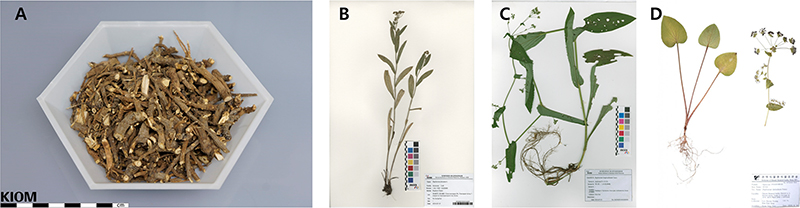
Morphological appearance of Bupleurum species.(A) Bupleurum komarovianum sample 2-19-0425, (B) B. komarovianum, (C) B. longiradiatum, and (D) B. latissimum. Images (A–C) were provided by the Korea Institute of Oriental Medicine (KIOM), and image (D) was provided by Hantaek Botanical Garden.

Information on Bupleurum samples used for sequencing and HRM marker validation.
각 시료의 total genomic DNA는, 표본을 액체질소로 급속 냉각한 후 막자사발로 분쇄하여 준비하였으며, 이후 Plant SV mini kit (GeneAll Biotechnology, Seoul, Korea)를 이용하여 추출하였다. 추출한 DNA의 농도는 NanoDrop ND-1000 (NanoDrop Technologies, Inc., Wilmington, DE, USA)를 이용하여 확인하였다. 다음 실험을 위해 각 샘플의 농도는 5ng/µl로 맞추어 사용하였다.
2. 엽록체 유전체 및 45S nuclear ribosomal DNA (45S nrDNA) assembly와 주석화 (annotation)
개시호, 섬시호의 엽록체 유전체 서열과 45S nrDNA 서열은 Illumina MiSeq platform (Illumina Inc., San Diego, CA, USA)을 사용하여 next generation sequencing (NGS) 데이터를 획득하였다. 이 NGS 정보는 CLC genome assembler program (ver. 4.6 beta, CLC Inc., Aarhus, Denmark)을 기반으로 한 de novo assembly of low-coverage whole-genome sequencing (dnaLCW) 방법을 통해 조립하였으며, 이를 통해 엽록체 유전체 서열과 45S nrDNA 서열을 완성하였다 (Kim et al., 2015; Hong et al., 2017). 시호의 엽록체 유전체 및 45S nrDNA 서열은 선행 연구에서 확보된 자료를 활용하였다 (Ahn et al., 2026).
완성한 엽록체 유전체 서열은 Artemis (Rutherford et al., 2000)을 이용하여 주석화하였고, OGDRAW (https://chlorobox.mpimp-golm.mpg.de/OGDraw.html) (Greiner et al., 2019)을 활용하여 시각화하였다. 추가적으로, NCBI GenBank에 Bupleurum falcatum으로 등록된 2개의 엽록체 유전체 서열 (OR508820.1, KM207676.1)과 개시호 2개 (OR508822.1, OR508823.1), 섬시호 2개 (MT821949.1, KT983258.1)의 엽록체 유전체 서열을 수집하여 염기서열 비교에 사용하였다.
3. 계통수 분석
본 연구의 시호, 섬시호, 개시호 엽록체 유전체 서열 3개와 외군 (outgroup)으로 지정한 인삼 (Panax ginseng)을 포함한 NCBI GenBank (https://www.ncbi.nlm.nih.gov/genbank/)에서 수집한 7개의 엽록체 유전체 서열을 포함하여, 총 10개의 엽록체 유전체 서열을 계통수 분석에 사용하였다. 국내 유래 시호 서열 (PV995370.1)은 Bupleurum komarovianum으로 처리하였으며, GenBank에 B. falcatum으로 등록된 OR508820.1과 KM207676.1은 별도의 분류군으로 구분하여 비교 분석에 포함하였다. 계통분석에서 본 연구의 시호 (B. komarovianum), 섬시호 (B. latissimum) 및 개시호 (B. longiradiatum) 서열은 각각 Bk, Ba 및 Bo로 표기하였으며, GenBank에서 수집한 B. falcatum 서열은 Bf로 구분하여 표기하였다.
총 10개의 엽록체 유전체 서열은 MAFFT v7.0을 사용하여 정렬하였다 (Katoh and Standley, 2013). 정렬된 서열을 기반으로 각 종 간의 유전적 유연관계를 분석하기 위해 최대우도법 (Maximum Likelihood, ML) 기반의 계통수 분석을 수행하였다. 분석에는 RAxML (Randomized Axelerated Maximum Likelihood) 프로그램 (Stamatakis, 2014)을 사용하였으며, 각 분지 (branch)의 신뢰도 평가는 1,000회의 bootstrap 반복 분석을 통해 수행하였다. 계통수의 뿌리 (root)를 명확히 설정하기 위해 NCBI GenBank에서 수집한 인삼 (Panax ginseng) 엽록체 서열 (KM067388.1)을 외군으로 지정하였다. 생성된 계통수는 FigTree v1.4.4 (http://tree.bio.ed.ac.uk/software/figtree/) 프로그램을 사용하여 시각화하였다.
또한, 본 연구의 시호, 섬시호, 개시호 3종의 45S nrDNA 서열과 계통분석의 비교 범위를 확대하기 위해 NCBI GenBank에서 수집한 14종의 Bupleurum 45S nrDNA 서열을 추가하여 계통수 분석을 수행하였다. 계통수의 외군으로는 NCBI GenBank에서 수집한 인삼 (Panax ginseng) 45S nrDNA 서열 (KM036295.1)을 사용하였다. 45S nrDNA 기반 계통수는 엽록체 유전체와 동일한 방식으로 분석하였다.
4. 변이 영역 마커 개발 및 적용
계통수 분석에 사용한 외군을 제외한 총 9개의 엽록체 유전체 서열을 MAFFT로 정렬한 후, BioEdit Sequence Alignment Editor v7.2.5 (Hall, 1999)를 이용하여 정렬 결과를 비교하였다. 약 150 bp 범위 내에서 시호, 개시호 및 섬시호 각각을 나머지 두 종과 구분할 수 있는 SNP가 포함된 영역을 탐색하였으며, 선별된 SNP 영역을 대상으로 NCBI Primer-BLAST 프로그램을 이용하여 프라이머를 설계하였다. PCR 반응은 총 20 μL 반응 용량으로 구성하였으며, 각 시료당 10X Inclone Taq buffer (Inclone Biotech Co, Yongin, South Korea), 2.5 mM deoxynucleotide triphosphates (dNTPs), 10 pmol의 forward/reverse primer 혼합물, 1 unit Taq DNA polymerase, 1 μL의 SYTO 9 Green Fluorescent Nucleic Acid Stains (Invitrogen, Carlsbad, CA, USA), genomic DNA 5 ng를 포함하였다. 나머지 부피는 증류수로 보정하였다.
PCR 및 HRM 분석은 Roche 고해상도 융해 분석 LC96 전용 장비를 이용하여 다음 조건으로 수행되었다. 먼저 95°C에서 6분 간 pre-incubation을 수행한 후, 95°C 20초, 57°C 20초, 72°C 20초 반응을 40 사이클 수행하였다. 증폭 후 HRM 분석은 95°C에서 60초, 65°C에서 1초 처리 후, 95°C에서 1초간 연속 측정 모드 (continuous acquisition)를 통해 melting curve를 획득하였다. HRM 분석은 기술적 3반복으로 수행하였으며, 생성된 melting profile은 LightCycler 96 소프트웨어의 자동 분류 설정을 이용하여 분석하였다. 각 시료는 normalized melting curve의 융해 온도 (Tm) 차이와 곡선 형태 (curve shape)를 기반으로 자동 분류하였으며, 소프트웨어의 기본 설정값인 Delta Tm Discrimination 50% 및 Curve Shape Discrimination 50%를 적용하였다. 이후 구분된 HRM 분류군을 A 또는 B로 명명하였으며, 이를 바탕으로 시호, 개시호 및 섬시호 간 HRM melting profile의 차이를 평가하였다.
결과 및 고찰
1. 시호 및 비교종의 엽록체 유전체 및 45S nrDNA 서열
본 연구에서는 dnaLCW 방법을 활용하여 개시호, 섬시호의 엽록체 유전체 및 45S nrDNA 서열을 조립하였고, 시호 (PV995370.1)는 선행 연구에서 확보된 서열을 활용하였다 (Fig. 2, Table 2). 완성된 엽록체 유전체의 전체 길이는 시호 155,817 bp, 개시호 156,036 bp, 섬시호 155,568 bp로 확인되었으며, 이 중 개시호의 유전체 크기가 가장 큰 것으로 확인되었다.
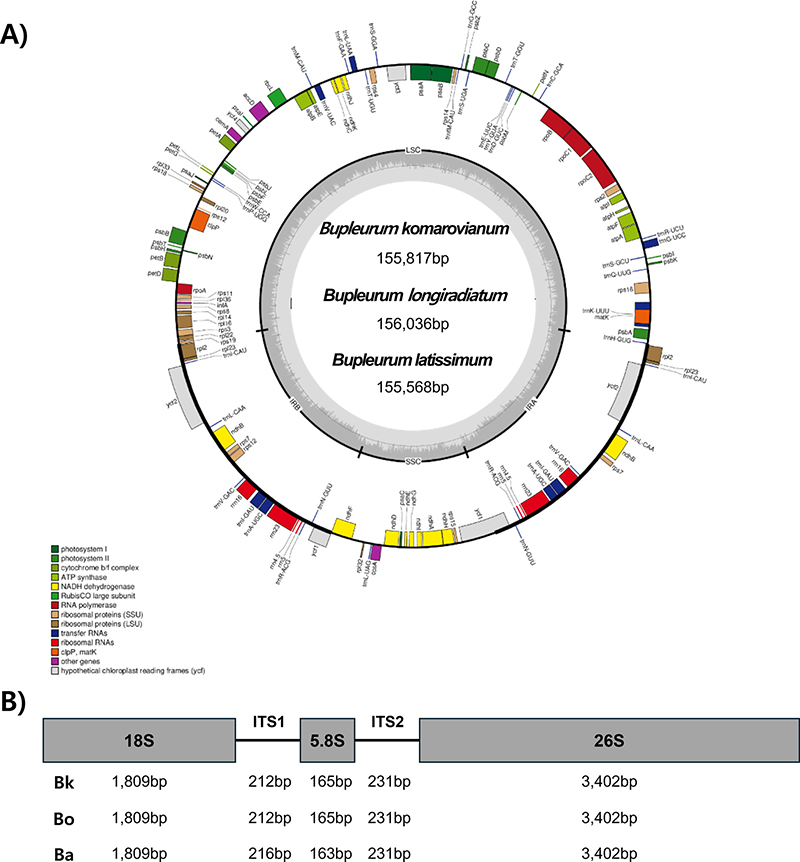
Plastome maps and 45S nuclear ribosomal DNA (nrDNA) structures of three Bupleurum species.(A) Plastome maps of Bupleurum komarovianum (Bk), Bupleurum longiradiatum (Bo), and Bupleurum latissimum (Ba). Colored boxes indicate conserved chloroplast genes categorized by function. Genes located on the inside of the circle are transcribed clockwise, whereas those on the outside are transcribed counterclockwise. (B) Schematic diagrams of the 45S nrDNA structures. The values below each region indicate the nucleotide lengths in base pairs (bp).
Plastome and 45S nrDNA sequence information of Bupleurum species.
각 엽록체 유전체는 공통적으로 Large Single Copy (LSC), Small Single Copy (SSC), 그리고 두 개의 Inverted Repeat (IR) 구간으로 구성되어 있었다 (Fig. 2A). LSC 구간은 85,450–85,869 bp, SSC 구간은 17,500–17,589 bp, IR 구간은 각각 26,285–26,302 bp로, 종 간 영역별 길이 차이는 매우 작았다 (Table 2). 또한, 세 종의 엽록체 유전체는 모두 유사한 GC 함량 (37.65–37.66%)을 나타내었다.
본 연구에서 사용한 시호 엽록체 유전체는 Huang 등 (2021)의 연구에서 보고된 시호 엽록체 유전체 구성과 전반적으로 유사한 구조를 보였다. 또한, Gao 등 (2023)이 보고한 Bupleurum falcatum 엽록체 유전체의 LSC, SSC, IR 영역 길이와 비교했을 때, 각 영역 길이 차이는 22–50 bp 범위로 나타났다. 이러한 결과는 본 연구에서 사용한 엽록체 유전체 서열이 기존에 보고된 Bupleurum 속 엽록체 유전체와 전반적으로 일치하는 구조를 나타냈다.
45S nrDNA의 총 길이는 시호와 개시호에서 5,819 bp, 섬시호에서 5,821 bp로 나타나 2 bp의 차이를 보였다. 세 종의 18S (1,809 bp), ITS2 (231 bp), 26S (3,402 bp) 구간 길이는 동일하였으나, ITS1과 5.8S 구간에서는 길이 변이가 관찰되었다. 구체적으로 섬시호는 시호 및 개시호에 비해 ITS1 구간이 4 bp 더 길었으며 (각각 216 bp와 212 bp), 5.8S 구간은 2 bp 더 짧았다 (각각 163 bp와 165 bp). 이러한 구간별 길이 변이가 종 간 총 길이의 차이를 야기한 것으로 나타났다.
2. 시호 및 비교종의 엽록체 유전체 서열 및 45S nrDNA 서열 비교와 계통수 분석
시호, 섬시호, 개시호를 포함한 총 9개의 엽록체 유전체 서열을 MAFFT로 정렬한 결과, 종간 비교에서 최대 511개의 SNP가 관찰되었다 (Table 3). 종 간 비교에서는 섬시호와 개시호 사이에서 가장 많은 SNP가 확인되었으며, 시호와 개시호 사이에서는 가장 적은 SNP가 확인되었다. 한편, 동일 종 내 개체 간 비교에서 확인된 SNP 및 Indel 수는 섬시호에서 0–12개, 개시호에서 27–238개로 나타났다 (Table 3). Bk, Bf_1 및 Bf_2의 상호 비교에서는 23–179개의 SNP 차이가 확인되었으며, Bf_1과 Bf_2 사이에 비해 Bk와 Bf_1 및 Bf_2 사이에서 상대적으로 많은 SNP가 관찰되었다.
Plastome variation among three Bupleurum species.
이러한 서열 기반 비교 분석을 바탕으로, 외군을 포함한 총 10개의 엽록체 유전체 서열과 45S nrDNA에 대해 각각 최대우도법 (Maximum Likelihood)을 적용한 계통수 분석을 수행하였다 (Fig. 3, Fig. 4). 엽록체 유전체 기반 계통수에서 개시호 (Bo, Bo_1, Bo_2)와 섬시호 (Ba, Ba_1, Ba_2)는 각각 종별로 뚜렷한 군집을 형성하였다. 특히 섬시호는 다른 비교 서열들과 명확히 구분되는 계통군을 형성하였으며, 이는 엽록체 유전체 SNP 분석에서 관찰된 종간 변이 패턴과도 일관되었다. 이러한 결과는 완전한 엽록체 유전체를 기반으로 한 기존 계통 연구에서 B. latissimum이 다른 Bupleurum 종들과 구분되는 계통적 위치를 보인 기존 연구 결과와 대체로 일치하였다 (Li et al., 2020; Huang et al., 2021). 반면, 시호 관련 서열의 계통적 관계에서는 본 연구의 Bk와 GenBank에 B. falcatum으로 등록된 Bf_1 및 Bf_2가 서로 다른 위치를 나타냈으며, 이는 SNP 비교에서 확인된 서열 차이와도 일관되었다. B. komarovianum과 B. falcatum은 형태적·분류학적으로 밀접한 분류군으로, 과거 문헌에서 서로 다르게 분류학적으로 처리되어 온 이력이 있으며 (Pimenov, 2017), B. falcatum 내에서도 지역 집단에 따른 유전적 변이가 보고되어 있다 (Wang et al., 2008). 이러한 기존 보고를 고려하면, 본 연구에서 확인된 Bk와 Bf 서열 간의 차이는 두 분류군의 분류학적 관계와 지역 집단 간 유전적 차이를 함께 고려하여 해석할 필요가 있다.
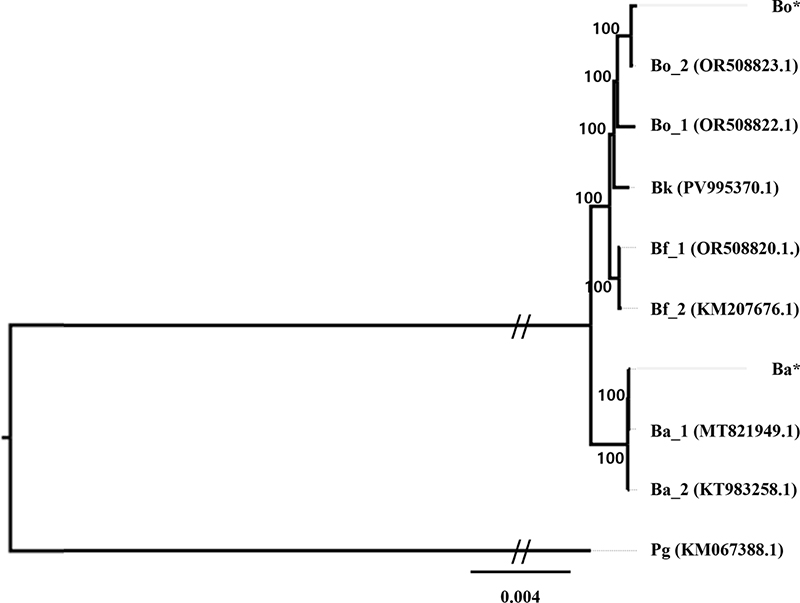
Phylogenetic tree of Bupleurum species based on complete plastome sequences.Maximum likelihood (ML) trees were constructed based on complete plastome sequences of Bupleurum species using RAxML (Stamatakis, 2014) under the GTRGAMMA model. Bootstrap support values based on 1,000 replicates are indicated at each node. Panax ginseng was used as an outgroup. Bk: Bupleurum komarovianum; Bf: Bupleurum falcatum; Bo: Bupleurum longiradiatum; Ba: Bupleurum latissimum. NCBI accession numbers are shown in parentheses. Samples marked with an asterisk were newly sequenced in this study.
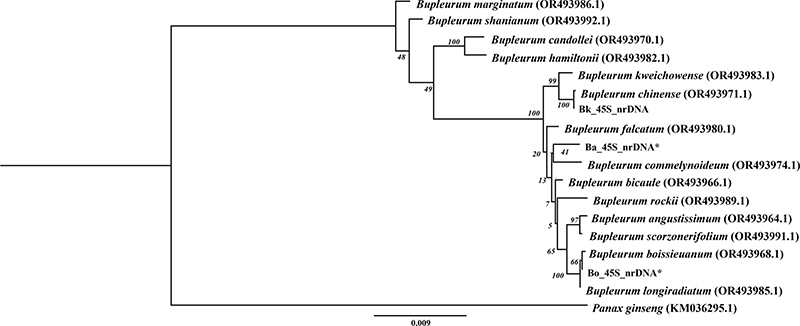
Phylogenetic tree of Bupleurum species based on 45S nrDNA sequences.Maximum likelihood (ML) analysis was performed based on 45S nrDNA sequences of Bupleurum species using RAxML (Stamatakis, 2014) under the GTRGAMMA model. Bootstrap support values based on 1,000 replicates are indicated at each node. Publicly available Bupleurum 45S nrDNA sequences were retrieved from NCBI GenBank, and Panax ginseng was used as an outgroup. NCBI accession numbers are shown in parentheses. Bk: Bupleurum komarovianum; Bo: Bupleurum longiradiatum; Ba: Bupleurum latissimum. Samples marked with an asterisk were newly sequenced in this study.
45S nrDNA 기반 계통수에서도 본 연구 시료들의 계통학적 배치 양상이 확인되었으나, 일부 내부 분기점의 bootstrap 지지도가 낮아 세부적인 계통 관계를 명확하게 해석하기에는 제한이 있었다 (Fig. 4). 또한 본 연구에서는 dnaLCW 데이터를 바탕으로 다수결 원칙 (majority-rule)에 기반한 단일 45S nrDNA consensus 서열을 추출하여 분석에 사용하였다. 따라서 소수 copy로 존재하는 개체 내 미세 서열 다양성은 consensus 형성 과정에서 병합되어 충분히 반영되지 않았을 가능성이 있으며, 향후 계통학적 해석에서는 이러한 기술적 한계를 고려할 필요가 있다. 따라서 45S nrDNA 분석 결과는 엽록체 유전체 기반 계통수에서 관찰된 경향과 유사한 양상을 보였으나, 계통 관계를 독립적으로 뒷받침하는 근거로 해석하기에는 제한적이었다.
종합적으로, 본 연구의 엽록체 유전체 서열 비교와 계통수 분석 결과는 섬시호가 시호 및 개시호와 유전적으로 구분되는 양상을 보여주었다. 또한 종 간에 확인된 엽록체 SNP 차이는 세 분류군을 구분하기 위한 후보 마커 영역을 선별하는 근거로 활용되었다.
3. HRM 분석을 이용한 시호 및 비교종 식별
시호, 개시호, 섬시호의 엽록체 유전체는 높은 서열 유사성을 보였으며, 전체 염기서열 비교 결과 10 bp 미만의 Indel은 존재했지만, 마커 설계에 활용 가능한 뚜렷한 Indel은 확인되지 않았다. 이에 따라 본 연구에서는 세 분류군 간 구분에 활용 가능한 SNP 영역을 선별하여, 이를 기반으로 총 6개의 High Resolution Melting (HRM) 기반 SNP 마커를 개발하였다 (Table 4). 각 마커는 세 분류군 간 구분에 활용될 수 있도록 엽록체 내 보존된 유전자 부위에서 확인된 SNP를 기반으로 설계되었으며, melting temperature (Tm), GC 함량, primer 간 dimer 형성 가능성 등을 고려하였다. 증폭 산물의 길이는 HRM 분석의 민감도를 높이기 위해 150 bp 이내로 제한하였다.
Species-specific molecular markers derived from plastome variations among Bupleurum species.
각 마커에 대한 HRM 분석 결과는 Fig. 5에 melting curve 형태로 제시하였다. 분석 결과, 시호 식별 후보 마커 (Fig. 5A, 5B)에서는 시호가 섬시호와 개시호보다 낮은 융해 온도를 보여 명확히 구별되었고, 섬시호 (Fig. 5C, 5D)와 개시호 (Fig. 5E, 5F)를 대상으로 설계한 후보 마커에서도 각각 구분되는 melting curve가 관찰되어, 분석에 사용된 시료에서 세 분류군을 구별할 수 있었다. 각 마커를 실제 시료에 적용하여 유전형을 분석하였다 (Table 5). 이러한 결과는 본 연구에서 분석한 시료에서 시호, 섬시호 및 개시호의 구분 가능성을 보여주며, 보다 다양한 지역 및 개체를 대상으로 한 추가 검증을 통해 종 식별을 위한 마커로서의 적용 가능성을 확장할 수 있을 것으로 판단된다.
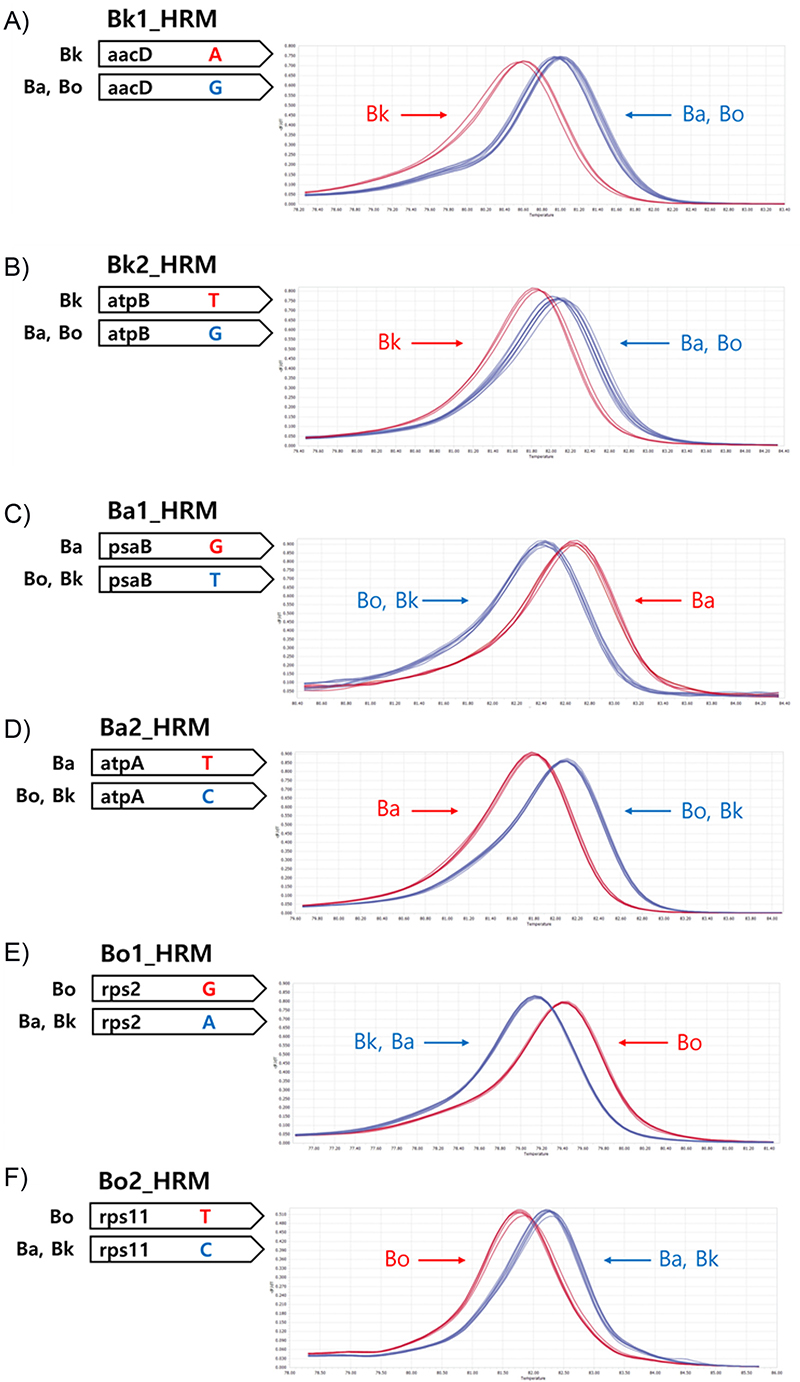
High-resolution melting (HRM) analysis of Bupleurum species using species-specific SNP markers.HRM curve profiles for distinguishing Bupleurum species using six SNP markers targeting species-specific gene regions. (A); Bk1_HRM, (B); Bk2_HRM, (C); Ba1_HRM, (D); Ba2_HRM, (E); Bo1_HRM, (F); Bo2_HRM. Red and blue lines represent distinct, species-specific melting profiles generated from each SNP marker.
HRM-based genotyping results of Bupleurum species using six chloroplast-derived SNP markers.
본 연구에서 분석한 세 분류군의 엽록체 유전체는 전반적으로 높은 서열 유사성을 보였음에도, 선별된 SNP를 포함하는 짧은 증폭 구간에서는 분류군에 따라 서로 다른 melting profile이 확인되었다. 이는 유전적으로 근연한 분류군에서도 종 간 차이를 나타내는 SNP를 선별하여 HRM 분석에 적용함으로써 분류군 간 차이를 확인할 수 있음을 보여준다. 또한 HRM 분석은 선별된 SNP 영역의 염기서열을 개별적으로 분석하지 않고도 melting profile의 차이를 통해 유전형을 비교할 수 있다는 점에서, 종 간 SNP 차이를 확인하기 위한 방법으로 활용될 수 있다.
기존 분류 연구는 형태 형질 (So et al., 2008)과 ITS 서열 기반 계통 분석 (Neves and Watson, 2004)이 주를 이루었고, ITS 영역을 활용한 PCR 표지도 보고되었으나 시호, 섬시호 및 개시호의 식별을 위한 HRM 기반 마커 연구는 보고되지 않았다. 한편 엽록체 유전체 기반 표지도 제안되었지만 (Zhang et al., 2022; National Institute for Korean Medicine Development, 2023), 개시호가 대상에 포함되지 않거나 HRM 분석이 적용되지 않았다. 본 연구에서는 종별 SNP를 기반으로 총 6개의 HRM 후보 마커를 개발하고, 개별 HRM 분석을 통해 세 분류군의 식별 가능성을 평가하였다.
또한 각 종에 대해 서로 다른 SNP 부위를 기반으로 2개의 HRM 마커를 설계하여, 단일 마커에서 식별이 어려운 경우 상호 보완적으로 활용할 수 있도록 하였다. 이를 통해 서로 다른 SNP 부위에서 얻어진 종 판별 결과를 함께 비교할 수 있어, 단일 마커에 의한 판정 결과를 보완할 수 있다.
본 연구에서는 시호, 개시호 및 섬시호 시료를 대상으로 개발한 HRM 후보 마커의 종 간 식별 가능성을 확인하였다. 향후 보다 다양한 지역에서 충분한 수의 시료를 확보하고, 등대시호와 참시호를 비롯한 다른 국내 자생종과 국내에서 재배 또는 수입되는 Bupleurum 분류군까지 검증 범위를 확대한다면, 개발된 HRM 후보 마커의 식별 성능과 적용 범위를 보다 폭넓게 평가할 수 있을 것으로 판단된다. 또한 건조 뿌리, 절편, 분말 등 다양한 가공 및 유통 형태의 약재 시료에 대한 추가 검증은 실제 약재 유통 환경에서의 적용 가능성을 평가하고 활용 범위를 더욱 확장하는 데 기여할 수 있을 것이다.
본 연구에서 개발한 HRM 후보 마커는 시호속 식물의 분자적 식별을 위한 기초자료로 활용될 수 있으며, 향후 추가적인 시료 및 적용성 검증을 통해 실제 약재 유통 과정에서의 종 식별과 혼·오용 방지를 위한 활용 가능성을 확장할 수 있을 것으로 기대된다.
Acknowledgments
본 연구는 보건복지부의 재원으로 한국보건산업진흥원의 보건의료기술연구개발사업(과제번호: HI23C1420) 지원에 의하여 이루어진 결과로 이에 감사드립니다.
References
-
Ahn JY, Park JY, Park HS, Lee JH, Kim SK, Kim YJ, Lee YS and Yang TJ. (2026). Development of plastome-based HRM markers for the authentication of 12 major medicinal herbs in the Apiaceae family. Scientific Reports. 16:17548.
[https://doi.org/10.1038/s41598-026-47346-4]

-
Ashour ML and Wink M. (2011). Genus Bupleurum: A review of its phytochemistry, pharmacology and modes of action. Journal of Pharmacy and Pharmacology. 65:305-312.
[https://doi.org/10.1111/j.2042-7158.2010.01170.x]
-
Carbonell-Caballero J, Alonso R, Ibañez V, Terol J, Talon M and Dopazo J. (2015). Phylogenetic analysis of 34 chloroplast genomes elucidates the relationships between wild and domestic species within the genus Citrus. Molecular Biology and Evolution. 32:2015-2035.
[https://doi.org/10.1093/molbev/msv082]
-
Chagné D, Gasic K, Crowhurst RN, Han Y, Bassett HC, Bowatte DR, Lawrence TJ, Rikkerink EHA, Gardiner SE and Korban SS. (2008). Development of a set of SNP markers present in expressed genes of the apple. Genomics. 92:353-358.
[https://doi.org/10.1016/j.ygeno.2008.07.008]
-
Cholet J, Decombat C, Vareille Delarbre M, Gainche M, Berry A, Senejoux F, Ripoche I, Delort L, Vermerie M, Fraisse D, Felgines C, Ranouille E, Berthon JY, Priam J, Saunier E, Tourrette A, Troin Y, Thebaud G, Chalard P and Caldefie Chezet F. (2019). In vitro anti-inflammatory and immunomodulatory activities of an extract from the roots of Bupleurum rotundifolium. Medicines. 6:101.
[https://doi.org/10.3390/medicines6040101]
-
Daniell H, Lin CS, Yu M and Chang WJ. (2016). Chloroplast genomes: Diversity, evolution, and applications in genetic engineering. Genome Biology. 17:134.
[https://doi.org/10.1186/s13059-016-1004-2]
-
Gao M, Huo X, Lu L, Liu M and Zhang G. (2023). Analysis of codon usage patterns in Bupleurum falcatum chloroplast genome. Chinese Herbal Medicines. 15:284-290.
[https://doi.org/10.1016/j.chmed.2022.08.007]
-
Gevrenova R, Kondeva-Burdina M, Denkov N and Zheleva - Dimitrova D. (2015). Flavonoid profiles of three Bupleurum species and in vitro hepatoprotective activity of Bupleurum flavum Forsk. Pharmacognosy Magazine. 11:14-23.
[https://doi.org/10.4103/0973-1296.149680]
-
Greiner S, Lehwark P and Bock R. (2019). OrganellarGenome DRAW (OGDRAW) version 1.3.1: Expanded toolkit for the graphical visualization of organellar genomes. Nucleic Acids Research. 47:W59-W64.
[https://doi.org/10.1093/nar/gkz238]
- Hall TA. (1999). BioEdit: A user-friendly biological sequence alignment editor and analysis program for Windows 95/98/NT. Nucleic Acids Symposium Series. 41:95-98.
-
Hong SY, Cheon KS, Yoo KO, Lee HO, Cho KS, Suh JT, Kim SJ, Nam JH, Sohn HB and Kim YH. (2017). Complete Chloroplast Genome Sequences and Comparative Analysis of Chenopodium quinoa and C. album. Frontiers in Plant Science. 8:1696.
[https://doi.org/10.3389/fpls.2017.01696]
-
Huang R, Xie X, Chen A, Li F, Tian E and Chao Z. (2021). The chloroplast genomes of four Bupleurum(Apiaceae) species endemic to Southwestern China, a diversity center of the genus, as well as their evolutionary implications and phylogenetic inferences. BMC Genomics. 22:714.
[https://doi.org/10.1186/s12864-021-08008-z]
-
Katoh K and Standley DM. (2013). MAFFT multiple sequence alignment software version 7: Improvements in performance and usability. Molecular Biology and Evolution. 30:772-780.
[https://doi.org/10.1093/molbev/mst010]
-
Khan MA, Han Y, Zhao YF and Korban SS. (2012). A high-throughput apple SNP genotyping platform using the Golden GateTM assay. Gene. 494:196-201.
[https://doi.org/10.1016/j.gene.2011.12.001]
-
Kim K, Lee SC, Lee J, Yu Y, Yang K, Choi BS, Koh HJ, Waminal NE, Choi HI, Kim NH, Jang W, Park HS, Lee J, Lee HO, Joh HJ, Lee HJ, Park JY, Perumal S, Jayakodi M, Lee YS, Kim B, Copetti D, Kim S, Kim S, Lim KB, Kim YD, Lee J, Cho KS, Park BS, Wing RA and Yang TJ. (2015). Complete chloroplast and ribosomal sequences for 30 accessions elucidate evolution of Oryza AA genome species. Scientific Reports. 5:15655.
[https://doi.org/10.1038/srep15655]
-
Kwok PY. (2001). Methods for genotyping single nucleotide polymorphisms. Annual Review of Genomics and Human Genetics. 2:235-258.
[https://doi.org/10.1146/annurev.genom.2.1.235]
- Lee TB. (2003). Coloured Illustrated Flora of Korea. Hyangmunsa. Seoul, Korea. p.831.
-
Lehmensiek A, Sutherland MW and McNamara RB. (2008). The use of high resolution melting(HRM) to map single nucleotide polymorphism markers linked to a covered smut resistance gene in barley. Theoretical and Applied Genetics. 117:721-728.
[https://doi.org/10.1007/s00122-008-0813-4]
-
Li J, Xie DF, Guo XL, Zheng ZY, He XJ and Zhou SD. (2020). Comparative analysis of the complete plastid genome of five Bupleurum species and new insights into DNA barcoding and phylogenetic relationship. Plants. 9:543.
[https://doi.org/10.3390/plants9040543]
-
Morley SA and Nielsen BL. (2016). Chloroplast DNA copy number changes during plant development in organelle DNA polymerase mutants. Frontiers in Plant Science. 7:57.
[https://doi.org/10.3389/fpls.2016.00057]
- National Institute for Korean Medicine Development. (2023). Marker derived from complete sequencing of chloroplast genome of Bupleurum genus, primer set for discrimination of Bupleurum genus and uses thereof. Korea. Patent. 10-2604105.
-
Neves SS and Watson MF. (2004). Phylogenetic relationships in Bupleurum(Apiaceae) based on nuclear ribosomal DNA ITS sequence data. Annals of Botany. 93:379-398.
[https://doi.org/10.1093/aob/mch052]
-
Oh SD, Lee SK, Yun DW, Sun HJ, Kang HG, Lee HY, Xi H, Park J and Lee B. (2021). The complete chloroplast genome of Zoysia macrostachya Franch. & Sav. isolated in Korea: Insights into intraspecific variations and species delimitation of the Zoysia species. Korean Journal of Plant Taxonomy. 51:326-331.
[https://doi.org/10.11110/kjpt.2021.51.3.326]
-
Pimenov MG. (2017). Updated checklist of Chinese Umbelliferae: Nomenclature, synonymy, typification, distribution. Turczaninowia. 20:106-239.
[https://doi.org/10.14258/turczaninowia.20.2.9]
-
Rutherford K, Parkhill J, Crook J, Horsnell T, Rice P, Rajandream MA and Barrell B. (2000). Artemis: Sequence visualization and annotation. Bioinformatics. 16:944-945.
[https://doi.org/10.1093/bioinformatics/16.10.944]
-
Stamatakis A. (2014). RAxML version 8: A tool for phylogenetic analysis and post-analysis of large phylogenies. Bioinformatics. 30:1312-1313.
[https://doi.org/10.1093/bioinformatics/btu033]
-
So SK, Park HR, Seo EK, Han KS, Kim MY and Park KR. (2008). Numerical taxonomic analyses of Bupleurum latissimum (Apiaceae). Korean Journal of Plant Taxonomy. 38:31-42.
[https://doi.org/10.11110/kjpt.2008.38.1.031]
-
Teng L, Guo X, Ma Y, Xu L, Wei J and Xiao P. (2023). A comprehensive review on traditional and modern research of the genus Bupleurum(Bupleurum L., Apiaceae) in recent 10 years. Journal of Ethnopharmacology. 306:116129.
[https://doi.org/10.1016/j.jep.2022.116129]
-
Vroh Bi I, McMullen MD, Sanchez-Villeda H, Schroeder S, Gardiner J, Polacco M, Soderlund C, Wing R, Fang Z and Coe EH. (2006). Single nucleotide polymorphisms and insertion–deletions for genetic markers and anchoring the maize fingerprint contig physical map. Crop Science. 46:12-21.
[https://doi.org/10.2135/cropsci2004.0706]
-
Wang CB, Ma XG and He XJ. (2011). A taxonomic reassessment in the Chinese Bupleurum(Apiaceae): Insights from morphology, nuclear ribosomal internal transcribed spacer, and chloroplast (trnH–psbA, matK) sequences. Journal of Systematics and Evolution. 49:558-589.
[https://doi.org/10.1111/j.1759-6831.2011.00157.x]
- Wang QZ, Zhou SD, Liu TY, Pang YL, Wu YK and He XJ. (2008). Phylogeny and classification of Chinese Bupleurum based on nuclear ribosomal DNA internal transcribed spacer and rps16. Acta Biologica Cracoviensia Series Botanica. 50: 105-116.
-
Wicke S, Schneeweiss GM, dePamphilis CW, Müller KF and Quandt D. (2011). The evolution of the plastid chromosome in land plants: Gene content, gene order, gene function. Plant Molecular Biology. 76:273-297.
[https://doi.org/10.1007/s11103-011-9762-4]
-
You YJ, Lee IS, Kim Y, Bae KH and Ahn BZ. (2002). Antiangiogenic activity of Bupleurum longiradiatum on human umbilical venous endothelial cells. Archives of Pharmacal Research. 25:640-642.
[https://doi.org/10.1007/BF02976936]
-
Yuan B, Yang Y, Ma Y, Zhou S, Zhang X and Liu Y. (2017). A systematic review of the active saikosaponins and extracts isolated from Radix Bupleuri and their applications. Pharmaceutical Biology. 55:620-635.
[https://doi.org/10.1080/13880209.2016.1262433]
-
Zhang G, Wang H, Shi L, Liu Y, Yao R, Sui C, Yang C, Ji H, Wang Q and Wei J. (2022). Identification of the original plants of cultivated Bupleuri Radix based on DNA barcoding and chloroplast genome analysis. PeerJ. 10:e13208.
[https://doi.org/10.7717/peerj.13208]