
삽주 신품종 ‘위풍’의 지역별 수량성, 역병 저항성 및 품질 특성
This is an open access article distributed under the terms of the Creative Commons Attribution Non-Commercial License (http://creativecommons.org/licenses/by-nc/3.0/) which permits unrestricted non-commercial use, distribution, and reproduction in any medium, provided the original work is properly cited.
Abstract
Atractylodes japonica is a medicinal crop used to produce Atractylodis Rhizoma. This study evaluated the agronomic, yield, disease resistance, and quality characteristics of the new cultivar ‘Wipung.’
‘Wipung’ was compared with the control cultivar ‘Wigang’ at three locations. ‘Wipung’ had an erect growth habit, greater plant height and stem diameter, and fewer stems. Dried rhizome yield was significantly affected by location and the cultivar × location interaction, with ‘Wipung’ showing a significantly higher yield only at Cheorwon. No symptoms were observed in either cultivar after inoculation with Phytophthora sansomeana, whereas the susceptible reference species showed approximately 85% disease incidence. Atractylenolide Ⅰ and Ⅲ contents were significantly higher in ‘Wipung,’ and the sum of the four analyzed compounds was approximately 1.42 times that in ‘Wigang.’
‘Wipung’ exhibited distinct morphological and quality characteristics and was resistant to the tested P. sansomeana isolate, although its yield performance varied among locations.
Keywords:
Active Ingredient Content, Agronomic Characteristics, Atractylodes japonica, Atractylodis Rhizoma, Phytophthora Root Rot서 언
삽주 (Atractylodis Rhizoma)는 동아시아에서 널리 이용되는 대표적인 약용작물로 (Park et al., 2000; Zhang et al., 2023), 대한민국약전 의약품각조 제2부에는 삽주 (Atractylodes japonica Koidzumi)의 뿌리줄기로서 그대로 또는 주피를 제거한 것을 한약재 ‘백출’로 사용한다고 명시되어 있다 (MFDS, 2024).
삽주 재배에서 가장 큰 제약 요인은 토양전염성 병원균인 역병으로, 타 작물에서도 감염 시 지상부 위조 및 고사를 유발하고 근경 부패로 이어져 심각한 수량 감소를 초래하는 것으로 보고되고 있다 (An et al., 2019; Han et al., 2025).
역병은 난균류 (Oomycetes)에 속하는 Phytophthora spp.에 의해 유발되는 대표적인 식물병으로, 현재까지 약 200종 이상의 종이 보고되어 있다 (Clement et al., 2025). 이러한 Phytophthora spp.는 다양한 작물에서 심각한 피해를 유발하며, 삽주에서도 주요 병해로 보고되고 있다. 삽주에서 A. japonica를 대상으로 한 역병의 원인 병원균 보고는 부족하지만, A. macrocephala에서는 Phytophthora sansomeana (An et al., 2019)와 P. drechsleri (Cho et al., 2002) 등이 병원균으로 보고된 바 있다. 또한, 역병은 토양 수분이 많고 따뜻한 조건하에서 폭우가 내린 후 발생하는데 이는 난포자 발아에 최적 조건이기 때문이다 (Giachero et al., 2022).
이와 같이 역병 원인 병원균의 다양성과 환경 의존적 발병 특성은 발병의 예측을 어렵게 하고, 효과적인 방제 전략 수립에 주요한 제약 요인으로 작용한다.
또한 삽주는 재배 환경에 따른 생육 및 수량 변동성이 큰 작물로, 동일 계통에서도 재배 지역 및 연차에 따라 근경 수량이 크게 달라지는 특성을 보인다 (Park et al., 2004). 이러한 불안정성은 대규모 재배 및 산업적 원료 공급 체계 구축에 중요한 제약 요인으로 작용한다. 더불어 주요 유효성분인 sesquiterpenoid 화합물의 함량 또한 환경 요인에 따라 크게 변동하는 것으로 보고되어 있으며 (Kim, 2021; Guo et al., 2022), 이는 약용 원료로서 요구되는 품질의 균일성 확보를 어렵게 한다.
삽주는 위장 기능 개선, 면역 조절 및 항염 작용 등 다양한 약리 효과를 나타내는 것으로 알려져 있다 (Oh, 2021; Singh et al., 2024). 이러한 약리 활성은 atractylenolide Ⅰ, Ⅱ, Ⅲ, atractylon 및 β-eudesmol과 같은 sesquiterpenoid 계열의 유효성분에 기인하며, 암세포 및 종양 억제 효과 (Acharya et al., 2021), 항염 (Gao et al., 2025), 항산화 (Bailly, 2021), 면역 조절 (Cheng et al., 2016), 간보호 (Wang et al., 2012), 항균 및 위장관 운동 조절 효과 (Wang et al., 2010)를 나타내는 것으로 보고되고 있다. 최근에는 위장 기능 개선 및 소화기 질환 완화 (Kimura and Sumiyoshi, 2012)뿐만 아니라, 염증성 질환 조절, 대사질환 및 면역 관련 기능성 소재로서의 활용 가능성이 제시되면서 삽주의 의약품·건강기능성 식품 원료로서의 산업적 가치가 더욱 확대되고 있다 (Hong et al., 2010; Singh et al., 2024).
이러한 산업적 가치 확대에 따라 삽주의 재배면적은 2010년 이후 2017년까지 꾸준히 증가하였으나, 최근 중국산 수입 증가에 따른 가격 경쟁력 약화 (MAFRA, 2025)와 병해 발생 (Fan et al., 2024) 등의 요인이 복합적으로 작용하여 재배면적이 감소하는 추세를 보여, 이에 따라 역병 저항성, 수량성 및 유효성분 함량을 동시에 개선한 삽주 품종 개발이 요구된다.
본 연구에서는 삽주 신품종 ‘위풍’의 형태적 특성, 지역별 수량 반응, P. sansomeana 접종 조건에서의 저항성 및 주요 sesquiterpenoid 성분 함량을 대조품종 ‘위강’과 비교하여 품종의 농업적·품질적 특성을 평가하고자 하였다.
재료 및 방법
1. 시험재료
본 시험은 삽주 (Atractylodes japonica Koidzumi) 신품종 ‘위풍’을 대상으로 수행하였으며, 대조품종으로 기존에 개발된 ‘위강’ (Jeong et al., 2025)을 사용하였다. 역병 저항성 평가에서는 저항성 품종인 ‘위강’을 대조품종으로, 대한민국약전에서 A. japonica와 함께 백출의 기원식물로 규정된 큰꽃삽주 (Atractylodes macrocephala Koidz.) 재래종을 감수성 참조종 (reference species)으로 사용하였다. 식물 학명과 생약명인 Atractylodis Rhizoma는 구분하여 표기하였다.
2. 재배 방법
실험은 충청북도 음성군 소이면 비산리에 위치한 농촌진흥청 국립원예특작과학원 인삼특작부의 재배 시험포에서 2022년에 삽주 종근을 정식하여 2023년까지 재배하였고, 이 기간 동안 수확 및 평가에 사용하였다. 시비량은 질소, 인산, 칼륨을 7 : 4 : 3 ㎏/10a로 하였고 유기물 공급을 위해 퇴비 2,000 ㎏/10a를 전량 기비로 시용하였다. 3월에 수확한 2년생 뿌리줄기를 절단하여 20 g 정도의 종근을 사용하였고, 4월 하순에 흑색 비닐로 멀칭된 두둑에 주간 30 ㎝, 조간 15 ㎝ 간격으로 눈을 위로 향하도록 정식하였다. 시험구는 난괴법 3 반복으로 하였고 각 반복에 100개체씩 식재하였다.
시험포의 토양 화학적 특성은 농촌진흥청 토양화학 분석법 (RDA, 2010)과 Jeong 등 (2025)의 토양화학 분석법을 참고하여 평가하였다.
3. 생육, 수량 및 역병 저항성 평가
생육 및 수량 특성 평가는 철원, 음성 및 나주 등 3개 지역에서 난괴법 3 반복으로 수행하였다. 포장의 환경적 변이를 고려하여 3개의 블록 (block)을 설정하고, 각 블록 내에 ‘위강’과 ‘위풍’을 각각 하나의 시험구 (plot)로 무작위 배치하여 품종당 3개, 총 6개의 시험구를 구성하였다. 생육 및 수량 특성은 각 시험구에서 20개체를 조사한 후 시험구 평균을 산출하였다. 조사한 개체는 시험구 평균을 산출하기 위한 하위표본 (subsample)으로 처리하였으며, 통계분석에서는 개별 식물이 아닌 시험구 평균을 실험단위로 사용하였다. 따라서 품종당 총 조사식물 수는 60개체였으나, 통계적 표본수는 품종당 3개의 독립된 시험구 (n = 3)였다. 조사는 농촌진흥청 농업과학기술 연구조사분석기준 (RDA, 2012)에 따라 수행하였다. 정성적 형태, 형질도 반복구 당 20개체에서 확인하였으며, 엽 형태는 개화 전 성숙기에 주경에서 발생한 측지를 대상으로 조사하였으며, 측지 내 상대적인 착생 위치에 따라 선단부 쪽 잎을 상부엽, 기부 쪽 잎을 하부엽으로 구분하였다. 정성적 형태, 형질은 2개년 및 반복구에서 형질의 유지 여부를 확인하였다.
역병 저항성 평가는 노지와 실내 조건에서 실시하였다. 노지 조건에서의 역병 (Phytophthora root rot) 발생 정도는 반복구 당 20개체 이상에서 육안으로 조사하였으며, 발병률에 따라 각각 무발병 (0), 10% 미만 (1), 10–30% 미만 (3), 30–40% 미만 (5), 40–60% 미만 (7), 60% 이상 (9)으로 지수화하였다.
실내 조건은 유리온실 (25℃)에서 실시하였고, 역병 저항성 검정은 An 등 (2019)이 제시한 접종 및 평가 방법을 기반으로, 무처리구를 포함하여 총 7개체씩 3 반복으로 정식하여 3주간 재배한 후 저항성 검정을 수행하였으며, 접종 전에 고사한 개체는 발병률 산출에서 제외하였다. 접종원 (Phytophthora sansomeana isolate HCRD 17065) 준비, 접종 농도 및 발병도 평가는 선행 연구에 기술된 절차를 따랐다 (Kwon et al., 1990; Jeong et al., 2025). 저항성 등급은 고사율 기준에 따라 구분하였다 (Pontes et al., 2014; Jee et al., 2000). 본 결과의 해석 범위는 사용한 분리주와 시험 조건으로 한정하였다.
4. 성분 분석
Atractylenolide Ⅰ와 Atractylenolide Ⅲ (Fig. 1) 분석은 Yun 등 (2013)과 Jeong 등 (2022)의 방법을 참고하였으며, 분석에 사용한 표준물질들은 ChemFaces (Wuhan, Hubei, China)에서 구매하였다. 난괴법으로 배치된 각 시험구에서 20개체를 채취하여 혼합함으로써 반복별 composite sample을 준비하였으며, 총 3 반복의 시료를 확보하였다. 준비된 시료를 동결 건조한 뒤 분말로 만들어 50 mesh (279 ㎛) 체를 이용하여 균질화하였다. 이후, 균질화된 분말 100 ㎎을 메탄올 (70%)을 용매로 하여 상온에서 혼합 후 30분간 초음파 추출을 하였다. 추출액은 4℃에서 13,500 rpm으로 5분간 원심분리한 후 상등액을 회수하여 0.22 ㎛ PTFE 여과지로 여과하고, 10% acetonitrile로 희석하여 HPLC 분석에 사용하였다. 분석에는 YMC-Pack ODS-AM 컬럼 (250 ㎜ × 4.6 ㎜, 5 ㎛; YMC Co., Ltd., Kyoto, Japan)을 사용하였으며, 컬럼 온도 40℃, 유속 1 ㎖/min, 시료 주입량 10 ㎕로 설정하였다. 이동상은 0.1% formic acid가 포함된 water와 acetonitrile을 사용하였고, 기울기 용출 조건은 Table 1에 제시하였다. 검출은 240 ㎚의 UV 파장에서 수행하였다 (Table 1).

Chemical structures of atractylenolide Ⅰ (A), atractylenolide Ⅲ (B), atractylon (C) and β-eudesmol (D).Structures were drawn based on Cheng et al. (2016) and Murayama et al. (2014).

Gradient elution program for HPLC analysis of sesquiterpenoids.
Atractylon과 β-eudesmol (Fig. 1)의 분석을 위한 전처리는 Atractylenolide I와 동일하게 하였다. Phenomenex SynergiTM Fusion-RP 컬럼 (250 × 4.6 ㎜, 4 ㎛)을 사용하였으며, 컬럼 온도, 유속 및 시료 주입량, 이동상 조건은 Atractylenolide 분석 조건과 동일하게 적용하였다. UV 검출 파장은 210 ㎚로 설정하여 분석하였다.
분석 조건하에서 4종 화합물에 대한 검량선을 작성하였으며, 그 결과는 Table 2에 제시하였다. Atractylenolide Ⅰ의 검량식은 y = 18.44x + 0.33, Atractylenolide Ⅲ의 검량식은 y = 1.16x – 0.15, Atractylon은 y = 1,611.50x + 830.64, β-eudesmol은 y = 40,863x + 7962.90로 나타났다. 모든 분석 물질에서 결정계수 (R2)는 0.999로 확인되었다 (Table 2).
Calibration curves for quantitative analysis of four sesquiterpenoids.
5. 통계 분석
생육 및 수량 특성은 난괴법 3 반복으로 조사하였으며, 각 반복구를 통계적 실험단위로 설정하였다. 반복구 당 조사한 20개체는 반복구 평균을 산출하기 위한 하위표본 (subsample)으로 처리하였고, 각 형질의 분석에는 3개의 반복구 평균값 (n = 3)을 사용하였다. ‘위강’과 ‘위풍’의 생육 및 수량 특성은 동일 블록의 두 품종을 짝지은 양 측 대응표본 t-test를 이용하여 형질별로 비교하였다.
철원, 음성 및 나주의 건근 수량은 품종, 지역, 품종 × 지역 상호작용 및 지역 내 블록 효과를 포함한 통합 분산분석으로 분석하였다. 품종 × 지역 상호작용이 유의한 경우, 각 지역의 품종 간 차이는 블록을 기준으로 한 양 측 대응표본 t-test로 비교하였다. 분석에는 지역·품종별 3개 반복구 평균값을 사용하였으며, 결과는 평균±표준편차로 나타냈다. 모든 통계분석은 SAS Enterprise Guide 7.1 (SAS Institute Inc., Cary, NC, USA)을 이용하였고, 유의수준은 p < 0.05로 설정하였다.
결과 및 고찰
1. 육성경위
‘위풍’은 MCD-025 (MPR번호: 0972)와 화순재래를 교배한 실생자원 중 초장이 크고 줄기가 굵으며 생육이 균일한 개체를 2017년에 선발하였고 2018년부터 2019년까지 증식을 겸하여 계통 선발하였으며 2020년에서 2021년까지 생산력 검정을 시행하였다 (Fig. 2).
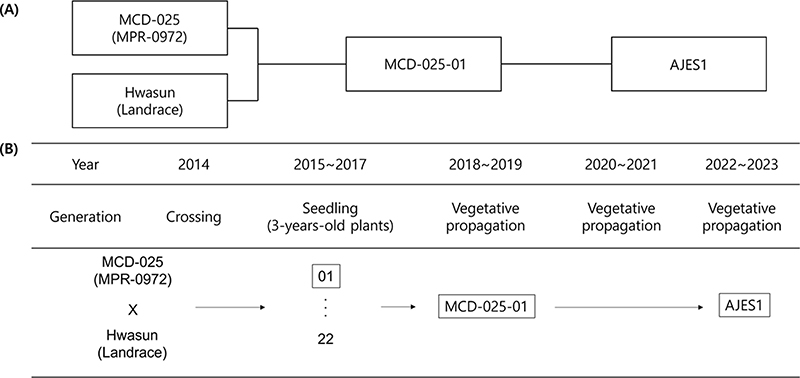
Pedigree diagram of Atractylodes japonica cultivar ‘Wipung’.
그 결과 역병 저항성을 나타내고 농업적 특성이 양호한 삽주-MCD-025-01를 선발하여 계통명을 AJES1호로 정하였다. 2022년부터 2023년까지 2년간 철원, 음성 및 나주 등 3개 지역에서 지역별 수량성 검정을 수행하였다. 지역에 따라 수량 반응이 달랐으나, 형태적 구별성, 시험 조건에서의 역병 저항성 및 유효성분 특성을 종합하여 2023년 직무육성 신품종 선정위원회를 거쳐 위 (胃) 보호 효능으로 알려진 삽주의 수량이 풍 (豊)부한 품종이라는 뜻의 ‘위풍’으로 명명하였다.
‘식물신품종보호법’에 따라 2024년 3월 15일 품종보호출원을 완료하였다 (품종보호출원번호: 2024-05).
2. 형태적 특성
초형은 ‘위풍’이 직립형인 반면 ‘위강’은 약개장형이었고, 엽색은 ‘위풍’이 녹색, ‘위강’이 진녹색이었다. 개화 전 성숙기에 주경에서 발생한 측지를 대상으로 조사한 결과, 측지의 선단부 쪽 상부엽은 두 품종 모두 단엽이었으나 ‘위풍’은 난형, ‘위강’은 좁은 장타원형이었다. 하부엽은 ‘위풍’이 단엽, ‘위강’이 3출복엽으로 나타났다 (Fig. 3).
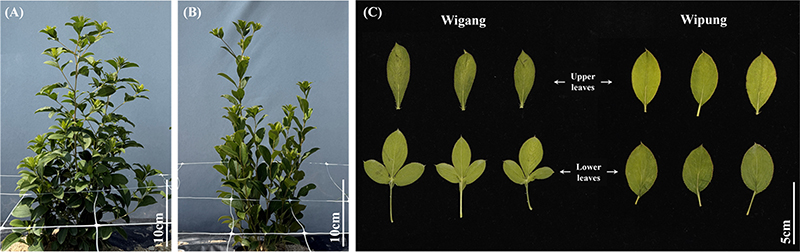
Morphological comparison between the Atractylodes japonica cultivars 'Wigang' and 'Wipung'.Aerial part morphology of (A) 'Wigang' and (B) 'Wipung'. (C) Upper and lower leaf morphology of the two cultivars. Scale bars represent 10 ㎝ (A, B) and 5 ㎝ (C).
이에 따라 직립형 초형, 옅은 녹색 잎, 넓은 타원형의 상부엽 및 단엽인 하부엽을 ‘위풍’을 ‘위강’과 구별하는 핵심 진단 형질로 정리하였다. 이들 정성형질은 반복구 당 20개체를 대상으로 한 2년간의 조사에서 동일하게 관찰되었다. 근경 표피는 두 품종 모두 적갈색, 내부 조직은 황백색이었다 (Fig. 4, Table 3).
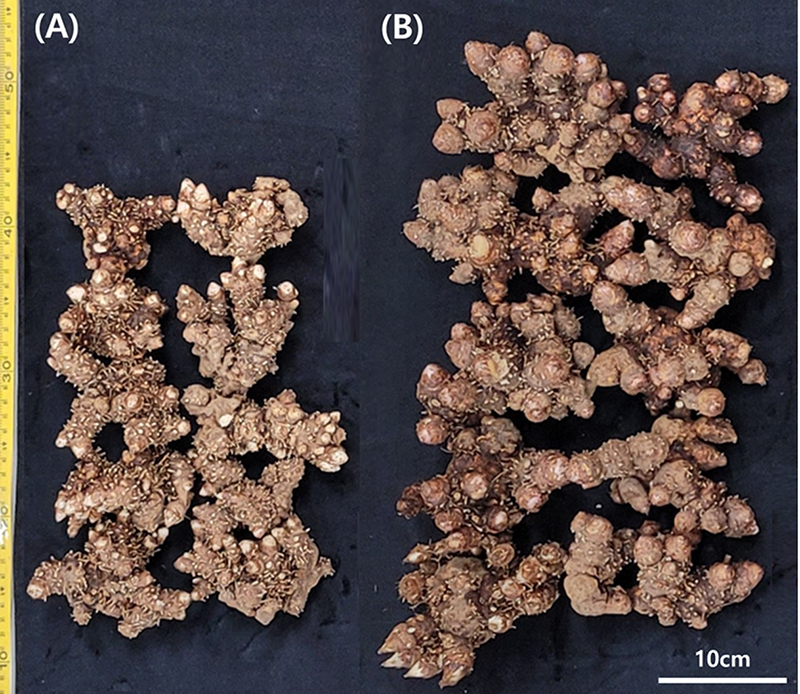
Rhizome of Atractylodes japonica cultivars ‘Wigang’ (A) and ‘Wipung’ (B).The scale bar indicates 10 ㎝.
Morphological characteristics of Atractylodes japonica cultivars ‘Wigang’ and ‘Wipung’.
3. 가변특성
‘위풍’의 주요 농업적 특성을 대조품종 ‘위강’과 비교한 결과는 Table 4와 같다. ‘위풍’의 초장은 64.49 ㎝로 ‘위강’의 49.75 ㎝보다 유의하게 컸으며, 경경도 3.37 ㎜로 ‘위강’의 2.84 ㎜보다 유의하게 굵었다. 반면, ‘위풍’의 경수는 6.76개로 ‘위강’의 9.10개보다 유의하게 적었다 (p < 0.05). 엽장과 엽폭은 ‘위풍’이 각각 8.07 ㎝와 3.67 ㎝로 ‘위강’의 7.37 ㎝ 와 3.13 ㎝보다 수치상 컸으나, 품종 간 차이는 유의하지 않았다. 눈수와 근경장의 평균값은 ‘위풍’에서 각각 10.60개와 10.90㎝로 ‘위강’의 8.77개와 9.68 ㎝보다 높았으나, 품종 간 차이는 통계적으로 유의하지 않았다. 생근중과 건근중도 ‘위풍’이 각각 154.20 g과 60.80 g으로 ‘위강’의 118.37 g과 49.13 g보다 수치상 높았으나 유의한 차이는 나타나지 않았다. 역병 지수는 두 품종 모두 1로 평가되어 노지에서의 발병률이 10% 미만인 것으로 나타났다.
Agronomic characteristics of Atractylodes japonica cultivars ‘Wigang’ and ‘Wipung’.
약용작물의 수량 구성요소는 초장, 줄기 직경 및 저장기관의 비대와 관련되는 것으로 알려져 있다 (Park et al., 2000). 본 연구에서 ‘위풍’은 초장과 줄기 직경이 유의하게 높고 근경 길이와 개체당 근경중도 수치상으로는 비교적 높은 경향을 보였다. 그러나 근경 길이, 생근중 및 건근중의 품종 간 차이가 통계적으로 유의하지 않았고 형질 간 직접적인 연관성도 분석하지 않았으므로, 지상부 생육 특성이 근경중 증가에 기여했다고 단정하기는 어렵다.
4. 지역별 수량 특성
‘위풍’과 ‘위강’의 지역별 건근 수량은 철원에서 ‘위풍’의 건근 수량은 1,121.4 ㎏/10a로 ‘위강’의 588.3 ㎏/10a보다 약 91% 높았으며, 품종 간 차이는 통계적으로 유의하였다 (p < 0.01). 음성에서는 ‘위풍’의 건근 수량이 607.5 ㎏/10a로 ‘위강’의 485.2 ㎏/10a보다 약 25% 높았으나, 통계적으로 유의하지 않았다. 반면, 나주에서 ‘위풍’의 건근 수량은 89.8 ㎏/10a로 ‘위강’의 367.2 ㎏/10a 대비 약 24% 수준이었으며, 품종 간 차이는 유의하지 않았다 (Table 5). 이러한 결과는 ‘위풍’과 ‘위강’의 상대적인 수량 차이가 시험 지역에 따라 다르게 나타났음을 보여준다.
Dry rhizome yields of Atractylodes japonica cultivars ‘Wigang’ and ‘Wipung’ across three locations.
각 시험 지역의 반복 블록 간 차이를 고려한 통합 분산분석 결과, 건근 수량에 대한 지역 효과가 유의하였으며 (p < 0.001), 품종 × 지역 상호작용도 유의하였다 (p < 0.05). 반면, 세 지역을 통합한 품종 효과는 유의하지 않았다 (Table 6).
Combined analysis of variance for dried rhizome yield of Atractylodes japonica cultivars ‘Wigang’ and ‘Wipung’ across three locations.
지역별 건근 수량을 비교한 결과, ‘위풍’은 철원에서 ‘위강’보다 유의하게 높은 수량을 보였으나, 음성과 나주에서는 품종 간 유의한 차이가 나타나지 않았다. 특히 나주에서는 ‘위풍’의 수량이 ‘위강’보다 낮아 지역에 따라 품종의 상대적인 수량 반응이 상반되게 나타났다. 통합 분산분석에서도 지역 효과와 품종 × 지역 상호작용은 유의하였으나, 세 지역을 통합한 품종 주효과는 유의하지 않았다. 이는 전체 시험지역 평균에서 ‘위풍’의 수량이 ‘위강’보다 약 26% 높았더라도, 이러한 수량 우위가 모든 지역에서 일관되게 나타난 것은 아님을 의미한다.
일반적으로 약용작물의 생육과 수량은 재배환경, 특히 온도 조건의 영향을 크게 받는 것으로 알려져 있으며 (Jeong et al., 2021), Atractylodes 속 식물도 비교적 서늘한 환경에서 안정적인 생육 특성을 나타내는 것으로 보고되었다 (Zhu et al., 2025). 이러한 선행연구를 고려하면, 철원과 나주에서 나타난 ‘위풍’의 상반된 수량 반응에는 지역별 온도 조건을 비롯한 재배환경의 차이가 관련되었을 가능성이 있다. 다만 본 연구에서는 지역별 환경요인과 수량의 관계를 직접 분석하지 않았으므로, 온도 조건을 지역별 수량 차이의 직접적인 원인으로 단정하기는 어렵다. 향후 다양한 연차와 재배환경에서 추가적인 수량 검정을 수행하고 주요 환경요인과 품종별 수량 반응의 관계를 분석할 필요가 있다.
5. 역병 저항성 검증
‘위풍’의 역병 저항성은 저항성 대조품종 ‘위강’ 및 감수성 참조종 A. macrocephala와 비교하여 평가하였다. 시험의 유효성을 확인하기 위해 동일 조건의 무접종 대조구도 함께 관찰하였다.
P. sansomeana 접종 후 2주 동안 ‘위풍’과 ‘위강’에서는 병징과 고사가 관찰되지 않아 두 품종 모두 highly resistant (HR)로 판정되었다. 반면 감수성 참조종 A. macrocephala에서는 접종 3일 후부터 병징이 나타났고 최종 발병률은 약 85%였다 (Table 7).
Disease responses of Atractylodes japonica cultivars ‘Wigang’ and ‘Wipung’ and the reference species Atractylodes macrocephala to inoculation with Phytophthora sansomeana.
이 결과는 ‘위강’의 역병 저항성을 보고한 내용 (Jeong et al., 2025)과 일치하였으며, ‘위풍’도 본 시험에 사용한 P. sansomeana 분리주와 접종 조건에서 ‘위강’과 유사한 저항성 반응을 보였다.
본 연구에서는 저항성 기작을 직접 분석하지 않았으므로 병원균 침입 억제나 특정 방어반응을 추론하지 않았다. 관찰 결과는 시험에 사용한 P. sansomeana 분리주와 유리온실 접종 조건에서 확인된 표현형 저항성으로 한정하여 해석하였다.
따라서 ‘위풍’은 시험한 P. sansomeana 분리주에 대한 저항성 육종 소재로 활용될 가능성이 있다. 다만 실제 재배 환경에서의 저항성 안정성을 판단하려면 다양한 분리주와 환경 조건을 이용한 추가 검정이 필요하다.
6. 성분 특성
‘위풍’과 ‘위강’의 주요 유효성분 함량을 비교한 결과는 Table 8과 같다. ‘위풍’의 atractylenolide Ⅰ과 atractylenolide Ⅲ 함량은 각각 5.63 ㎎/g과 2.07 ㎎/g으로, ‘위강’의 3.78 ㎎/g과 1.43 ㎎/g보다 유의하게 높았다 (p < 0.01). 이는 ‘위강’ 대비 각각 약 1.49배와 1.45배에 해당한다. Atractylon과 β-eudesmol 함량도 ‘위풍’이 각각 2.70 ㎎/g과 0.10 ㎎/g으로 ‘위강’의 2.13 ㎎/g과 0.08 ㎎/g보다 수치상 높았으나, 품종 간 차이는 유의하지 않았다. 네 성분의 평균 함량을 합산한 총함량은 ‘위풍’이 10.50 ㎎/g, ‘위강’이 7.42 ㎎/g으로, ‘위풍’이 약 1.42배 높은 것으로 계산되었다 (Table 8).
Contents of active ingredients in the Atractylodes japonica cultivars ‘Wigang’ and ‘Wipung’.
‘위풍’에서 확인된 atractylenolide Ⅰ과 atractylenolide Ⅲ의 높은 함량은 ‘위강’과 구별되는 주요 품질 특성으로 볼 수 있다. Atractylenolide Ⅲ는 위장관 보호 효과가 보고된 생리활성 성분으로 (Wang et al., 2010), 이 성분을 비교적 많이 함유한 ‘위풍’은 약용 원료로써 활용 가능성이 있을 것으로 판단된다. 그러나 본 연구는 주요 성분의 함량을 비교한 것으로 약리효능 자체를 검증한 것은 아니며, 성분 함량이 실제 효능 증가로 직접 이어진다고 단정할 수 없다. 따라서 ‘위풍’의 원료적 가치를 구체적으로 평가하기 위해서는 후속 약리효능 평가와 함께 재배지역 및 환경 조건에 따른 성분 함량의 안정성을 검증할 필요가 있다.
삽주 신품종 ‘위풍’은 직립형 초형, 옅은 녹색 잎, 넓은 타원형의 상부엽 및 단엽인 하부엽을 지녀 ‘위강’과 형태적으로 구별되었다. 또한 본 시험에 사용한 P. sansomeana 분리주에 저항성 반응을 보였으며, atractylenolide Ⅰ과 atractylenolide Ⅲ 함량이 ‘위강’보다 유의하게 높았다. 건근 수량은 지역과 품종 × 지역 상호작용의 영향을 받아 철원에서는 ‘위강’보다 유의하게 높았지만, 세 지역을 통합한 품종 효과는 유의하지 않았다. 따라서 ‘위풍’은 유효성분 함량과 역병 저항성이 우수한 삽주 품종으로 활용할 수 있으나, 안정적인 생산을 위해서는 적합 재배지역의 선정과 다양한 환경에서의 추가 검정이 필요하다.
Acknowledgments
본 성과물은 농촌진흥청 연구사업(과제번호: RS-2025-02303532)과 2026년도 농촌진흥청 국립원예특작과학원 전문연구원 과정 지원사업의 지원으로 이루어진 결과로 이에 감사 드립니다.
References
-
Acharya B, Chaijaroenkul W and Na-Bangchang K. (2021). Therapeutic potential and pharmacological activities of β-eudesmol. Chemical Biology & Drug Design. 97:984-996.
[https://doi.org/10.1111/cbdd.13823]

-
An TJ, Park MS, Jeong JT, Kim YG, Kim YI, Lee ES and Chang JK. (2019). Occurrence of the Phytophthora Blight Caused by Phytophthora sansomeana in Atractylodes macrocephala Koidz. Korean Journal of Medicinal Crop Science. 27:404-411.
[https://doi.org/10.7783/KJMCS.2019.27.6.404]
-
Bailly C. (2021). Atractylenolides, essential components of Atractylodes-based traditional herbal medicines: antioxidant, anti-inflammatory and anticancer properties. European Journal of Pharmacology. 891:173735.
[https://doi.org/10.1016/j.ejphar.2020.173735]
-
Cheng Y, Mai JY, Hou TL, Ping J and Chen JJ. (2016). Antiviral activities of atractylon from Atractylodis Rhizoma. Molecular Medicine Reports. 14:3704-3710.
[https://doi.org/10.3892/mmr.2016.5713]
- Cho JH, Kim YW, Bang KH, Park CG and Seong NS. (2002). Isolation of the Phytophthora root rot pathogen of Atractylodes macrocephala, Phytophthora drechsleri, and bioassay of the isolates with seedlings. Korean Journal of Medicinal Crop Science. 10:155-161.
-
Clement WJJ, Kalpana K, Aiyanathan KEA, Ramakrishnan M, Kandan A, Manonmani K, Yesuraja I, Sabarinathan KG, Mini ML, Shanthi M, Rajangam J and Punitha, A. (2025). Exploring the perilous nature of Phytophthora: Insights into its biology, host range, detection, and integrated management strategies in the fields of spices and plantation crops. The Plant Pathology Journal. 41:121.
[https://doi.org/10.5423/PPJ.RW.07.2024.0108]
-
Fan H, Han J, Li X, Zhou J, Zhao L, Ying Y and Kai G. (2024). Atractylodes macrocephala root rot affects microbial communities in various root-associated niches. Agronomy. 14:2662. https://www.mdpi.com/2073-4395/14/11/2662, (cited by 2026 Mar 15).
[https://doi.org/10.3390/agronomy14112662]
-
Gao Y, Wang D, Ma X, Li J, Wang D, Chen B, Yang X and Leng H. (2025). The biological function of Atractylodes lancea and its application in animal husbandry: A review. Frontiers in Veterinary Science. 11:1518433. https://www.frontiersin.org/journals/veterinary-science/articles/10.3389/fvets.2024.1518433/full, (cited by 2026 Mar 11).
[https://doi.org/10.3389/fvets.2024.1518433]
-
Giachero ML, Declerck S and Marquez N. (2022). Phytophthora root rot: Importance of the disease, current and novel methods of control. Agronomy. 12:610. https://www.mdpi.com/2073-4395/12/3/610, (cited by 2026 Apr 11).
[https://doi.org/10.3390/agronomy12030610]
-
Guo X, Li Q, Yan B, Wang Y, Wang S, Xiong F, Zhang C, Zhang Y and Guo L. (2022). Mild shading promotes sesquiterpenoid synthesis and accumulation in Atractylodes lancea by regulating photosynthesis and phytohormones. Scientific Reports. 12:21648.
[https://doi.org/10.1038/s41598-022-25494-7]
-
Han Y, Sun T, Tang Y, Yang M, Gao W, Wang L and Sui C. (2025). Root rot in medicinal plants: a review of extensive research progress. Frontiers in Plant Science. 15:1504370.
[https://doi.org/10.3389/fpls.2024.1504370]
-
Hong MH, Kim JH, Bae H, Lee NY, Shin YC, Kim SH and Ko SG. (2010). Atractylodes japonica Koidzumi inhibits the production of proinflammatory cytokines through inhibition of the NF-κB/IκB signal pathway in HMC-1 human mast cells. Archives of Pharmacal Research, 33:843-851.
[https://doi.org/10.1007/s12272-010-0606-6]
- Jee HJ, Cho WD and Kim CH. (2000). Phytophthora diseases in Korea. National Institute of Agricultural Science and Technology. Rural Development Administration. Suwon, Korea. p.41-45, p.161.
- Jeong DH, Kim KY, Park SH, Jung CR, Jeon KS and Park HW. (2021). Growth and useful component of Angelica gigas Nakai under high temperature stress. Korean Journal of Plant Resources. 34:287-296.
-
Jeong JT, Oh SM, Lee JH, Wi SH, Chang JK, Ma KH and Han JW. (2022). Growth characteristics and change of major components in Atractylodes macrocephala. Korean Journal of Medicinal Crop Science. 30:117-123.
[https://doi.org/10.7783/KJMCS.2022.30.2.117]
-
Jeong JT, Lee JH, Shin WC, Han JW, Jang SY, Mo YM, An TJ, Park SY, Ma KH, Huh M, Kim DW, Lee DY and Han KS. (2025). cultivation and quality characterization of new variety Atractylodeds japonica ‘Wigang’. Korean Journal of Medicinal Crop Science. 33:26-33.
[https://doi.org/10.7783/KJMCS.2025.33.1.26]
-
Kim KS. (2021). Variation of growth characteristics and sesquiterpenoid contents in local germplasm of Atractylodes japonica Koidz. Korean Journal of Medicinal Crop Science. 29:398-408.
[https://doi.org/10.7783/KJMCS.2021.29.6.398]
-
Kimura Y and Sumiyoshi M. (2012). Effects of an Atractylodes lancea rhizome extract and a volatile component β-eudesmol on gastrointestinal motility in mice. Journal of Ethnopharmacology. 141:530-536.
[https://doi.org/10.1016/j.jep.2012.02.031]
- Kwon YJ, Jang CS, Kim SJ and Hong SK. (1990). Evaluation and inheritance of resistance to Phytophthora blight in pepper. Korean Journal of Plant Pathology. 6:447-451.
- Ministry of Agriculture, Food and Rural Affairs(MAFRA). (2025). agricultural and forestry production value and production index. Ministry of Agriculture, Food and Rural Affairs. Sejong, Korea. https://www.mafra.go.kr/home/5102/subview.do, (cited by 2026 Apr 13).
- Ministry of Food and Drug Safety(MFDS). (2024). Korean pharmacopoeia 12th edition. Ministry of Food and Drug Safety. Cheongju, Korea. p.46.
-
Murayama C, Wang CC, Michihara S and Norimoto H. (2014). Pharmacological effects of “jutsu”(Atractylodis rhizome and Atractylodis lanceae rhizome) on 1-(2, 5-dimethoxy-4-iodophenyl)-2-aminopropane (DOI)-induced head twitch response in mice (I). Molecules. 19:14979-14986. https://www.mdpi.com/1420-3049/19/9/14979, (cited by 2026 Apr 25).
[https://doi.org/10.3390/molecules190914979]
- Oh HK. (2021). Antioxidant and anti-inflammatory activities of Atractylodes japonica according to extract methods. Journal of the Korean Applied Science and Technology. 38:1543-1552.
- Park JM, Jang KH, Lee ST, Song GW and Kang JH. (2000). Growth characteristics of Atractylodes japonica Koidz. in its native habitat. Korean Journal of Medicinal Crop Science. 8: 327-333.
- Park JM, Kim MB and Kang JH. (2004). Growth and yield of Atractylodes japonica Koidz. affected by shading and flower bud pinching. Korean Journal of Medicinal Crop Science. 12: 231-236.
-
Pontes NC, Aguiar FM, Boiteux LS, Lima ML, Oliveira VR, Café Filho AC and Reis A. (2014). Identification of sources of seedling resistance to Phytophthora capsici in Cucumis melo. Tropical Plant Pathology. 39:74-81.
[https://doi.org/10.1590/S1982-56762014000100009]
- Rural Development Administration(RDA). (2010). Method of soil chemical analysis. Rural Development Administration. Jeonju, Korea. p.1-320.
- Rural Development Administration(RDA). (2012). Standard method of investigation and analysis for research on the agricultural science and technology. Rural Development Administration. Jeonju, Korea. pp.771-772.
-
Singh K, Singh G, Bhushan B, Kumar S, Dhurandhar Y and Dixit P. (2024). A comprehensive pharmacological review of Atractylodes Macrocephala: Traditional uses, phytochemistry, pharmacokinetics, and therapeutic potential. Pharmacological Research-Modern Chinese Medicine. 10:100394.
[https://doi.org/10.1016/j.prmcm.2024.100394]
- Wang C, Geng Q and Wang Y. (2012). Protective effect of atractylenolide Ⅰ on immunological liver injury. China Journal of Chinese Materia Medica. 37:1809-1813.
-
Wang KT, Chen LG, Wu CH, Chang CC and Wang CC. (2010). Gastroprotective activity of atractylenolide Ⅲ from Atractylodes ovata on ethanol-induced gastric ulcer in vitro and in vivo. Journal of Pharmacy and Pharmacology. 62:381-388.
[https://doi.org/10.1211/jpp.62.03.0014]
- Yun BR, Weon JB, Lee BH, Lee JW, Eom MR and Ma CJ. (2013). Quantitative analysis of atractylenolides Ⅰ and Ⅲ in Atractylodes japonica. Korean Journal of Pharmacognosy. 44: 53-59.
-
Zhang W, Bai Q, Cui G, Zhang X, Lyu C, Sun J, Gao W, Huang L and Guo L. (2023). Recent progress and ongoing challenges in Rhizoma atractylodis research: Biogeography, biosynthesis, quality formation and control. Medicinal Plant Biology. 2:19. https://www.maxapress.com/article/doi/10.48130/MPB-2023-0019?viewType=HTML, (cited by 2026 Apr 2).
[https://doi.org/10.48130/MPB-2023-0019]
-
Zhu J, Cheng Q, Alami MM, Zhong S, Li M, Mao M, Liu Y, Mei Z, Wang X, Weng D, Feng S and Shu S. (2025). The temperature-dependent changes of volatile oil content in Atractylodes lancea(Thunb.) DC detected by full-length transcriptomic and physiological approaches. Plant Growth Regulation. 105:1337- 1350.
[https://doi.org/10.1007/s10725-025-01321-7]