
Transplanting Mechanism Analysis and Field Performance Evaluation ofa Double-crank Five-bar Medicinal Crop Transplanter
This is an open access article distributed under the terms of the Creative Commons Attribution Non-Commercial License (http://creativecommons.org/licenses/by-nc/3.0/) which permits unrestricted non-commercial use, distribution, and reproduction in any medium, provided the original work is properly cited.
Abstract
This study investigated the transplanting mechanism and evaluated the field performance of a double-crank five-bar transplanter engineered for plug-grown Angelica gigas seedlings.
A three-dimensional model and closed-loop kinematic formulation were used to determine the displacement, velocity, acceleration, and trajectory of the planting end-effector. Simulation results indicated that the end-effector followed a smooth, repeatable elliptical path, with horizontal and vertical ranges of approximately 40 ㎝ and 30 ㎝, respectively, facilitating sequential seedling reception, transfer, soil insertion, release, and withdrawal. The velocity analysis focused on achieving a zero-speed transplanting condition, whereby the backward horizontal velocity of the planting mechanism offset the forward speed of the transplanter during insertion. Field tests were conducted using 60-day-old seedlings cultivated in 72-cell plug trays under controlled nursery conditions. The transplanter achieved an average transplanting rate of 88 seedlings per minute, yielding seedling damage and missed-planting rates of 3% and 4%, respectively. Although the mechanism demonstrated high operational capacity and satisfactory seedling-handling performance, increased vibration and occasional deviations in seedling posture occurred during high-speed operations. These issues were attributed to rapid changes in motion, linkage clearance, transmission backlash, and release-timing errors.
Further optimization of link dimensions, crank phase relationships, feeder synchronization, vibration isolation, and duckbill opening control is recommended to enhance planting accuracy, seedling uprightness, and operational reliability under field conditions.
Keywords:
Agricultural Machinery, Medicinal Crop, Transplanter, Kinematic Analysis, Seedling DamageINTRODUCTION
Medicinal crop production contributes to rural livelihoods and the supply of raw materials for traditional medicine, pharmaceuticals, functional foods, and related industries in the Republic of Korea. However, a survey of 406 medicinal crop armers across 14 Korean cities and counties showed that insufficient cultivation technology and the limited availability of crop-specific agricultural machinery remain major production constraints (Lee et al., 2020). The mechanization of medicinal crop cultivation is particularly difficult because cultivated species differ considerably in seedling form, root structure, planting depth, spacing, orientation, and soil-management requirements, while many transplanting operations continue to be performed manually despite being labor-intensive, time-consuming, and inconsistent (Habineza et al., 2023; Ali et al., 2024a). Conventional manual transplanting requires workers to handle and place seedlings individually, and its performance is strongly affected by operator skill, fatigue, and working speed, whereas semi-automatic systems still require continuous manual feeding and fully automatic systems require coordinated seedling recognition, extraction, transfer, positioning, and release (Liu et al., 2023).
These limitations are more critical for medicinal root crops because inappropriate planting depth, root orientation, or seedling posture can interfere with establishment and subsequent root development. Conventional transplanting methods for Codonopsis pilosula have been associated with unstable trench depth, unsuitable root positioning, and difficulty satisfying the crops inclined-transplanting requirements (Luo et al., 2024). The development of an electric self-propelled double-row transplanter for Angelica sinensis further demonstrated that medicinal crop mechanization requires specialized seedling clamping, conveying, planting, and soil-covering components compatible with crop morphology and field conditions, rather than the direct adoption of general-purpose vegetable transplanters (Ning et al., 2025).
Different mechanical systems, including rotary devices, cam–follower mechanisms, gear-linkage arrangements, robotic manipulators, and four- and five-bar linkages, have therefore been investigated to produce the sequential motions required for seedling pickup, transportation, insertion, release, and mechanism withdrawal during transplanting operations (Khadatkar et al., 2023). A five-bar path-generating mechanism was previously developed to extract vegetable seedlings from a 200-cell plug tray and transfer them to a transplanting position, showing that a compact linkage system could generate combined straight and curved motion paths for controlled seedling pickup and delivery (Choi et al., 2002). Kinematic and dynamic analyses are essential in linkage-based transplanter design because crank position, link dimensions, angular velocity, joint forces, and shaking forces determine the motion and structural behavior of the planting unit, while inappropriate mechanism design may increase vibration, impact, trajectory error, and operational instability (Kohli and Agrawal, 1993). Among the available linkage systems, the double-crank five-bar mechanism provides considerable flexibility for controlling the position and trajectory of the planting point, and a mechanism combining elliptical gears with a double-crank five-bar linkage was successfully developed and experimentally evaluated for potted rice seedling pickup and planting (Xin et al., 2017).
A two-degree-of-freedom five-bar mechanism was also developed for flower-seedling transplanting to overcome the high cost and poor adaptability of large-scale equipment and the seedling damage and low automation associated with smaller transplanting machines, demonstrating the potential of five-bar systems for adaptable and low-damage seedling handling (Zhao et al., 2020). The application of a double-crank five-bar mechanism in a fully automatic double-row vegetable transplanter further demonstrated that the coordinated design of seedling-feeding, seedling-separation, transfer, and planting devices can improve operational continuity and transplanting efficiency when the linkage motion is synchronized with machine travel (Wen et al., 2021). Recent medicinal crop machinery research has also integrated transplanting with field operations such as seedbed preparation, ridge formation, film laying, and seedling outcrop control, as demonstrated by a specialized Codonopsis pilosula machine developed to address unstable transplanting quality, high manual workload, and low field efficiency (Bai et al., 2025).
Although recent advancements have been made, few studies have directly linked the theoretical trajectory, displacement, velocity, and acceleration of the double-crank five-bar mechanism to field performance indicators, including planting depth, plant spacing, seedling posture, missed planting, seedling damage, and operational efficiency. Ali et al. (2025) developed and comparatively evaluated both a finger-type mechanism and a double-crank five-bar mechanism for medicinal crop transplanting, focusing primarily on overall mechanism design and comparative field performance. In contrast, the present study independently examines the double-crank five-bar mechanism through detailed kinematic formulation and systematic variation of the main linkage dimensions. The analysis includes changes in planting hopper trajectory, displacement, velocity, and acceleration, as well as the zero-speed planting condition and field performance. This methodology enables a more explicit evaluation of the effects of linkage configuration on practical transplanting behavior than previous comparative studies. The kinematic characteristics and field performance of the double-crank five-bar mechanism are therefore analyzed to determine a suitable linkage configuration that maintains the required planting depth, plant spacing, seedling uprightness, low rates of missed planting and seedling damage, and stable operational performance Habineza et al. (2025b). Therefore, this study aimed to analyze the kinematic characteristics of the transplanting mechanism and evaluate the field performance of a double-crank five-bar medicinal crop transplanter.
MATERIALS AND METHODS
1. 3D modeling and working principle of prototype medicinal crop transplanter
A prototype double-crank five-bar transplanter was fabricated for plug-type medicinal crop seedlings, particularly Angelica gigas. The machine was designed to improve transplanting efficiency while maintaining the required planting depth, spacing, and seedling orientation under field conditions. The main components consisted of a tractor power take-off attachment and drivetrain, seedling-feeding unit, double-crank five-bar planting mechanism, furrow opener, and soil-covering and compaction units.
Three-dimensional computer-aided design models of the prototype were developed using SOLIDWORKS 2018 (Dassault Systèmes SolidWorks Corp., Waltham, MA, USA). As shown in Fig. 1, the prototype comprised three principal subsystems. The tractor PTO attachment and drivetrain supplied rotational power to the transplanting unit. The seedling-feeding unit delivered plug seedlings to the planting mechanism, and the planting unit inserted the seedlings into the furrow and compacted the surrounding soil.
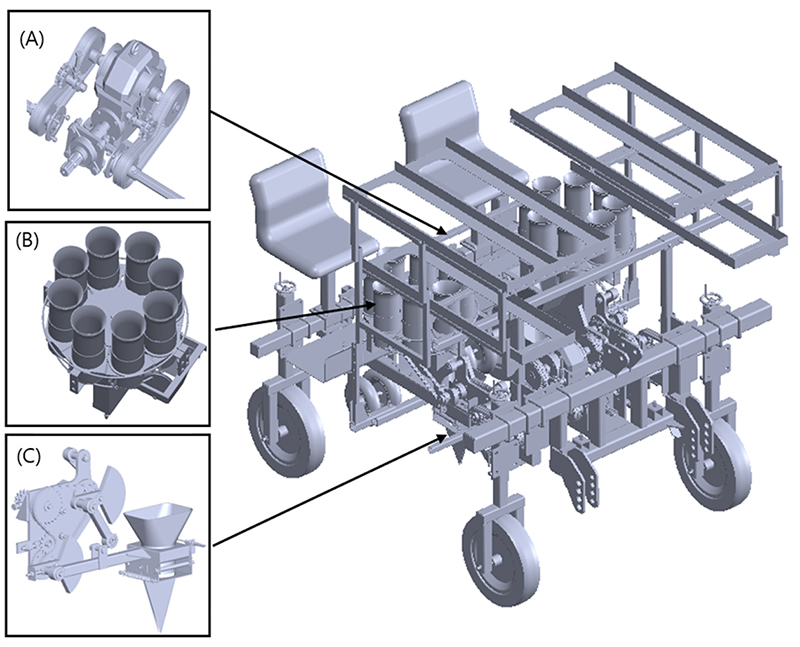
Isometric representation of the double-crank five-bar medicinal crop transplanting mechanism, illustrating (A) the tractor PTO connection and power transmission unit, (B) the seedling feeding unit, and (C) the transplanting mechanism.
The planting mechanism consisted of two rotating crank links connected by two coupler links to a duckbill-type end-effector. The synchronized rotation of the two cranks generated a closed-loop motion and produced an approximately elliptical trajectory at the planting point. This trajectory enabled the planting device to receive, transport, lower, release, and withdraw from the seedling while minimizing disturbance to the planted seedling. The linkage dimensions, crank phase relationship, and rotational speed were selected to reduce oscillation and maintain a nearly vertical seedling posture during soil insertion and release. During operation, plug seedlings were manually supplied to the feeding unit and conveyed sequentially toward the guide hole. When a seedling reached the discharge position, it was released into the duckbill-type planting device located near the uppermost point of the linkage trajectory. The rotating cranks then moved the planting device downward toward the furrow while maintaining control of the seedling orientation.
At the required planting depth, a cam-actuated mechanism opened the duckbill device and released the seedling into the soil. The planting device subsequently moved upward and away from the seedling to avoid displacement or inclination. The soil-covering and rear compaction units then pressed the soil around the root plug to improve soil–root contact and stabilize the seedling. After withdrawal, the duckbill device closed and returned to the seedling-receiving position, completing one transplanting cycle. The principal components and motion-transfer arrangement of the double-crank five-bar mechanism are presented in Fig. 2. The target planting depth was maintained at 4.0 ± 1.0 ㎝, and the plant-to-plant spacing was fixed at 20 ㎝ according to the cultivation requirements of the selected medicinal crops. The linkage and transmission parameters were designed to achieve a transplanting rate of approximately 70–90 seedlings min-1, while maintaining vertical seedling placement and minimizing mechanical impact during release.
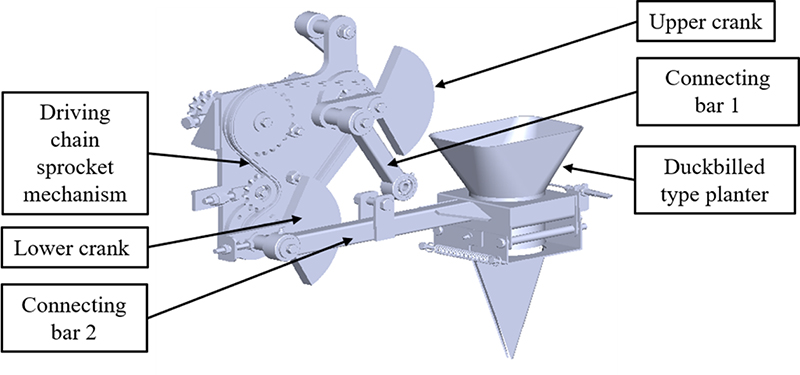
Main components of the double-crank five-bar planting mechanism.
The design requirements of the hopper-type planting mechanism were established from the dynamic and static trajectories shown in Fig. 3. Four characteristic positions were considered. Seedling receiving occurred at point a, duckbill opening was initiated at point b, seedling insertion and release were completed at point c, and duckbill closing and withdrawal occurred near point d. At the planting point, the horizontal velocity relative to the ground was reduced toward zero to minimize seedling dragging and displacement (Timene and Djalo, 2023; Ali et al., 2024b). The dynamic trajectory was required to provide a planting depth of 4–5 ㎝ and a planting interval of 20–25 ㎝. During soil insertion and withdrawal, the longitudinal axis of the planting hopper was maintained at an angle of at least 80° relative to the horizontal soil surface, corresponding to a maximum deviation of 10° from the vertical direction. The seedling was also required to remain nearly upright after release. In addition, the distance between the soil-entry and soil-exit positions of the duckbill was minimized to reduce soil disturbance and prevent interference with the transplanted seedling. These requirements were used to define the desired motion characteristics of the double-crank five-bar transplanting mechanism.
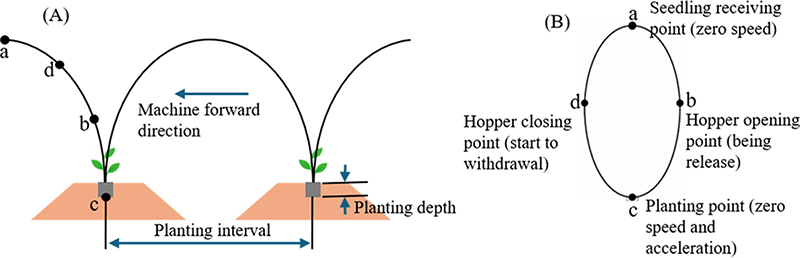
Trajectories of the hopper-type planting mechanism.(A) Dynamic trajectory. (B) Static trajectory of the planting mechanism.
2. Kinematic modeling of five-bar mechanism
The transplanting mechanism was modeled as a planar double-crank five-bar linkage used to control the motion of the duckbill-type planting device. As illustrated in Fig. 4, the main closed kinematic loop consisted of the fixed frame and links OA, AB, BC, CD, and DO. An extended linkage connected to point C transmitted the motion to the end-effector at point G, which represented the effective planting point of the duckbill mechanism. The lengths of links OA, AB, BC, CD, and DO were denoted by l1, l2, l3, l4, and l5, respectively. Link CE, with length l6, extended the motion of link CD, while l8 represented the distance from point E to the planting point G. The angular positions of the links relative to the positive horizontal axis were represented by θ1–θ7.
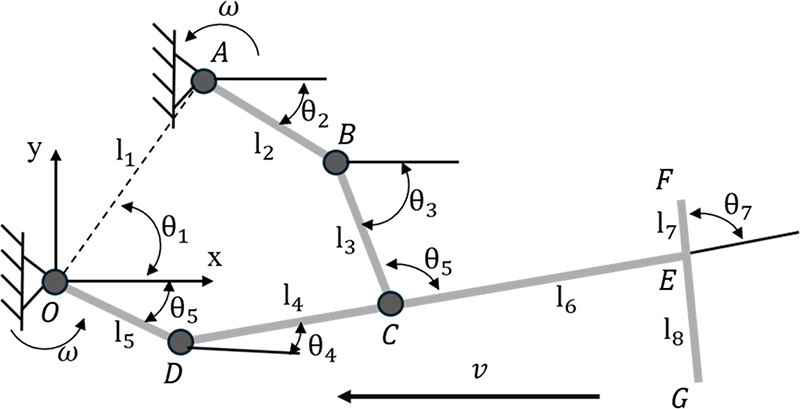
Kinematic configuration of the double-crank five-bar transplanting mechanism and the associated planting end-effector.
The linkage dimensions, angular relationships, and rotational direction were selected to generate the required sequence of seedling reception, downward transportation, soil insertion, release, and withdrawal. The resulting end-effector trajectory was subsequently evaluated in terms of displacement, velocity, acceleration, and suitability for zero-speed transplanting.
A ground-fixed rectangular coordinate system Oxy was established with the origin at the fixed pivot O. The positive x-axis was defined in the horizontal direction, while the positive y-axis was directed vertically upward. All links were assumed to be rigid, and joint clearance, friction, elastic deformation, and out-of-plane motion were neglected (Zhao et al., 2020; Zhao et al., 2024).
The coordinates of point A were expressed as in Equation (1).
| (1) |
The coordinates of point B were determined as in Equation (2).
| (2) |
Similarly, the coordinates of the fixed-link endpoint D were expressed as in Equation (3).
| (3) |
The vector-loop closure equation for the main five-bar linkage was as in Equation (4).
| (4) |
Therefore, the coordinates of joint C satisfied as in Equation (5).
| (5) |
Given the known angles θ1, θ2, and θ5, the unknown angles θ3, and θ4 can be determined as in Equation (6).
| (6) |
Where,
| (7) |
The angular position θ4 is obtained by combining the relationships presented in Equations (5) and (6), as shown in Equation (8).
| (8) |
The displacement equation for point E is presented in Equation (9).
| (9) |
For point G, the displacement is given by Equation (10).
| (10) |
The velocity and acceleration of point G were determined by differentiating the position equations with respect to time. The first derivatives yielded the horizontal and vertical velocity components for both the translational and rotational motions of the linkage. The second derivatives yielded the corresponding acceleration components, accounting for tangential and centripetal effects, and thus characterized the dynamic response of the mechanism during operation.
The angular velocity of the system at point G is determined by Equation (11).
| (11) |
Where, ψ = θ7 + θ4 and cos(π - ψ) = -cos ψ, sin(π - ψ) = sin ψ Given, xG = xE - l8cos(ψ), yG = yE + l8sin(ψ)
Equation (12) presents the derivation of the acceleration equation for point G.
| (12) |
Equations (13) and (14) present the magnitudes of velocity and acceleration for the planting hopper, respectively.
| (13) |
| (14) |
The power requirement P for operating the planting mechanism is determined as a function of velocity vm, acceleration am, and mass m.
The zero-speed transplanting condition was evaluated from the horizontal velocity of the planting hopper relative to the ground at the seedling release point. The relative horizontal velocity was expressed as in Equation (15).
| (15) |
Where, vr was the ground-relative horizontal velocity of the planting hopper at the release point, vm was the forward speed of the transplanter, and vGx,r was the horizontal velocity of point G relative to the machine at the release point. Because the planting hopper moved opposite to the machine travel direction during seedling release, vGx,r was negative. The zero-speed transplanting condition was satisfied when vr ≈ 0, and therefore vGx,r ≈ -vm. Based on Eq. (16), the machine forward speed was expressed as vm = Fsdpm, where Fs was the planting frequency and dpm was the target plant-to-plant spacing.
The motion trajectory of the planting hopper was analyzed by simulating five trial combinations, each varying the lengths of the primary links. The fixed crank distance (L1) was adjusted between 25 and 35㎝, and the upper crank length (L2) ranged from 8 to 12 ㎝. The connecting rod lengths (L3 and L4) were set to 15-20 ㎝ and 20-24 ㎝, respectively. The lower crank length (L5) varied from 5 to 10 ㎝, while the extended connecting link (L6) ranged from 27 to 35 ㎝. The hopper connecting link (L7) was adjusted between 20 and 30 ㎝, and the hopper length (L8) ranged from 13 to 21 ㎝. These parameter sets were incorporated into the kinematic equations to compute and compare the resulting planting hopper trajectories. The specific link dimensions for each simulation trial are presented in Table 1.

Proposed trial combinations of the main links of the five-bar planting mechanism.
3. Field test setup and performance evaluation
Plug-grown seedlings of A. gigas (Fig. 5) were used to evaluate the field performance of the prototype double-crank five-bar transplanter. The seedlings were cultivated in 72-cell plug trays for a standardized nursery period of 60 days. At 60 days after sowing, the seedlings exhibited relatively uniform morphological characteristics, with an average crown diameter of 7.2 mm, leaf length of 4.7 ㎝, and leaf width of 4.2 ㎝. The seedlings also developed sufficiently cohesive root plugs for mechanical extraction, transfer, and placement by the transplanting mechanism. Well-developed root systems and uniform shoot growth are important indicators of seedling vigor and transplanting readiness because they reduce root-plug breakage and improve post-transplant establishment (Park et al., 2025).
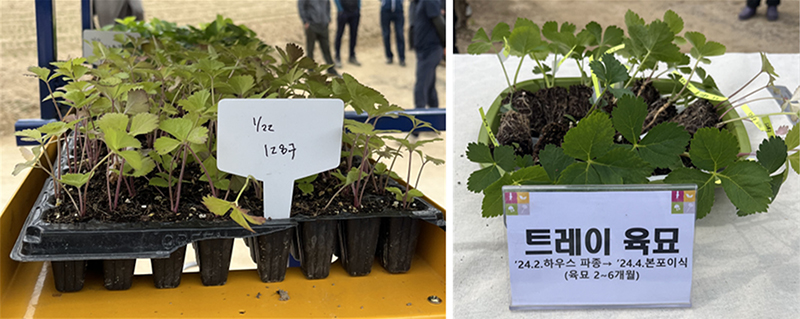
Plug-grown Angelica gigas seedlings used in the field experiment.
The field experiment was conducted at an experimental field in Pyeongchang-gun, Gangwon State, Republic of Korea (37.62396° N, 128.56200° E) on 30 April 2024. Before testing, the field was tilled and prepared to provide relatively uniform conditions for furrow opening, seedling insertion, soil covering, and compaction. The surface soil was visually dry to moderately dry and friable after tillage, with no visible standing water during the experiment. Ambient temperature and relative humidity during the field tests ranged from 20 to 23° and 65 to 70%, respectively. The target plant-to-plant spacing was maintained at 20 ㎝, and the average planting frequency was 88 seedlings/min. Based on the planting frequency and target spacing, the corresponding nominal machine forward speed was calculated as approximately 0.293 . The same machine setup and operating conditions were maintained throughout the three replicate field tests, and each replicate was conducted over a 20 m test section.
Uniform seedling morphology and adequate root-plug cohesion were required to reduce variations in seedling feeding, mechanical damage, and planting posture during the field tests. Seedlings with damaged shoots, poorly developed roots, loose root plugs, or visible disease symptoms were excluded before testing.
Field experiments (Fig. 6) were conducted at a single experimental field under practical operating conditions. Before testing, the fields were tilled and prepared to provide sufficiently uniform soil conditions for furrow opening, seedling insertion, soil covering, and compaction. During each test, A. gigas seedlings were manually supplied to the feeding unit and transferred sequentially to the duckbill-type planting mechanism. The linkage received each seedling, transported it downward along the planting trajectory, released it at the predetermined planting position, and withdrew from the soil. The rear soil-covering and compaction units then pressed the soil around the root plug to stabilize the transplanted seedling.
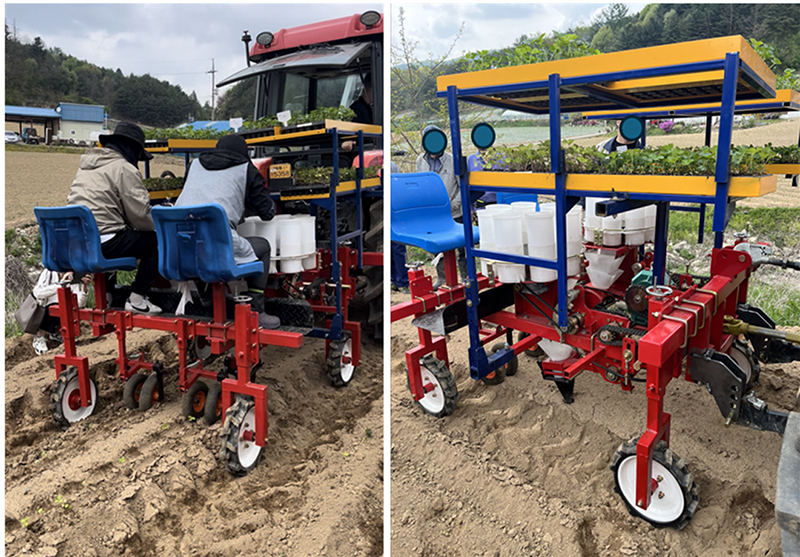
Field performance test of the prototype double-crank five-bar transplanter using plug-grown Angelica gigas seedlings.
The principal operational conditions recorded during the experiments included machine forward speed, planting frequency, plant-to-plant spacing, planting time, and test location. Experienced operators were employed to reduce variations associated with seedling feeding and machine handling, and the selected operating conditions were maintained consistently within each treatment. The field test was repeated three times, with each replicate conducted over a test distance of 20 m. A preliminary travel distance was provided before the measurement section to allow the tractor and transplanting mechanism to reach stable operating conditions. Seedlings planted within the acceleration and stopping zones were excluded from the performance analysis.
The field performance of the prototype was evaluated using planting frequency, seedling damage rate, missed-planting rate, transplanting accuracy, uprightness accuracy, and plant-to-plant spacing. These indices represented both the operational capacity of the machine and the agronomic quality of seedling placement. Planting frequency indicated the number of seedlings planted per unit time, whereas seedling damage and missed planting reflected the reliability of seedling handling and delivery. Transplanting accuracy incorporated major planting defects, including exposed seedlings, lodging, missed planting, and double planting. Uprightness accuracy was evaluated separately to quantify the post-transplant orientation of the seedlings relative to the vertical direction.
Planting frequency represented the theoretical number of seedlings planted per second based on machine forward speed and the target spacing between consecutive seedlings. It was calculated as in Equation (16) (Vlahidis et al., 2024).
| (16) |
Where, Fs is the planting frequency (seedlings s-1), Vm is the forward speed of the transplanter (㎳-1), and dpm is the target plant-to-plant spacing (m).
This relationship assumes that the machine travels at a constant speed and that planting intervals are uniform. An excessive planting frequency may reduce the time available for seedling feeding, receiving, insertion, and release, thereby increasing the probability of missed planting or improper seedling placement.
Seedling damage included visible mechanical injury occurring during feeding, transportation, gripping, insertion, or release. Seedlings with broken stems, severely damaged leaves, crushed crowns, detached root plugs, or substantial root-plug deformation were classified as damaged. The seedling damage rate was calculated as in Equation (17) (Feng et al., 2024).
| (17) |
Where, Dr is the seedling damage rate, %. Nd is the number of physically damaged seedlings, and No is the total number of seedlings observed.
A lower damage rate indicated gentler seedling handling by the feeding unit and duckbill-type planting mechanism. A high value could indicate excessive gripping force, impact during transfer, improper release timing, high operating speed, or insufficient root-plug cohesion.
A missed planting was defined as a designated planting position at which no seedling was successfully deposited. Missed planting could result from failure of the operator to supply a seedling, improper transfer from the feeding unit, premature seedling release, mechanical interference, or timing errors between the feeder and planting mechanism. The missed-planting rate was calculated as in Equation (18) (Vlahidis et al., 2024).
| (18) |
Where, Mr is the missed-planting rate, %. Nm is the number of missing seedlings or empty planting positions, and Nt is the total number of intended planting positions. A lower missed-planting rate represented greater operational reliability and improved synchronization among the seedling-feeding, linkage-driving, and seedling-release processes.
Transplanting accuracy was evaluated by considering four major planting defects: exposed seedlings, lodging, missed planting, and double planting. An exposed seedling was defined as one for which the root plug was not sufficiently covered by soil. Lodging was defined according to the adopted evaluation criterion as a seedling with an inclination angle greater than 60° from the vertical direction. Missed planting represented an empty planting position, while double planting indicated that two or more seedlings were deposited at one position.
| (19) |
Where, At is the transplanting accuracy, %. re is the exposed-seedling proportion, rl is the lodging proportion, rm is the missed-planting proportion, and rd is the double-planting proportion.
All defect variables in Eq. (19) were entered as decimal proportions rather than percentages. A value of At close to 100% indicates that most seedlings were placed individually at the intended positions, maintained an acceptable posture, and had their root plugs adequately covered with soil. Seedling uprightness was evaluated separately based on the inclination angle between the seedling stem axis and the vertical direction after transplanting. A seedling was classified as properly upright when the inclination angle was within 10° of the vertical direction (Timene and Djalo, 2023). Uprightness accuracy was calculated as the percentage of properly upright seedlings relative to the total number of evaluated seedlings. Uprightness accuracy was calculated as in Equation (20)
| (20) |
Where Ua was the uprightness accuracy, %, Nu was the number of upright seedlings, and Nt was the total number of evaluated seedlings. The measured performance data were expressed as mean ± standard deviation based on three replicate field tests.
RESULTS AND DISCUSSION
1. Simulated trajectory of planting end-effector
Fig. 7 presents the simulated trajectories of the planting hopper. All five trial combinations produced an oval-shaped motion path. The horizontal trajectory ranges were approximately -18.5 to 18.5 ㎝, −20.0 to 20.0 ㎝, −21.5 to 21.5 ㎝, −23.0 to 23.0 ㎝, and −24.5 to 24.5 ㎝ for Trials 1 through 5, respectively. The corresponding vertical trajectory ranges were −9.5 to −34.4 ㎝, −9.0 to −36.6 ㎝, −8.5 to −38.8 ㎝, −8.0 to −41.0 ㎝, and −7.5 to −43.0 ㎝. Both the horizontal span and downward displacement progressively increased across the trial combinations. The target plant-to-plant spacing of 20 ㎝ was consistently maintained. Among the five configurations, Trial 3 was selected for further analysis and prototype fabrication because the trajectory provided the required downward penetration and withdrawal while maintaining the target planting motion.
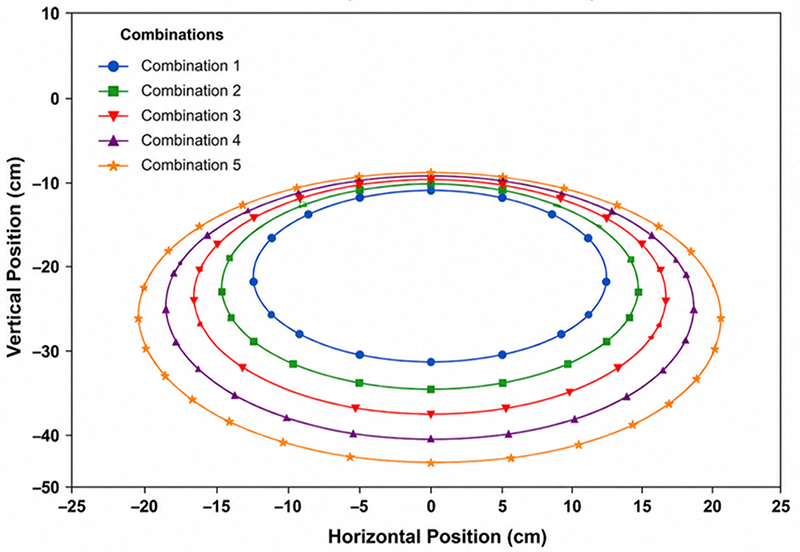
Simulated trajectory of the planting end-effector of the double-crank five-bar transplanting mechanism.
The progressive enlargement of the hopper trajectory demonstrated that the working envelope was significantly influenced by the selected linkage configuration, although the overall oval-shaped motion pattern remained consistent. A controlled oval trajectory is advantageous because it provides sufficient vertical displacement for soil penetration, while the horizontal motion enables the hopper to approach and withdraw from the planting position without excessive interference with the transplanted seedling. Habineza et al. (2025a) similarly reported that a link-driven hopper mechanism produced a stable near-oval trajectory and effective synchronization between seedling supply and deposition positions. The necessity of coordinating horizontal and vertical hopper movement was further emphasized by Habineza et al. (2025a) , who found that hopper trajectory and forward speed directly affected seedling deposition position and soil-contact orientation. Additionally, Ji et al. (2024) demonstrated that optimizing the trajectory of a double-crank five-bar planting mechanism was essential for achieving near-zero horizontal velocity relative to the ground during seedling release, thereby enhancing transplanting performance. Consequently, the trajectory selected in the present study was required to provide adequate downward penetration and smooth withdrawal, while maintaining the targeted 20 ㎝ plant spacing and minimizing unnecessary horizontal displacement during seedling release.
The simulated velocity and acceleration profiles of the planting hopper, as illustrated in Fig. 8, varied across the five trial combinations. The maximum horizontal velocity increased from 112 ㎝/s in Trial 1 to 150 ㎝/s in Trial 5, while the maximum vertical velocity rose from 76 ㎝/s to 112 ㎝/s. Acceleration exhibited a similar upward trend, with maximum horizontal acceleration increasing from 685 ㎝/s2 to 972 ㎝/s2 and maximum vertical acceleration rising from 472 ㎝/s2 to 715 ㎝/s2. Trials 4 and 5 demonstrated a more pronounced dynamic response, suggesting that larger working trajectories resulted in more rapid changes in hopper motion. The observed increase in acceleration is significant, as excessive dynamic loading may elevate vibration levels and compromise the stability of seedling release. Therefore, Trial 3 was selected as the intermediate linkage configuration for the prototype and field experiments, providing adequate soil penetration and smooth withdrawal while maintaining the required 20 ㎝ plant spacing.
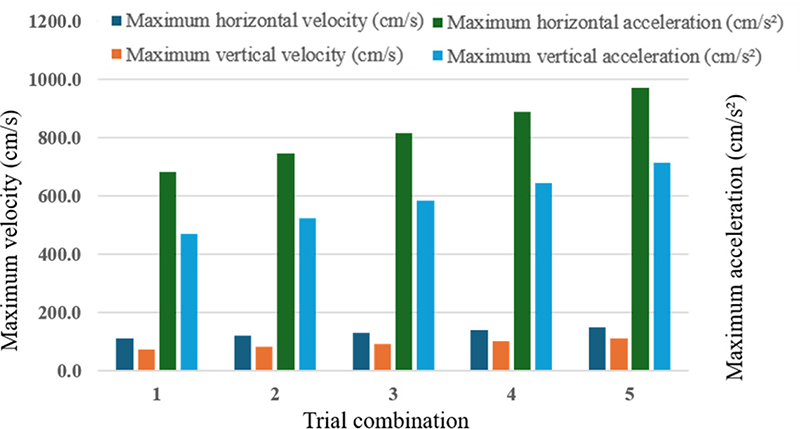
Maximum horizontal and vertical velocity and acceleration of the planting hopper for five trial combinations.
The progressive increase in hopper velocity and acceleration across the five trial combinations indicated greater dynamic loading. The higher acceleration observed in Trials 4 and 5 suggests that increased inertial forces and vibration may occur during rapid changes in hopper direction, particularly during soil penetration, seedling release, and withdrawal. Consequently, the linkage configuration must deliver sufficient planting motion and achieve the targeted 20 ㎝ plant spacing while minimizing excessive acceleration. Ji et al. (2024) similarly reported that the motion characteristics of a double-row automatic transplanter were closely associated with planting stability and seedling placement performance. Liu et al. (2016) demonstrated that coordinating the trajectory and velocity of a five-bar planting mechanism can achieve near-zero horizontal velocity relative to the ground during seedling release, thereby reducing displacement and improving planting accuracy. In the present study, the machine forward speed corresponding to the operating condition was calculated as 0.293 . At the seedling release position, the required backward horizontal velocity of the planting hopper was therefore − 0.293 . Accordingly, the calculated horizontal velocity relative to the ground approached 0 , satisfying the theoretical zero-speed planting condition. This result indicated that synchronization between machine travel and hopper motion was necessary to minimize horizontal displacement of the seedling during release. Additionally, Sun et al. (2023) emphasized that linkage parameters should be optimized based on the required trajectory and operating posture of the planting mechanism, rather than by maximizing the working envelope alone. Therefore, an intermediate parameter combination that ensures adequate hopper penetration, smooth withdrawal, moderate velocity and acceleration, and the required 20 ㎝ plant spacing is recommended to reduce dynamic disturbance and maintain stable seedling placement.
2. Field performance
Field performance of the five-bar transplanting mechanism was evaluated based on transplanting rate, seedling damage rate, missed-planting rate, transplanting accuracy, uprightness accuracy, and plant-to-plant spacing, as presented in Table 2. Under the selected operating conditions, a transplanting rate of 88.0 ± 2.0 seedlings min-1 was obtained. The seedling damage rate and missed-planting rate were 3.0 ± 1.0% and 4.0 ± 1.0%, respectively. The transplanting accuracy was 96.0 ± 1.0%, while the uprightness accuracy was 95.0 ± 1.0%. The mean plant-to-plant spacing was 20.0 ± 0.3 ㎝. These results demonstrate that the mechanism achieved a high transplanting capacity while maintaining acceptable levels of seedling damage and planting failure.
Field transplanting performance of the five-bar mechanism.
The observed seedling damage likely resulted from mechanical interactions during seedling transfer, soil insertion, and hopper release. However, the mechanical loads involved in these operations were not directly measured in this study, and the specific contribution of each operation to seedling damage could not be quantified. Rapid directional changes in the five-bar linkage increased velocity and acceleration, potentially transferring additional dynamic forces to the seedlings during high-speed operation. Previous studies on linkage-based transplanting mechanisms have shown that planting quality is strongly influenced by trajectory smoothness and the relative velocity between the planting device and the ground. Liu et al. (2016) found that near-zero horizontal velocity during seedling release reduced relative movement between the planting device and soil, thereby improving planting stability. Ji et al. (2024) also emphasized the importance of coordinating planting trajectory and operating speed to maintain seedling placement quality. These findings underscore the necessity for controlled hopper motion during the insertion and release stages.
The observed missed-planting rate may have been associated with occasional inconsistencies in seedling feeding and hopper operation. However, synchronization errors were not directly measured in the present study, and their contribution to missed planting could not be quantified. Occasional premature or delayed seedling release led to incomplete planting cycles or positional deviations from the intended planting location. The uprightness accuracy was 95.0 ± 1.0%, indicating that 95.0 ± 1.0% of the evaluated seedlings were positioned within 10° of the vertical direction after transplanting. However, some posture deviations occurred during higher-speed operation, particularly when increased vibration was present near rapid changes in linkage direction. Sun et al. (2023) reported that optimizing linkage parameters according to both the required motion trajectory and the operating posture of the planting device is essential, suggesting that simply enlarging the working envelope does not necessarily enhance transplanting performance.
Increased vibration was observed during continuous high-speed operation of the five-bar mechanism. Possible contributing factors included rapid changes in linkage acceleration, joint clearance, transmission backlash, and timing inconsistencies among crank motion, seedling feeding, and hopper release. However, these factors were not measured quantitatively in the present study. Therefore, their individual contributions to missed planting and reduced uprightness accuracy could not be determined. Consequently, further improvements should focus on minimizing acceleration peaks, enhancing linkage and transmission stability, and refining synchronization between seedling delivery and hopper operation.
The operational performance of the five-bar transplanter was assessed under standardized soil and seedling conditions. The crank-driven linkage mechanism enabled relatively high mechanical throughput; however, increased operating speed resulted in greater vibration and occasional inconsistencies in planting. During continuous operation, synchronization discrepancies between the rotating crank and the seedling delivery process were observed, sometimes causing premature seedling release and deviation from the intended planting position. Sustained high-speed operation resulted in increased vibration of the linkage mechanism. While loosening and wear are likely under repeated dynamic loading, these effects were not quantitatively assessed in this study. Jin et al. (2020) similarly emphasized that stable motion and reliable synchronization are critical for consistent transplanting performance.
Post-transplantation observations indicated occasional seedling misalignment and decreased uprightness during high-speed operation. Potential contributing factors included vibration and variations in hopper release timing; however, the specific effects of these factors on seedling posture were not quantified in this study. Increased dynamic loading during rapid directional changes of the five-bar linkage may have further contributed to seedling disturbance during soil insertion and withdrawal. Consequently, future improvements should prioritize reducing vibration, enhancing synchronization between the crank and feeder, and refining hopper release timing to sustain high transplanting rates while improving seedling positioning and operational stability. Representative examples of planting deviation and loss of upright posture are presented in Fig. 9.
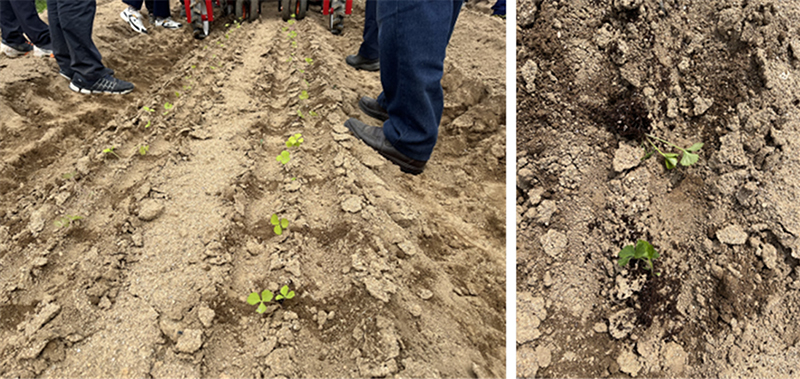
Post-transplantation challenges include seedling misplacement and deviation from the vertical orientation.
3. Engineering implications and mechanism optimization
The results demonstrate that the double-crank five-bar mechanism provides a compact and repeatable trajectory suitable for high-throughput transplanting of plug-grown A. gigas seedlings. Its main advantage was the average planting capacity of 88 seedlings min-1. However, the damage rate of 3%, missed-planting rate of 4%, increased vibration during high-speed operation, and observed seedling-posture deviations indicate that further optimization is necessary.
The priority should be optimization of the linkage geometry and crank phase relationship. Reducing abrupt changes in end-effector direction near the insertion and withdrawal positions would decrease acceleration peaks and vibration. A multi-objective optimization procedure could be used to minimize horizontal velocity at release, maximum acceleration, and trajectory curvature while maintaining the required planting depth.
The second priority should be improved synchronization between machine forward speed, seedling feeding, and duckbill opening. The transmission ratio should be adjusted so that the planting-point velocity satisfies the zero-speed condition at the exact release position. Encoder-based crank-position monitoring or cam-profile adjustment could improve release repeatability and reduce missed planting. Dynamic errors during high-speed operation must be addressed, as joint clearance in linkage mechanisms reduces motion accuracy and reliability due to repeated contact and wear at revolute joints (Liu et al., 2022). Operational vibration can negatively affect the stability and performance of high-speed transplanting machinery, while structural optimization can reduce vibration response (Jin et al., 2022). Joint clearance may be minimized by improving manufacturing tolerances, using precision bearings, and properly fitting linkage joints. Transmission backlash can be reduced through enhanced chain tensioning and sprocket alignment. Structural vibration may be suppressed by increasing frame stiffness and incorporating vibration-damping components at critical connection points. Future research should directly measure acceleration, joint displacement, and transmission backlash under field conditions to quantify these dynamic effects and optimize the mechanism for stable high-speed operation.
The duckbill contact surface should be manufactured from a compliant, low-friction material to reduce plug compression and bruising. Real-time force feedback could further improve seedling handling by adapting the holding force according to plug size and cohesion. Force-controlled gripping systems have achieved high clamping success while maintaining relatively uniform gripping force (Li et al., 2022).
Trial 3 was selected for prototype fabrication and field evaluation because the simulated trajectory achieved the required downward penetration and withdrawal while maintaining the target plant-to-plant spacing. Under the evaluated field conditions, the transplanting rate reached 88.0 ± 2.0 seedlings per minute. Seedling damage and missed-planting rates were 3.0 ± 1.0% and 4.0 ± 1.0%, respectively. Transplanting accuracy and uprightness accuracy were 96.0 ± 1.0% and 95.0 ± 1.0%, respectively, with a mean plant-to-plant spacing of 20.0 ± 0.3 ㎝. Increased vibration and occasional deviations in seedling posture were observed during high-speed operation. However, the individual effects of rapid acceleration changes, joint clearance, transmission backlash, and release-timing variations were not quantified. Additional field evaluations under varying operating speeds and soil conditions, along with direct measurement of hopper velocity at release and the dynamic response of the mechanism, are recommended.
Acknowledgments
This work was carried out with the support of “Cooperative Research Program for Agriculture Science & Technology Development (Project No.RS-2022-RD010298)”, Rural Development Administration, Republic of Korea.
References
- Ali MR, Ali M, Reza MN, Jang GH, Kang BS, Choi IJ and Koo JM. (2024a). Trends of vegetable transplanting mechanism for biodegradable seedling pots: A review. Precision Agriculture Science and Technology. 6:179-194.
-
Ali MR, Reza MN, Habineza E, Haque MA, Kang BS and Chung SO. (2024b). Kinematic analysis of a cam-follower-type transplanting mechanism for a 1.54 kW biodegradable potted cabbage transplanter. Machines. 12:925. https://www.mdpi.com/2075-1702/12/12/925, (cited by 2026 Sep 14).
[https://doi.org/10.3390/machines12120925]

- Ali MR, Reza MN, Rahman MA, Choi JM, Lee KH, Chung SO and Jeong K. (2025). Design and performance evaluation of a double crank five bar and finger type medicinal crop transplanter. Precision Agriculture Science and Technology. 7:243-263.
-
Bai H, Li X, Zeng F, Cui J and Zhang Y. (2022). Study on the impact damage characteristics of transplanting seedlings based on pressure distribution measurement system. Horticulturae. 8:1080. https://www.mdpi.com/2311-7524/8/11/1080, (cited by 2026 Sep 14).
[https://doi.org/10.3390/horticulturae8111080]
-
Bai J, Sun W, Zhao M, Zhang L, Wang J and Simionescu PA. (2025). Design and experiment of the Codonopsis pilosula outcrop film-laying and transplanting machine. AgriEngineering. 7:131.
[https://doi.org/10.3390/agriengineering7050131]
-
Cho Y and Nam JS. (2024). Soil mechanical systems and related farming machinery. Agriculture. 14:1661. https://www.mdpi.com/2077-0472/14/9/1661, (cited by 2026 Sep 14).
[https://doi.org/10.3390/agriculture14091661]
-
Choi WC, Kim DC, Ryu IH and Kim KU. (2002). Development of a seedling pick-up device for vegetable transplanters. Transactions of the ASAE. 45:13-19.
[https://doi.org/10.13031/2013.7864]
-
Feng Y, Liu M, Wang K, Ling Y, Hu Q, Zhang H and Zhang H. (2024). Optimal seeding rate enhances seedling quality, mechanical transplanting quality, and yield in hybrid rice. Frontiers in Plant Science. 15:1427972.
[https://doi.org/10.3389/fpls.2024.1427972]
-
Frasconi C, Martelloni L, Raffaelli M, Fontanelli M, Abou Chehade L, Peruzzi A and Antichi D. (2019). A field vegetable transplanter for use in both tilled and no-till soils. Transactions of the ASABE. 62:593-602.
[https://doi.org/10.13031/trans.12896]
-
Habineza E, Ali M, Reza MN, Woo JK, Chung SO and Hou Y. (2023). Vegetable transplanters and kinematic analysis of major mechanisms: A review. Korean Journal of Agricultural Science. 50:113-129.
[https://doi.org/10.7744/kjoas.20230007]
-
Habineza E, Ali MR, Reza MN and Lee KH. (2025a). Kinematic modeling and preliminary field evaluation of a link-driven hopper planting mechanism for a 3.4 kW walking-type pepper transplanter. Machines. 13:1074. https://www.mdpi.com/2075-1702/13/12/1074, (cited by 2026 Sep 14).
[https://doi.org/10.3390/machines13121074]
-
Habineza E, Bicamumakuba E, Reza MN, Chung SO and Hong SJ. (2025b). Theoretical kinematic analysis of a wheel-driven hopper planting mechanism for vegetable transplanters. Korean Journal of Agricultural Science. 52:233-245.
[https://doi.org/10.7744/kjoas.520303]
-
Ji D, Liu L, Zeng F, Zhang G, Liu Y, Diao H, Tian S and Zhao Z. (2024). Design and experimental study of a traction double-row automatic transplanter for Solanum lycopersicum seedlings. Horticulturae. 10:692. https://www.mdpi.com/2311-7524/10/7/692, (cited by 2026 Sep 14).
[https://doi.org/10.3390/horticulturae10070692]
-
Jin X, Cheng Q, Tang Q, Wu J, Jiang L, Wu C and Wang H. (2022). Research on vibration reduction test and frame modal analysis of rice transplanter based on vibration evaluation. International Journal of Agricultural and Biological Engineering. 15:116-122.
[https://doi.org/10.25165/j.ijabe.20221504.7244]
-
Jin X, Cheng Q, Zhao B, Ji J and Li M. (2020). Design and test of 2ZYM-2 potted vegetable seedlings transplanting machine. International Journal of Agricultural and Biological Engineering. 13:101-110.
[https://doi.org/10.25165/j.ijabe.20201301.5494]
-
Jin X, Li M, Li D, Ji J, Pang J, Wang J and Peng L. (2018). Development of automatic conveying system for vegetable seedlings. EURASIP Journal on Wireless Communications and Networking. 2018:178.
[https://doi.org/10.1186/s13638-018-1200-8]
-
Khadatkar A, Pandirwar AP and Paradkar V. (2023). Design, development and application of a compact robotic transplanter with automatic seedling picking mechanism for plug-type seedlings. Scientific Reports. 13:1883.
[https://doi.org/10.1038/s41598-023-28760-4]
-
Khadatkar A, Magar AP, Sawant CP and Modi RU. (2024). Development and testing of automatic seedling extractor in robotic transplanter using mechatronics for nursery seedlings. Discover Applied Sciences. 6:51.
[https://doi.org/10.1007/s42452-024-05670-2]
- Kim HS, Yoo SH, Seol M, Moon SH and Kim HY. (2020). Revision of biotechnology support act for accelerating the bioeconomy. Asian Journal of Innovation and Policy. 9:240-256.
-
Kohli SS and Agrawal VP. (1993). Analysis of a four-bar linkage for a proposed transplanter. Transactions of the ASAE. 36:317- 320.
[https://doi.org/10.13031/2013.28341]
- Kumar P and Raheman H. (2012). Automatic feeding mechanism of a vegetable transplanter. International Journal of Agricultural and Biological Engineering. 5:20-27.
-
Lee ES, An TJ, Park WT, Jeong JT, Lee YJ, Hur M, Han JW, Han SH, Kim YG, Park CG, Chang JK and Kim YI. (2020). A trend analysis of the cultivation status of medicinal crop farmers in Korea. Korean Journal of Agricultural Science. 47:139-161.
[https://doi.org/10.7744/kjoas.2020007]
-
Li P, Yun Z, Gao K, Si L and Du X. (2022). Design and test of a force feedback seedling pick-up gripper for an automatic transplanter. Agriculture. 12:1889. https://www.mdpi.com/2077-0472/12/11/1889, (cited by 2026 Sep 14).
[https://doi.org/10.3390/agriculture12111889]
- Li R, Feng H and Wang M. (2019). Mechanical behavior of root transplanting systems under field conditions. Agricultural Mechanization Research. 41:22-27.
- Liu J, Cao W, Tian D, Tang H and Zhao H. (2016). Kinematic analysis and experiment of planetary five-bar planting mechanism for zero-speed transplanting on mulch film. International Journal of Agricultural and Biological Engineering. 9:84-91.
-
Liu W, Tian S, Wang Q and Jiang H. (2023). Key technologies of plug tray seedling transplanters in protected agriculture: A review. Agriculture. 13:1488. https://www.mdpi.com/2077-0472/13/8/1488, (cited by 2026 Sep 14).
[https://doi.org/10.3390/agriculture13081488]
-
Liu X, Ding J and Wang C. (2022). Design framework for motion generation of planar four-bar linkage considering clearance joints and dynamics performance. Machines. 10:136. https://www.mdpi.com/2075-1702/10/2/136, (cited by 2026 Oct 03).
[https://doi.org/10.3390/machines10020136]
-
Luo W, Sun W, Zhao M, Wang J and Simionescu PA. (2024). Design and field experiment of Codonopsis pilosula film covering transplanter. Scientific Reports. 14:17266.
[https://doi.org/10.1038/s41598-024-68396-6]
- Mohammod A, Haque MA, Rahman MA, Moon JM, Kim KJ, Chung SO and Kim HI. (2024). Mechanization trends of cabbage harvesting practices: A review. Precision Agriculture Science and Technology. 6:218-237.
-
Ning M, Sun W, Luo J and Zhang L. (2025). Electric self- propelled double row transplanter for Angelica sinensis seedlings. Computers and Electronics in Agriculture. 237:110512.
[https://doi.org/10.1016/j.compag.2025.110512]
- Park J, Lee H, Kim S. (2025). Effects of light conditions and root development on plug seedling quality of Angelica gigas Nakai under plant factory environment. Horticultural Science & Technology. 43:21-31.
-
Reza MN, Ali M, Habineza E, Kabir MS, Kabir MSN, Lim SJ, Choi IS and Chung SO. (2023). Analysis of operating speed and power consumption of a gear-driven rotary planting mechanism for a 12-kW six-row self-propelled onion transplanter. Spanish Journal of Agricultural Research. 21:e0207.
[https://doi.org/10.5424/sjar/2023213-20245]
-
Reza MN, Karim MR, Ali MR, Lee KH, Bicamumakuba E, Lee KY and Chung SO. (2025). Field evaluation of a transplanter and a collector under development for Korean spring cabbage production in greenhouses. AgriEngineering. 7:226.
[https://doi.org/10.3390/agriengineering7070226]
-
Son J, Kim C, Park M, Choi D and Yun SW. (2020). Traditional medicine analysis and sustainable use of Korean pond wetland plants in the agricultural landscape. Sustainability. 12:5963. https://www.mdpi.com/2071-1050/12/15/5963, (cited by 2026 Sep 14).
[https://doi.org/10.3390/su12155963]
-
Sun L, Xu H, Zhou Y, Shen J, Yu G, Hu H and Miao Y. (2023). Kinematic synthesis and simulation of a vegetable pot seedling transplanting mechanism with four exact task poses. International Journal of Agricultural and Biological Engineering. 16:85-95.
[https://doi.org/10.25165/j.ijabe.20231602.6739]
-
Timene A and Djalo H. (2023). Design of a five-bar duckbill-type mechanism for sorghum transplanting. Journal of Agricultural Engineering. 54:109-119.
[https://doi.org/10.4081/jae.2023.1473]
-
Vlahidis V, Roșca R and Cârlescu PM. (2024). Evaluation of the functional parameters for a single-row seedling transplanter prototype. Agriculture. 14:388. https://www.mdpi.com/2077-0472/14/3/388, (cited by 2026 Sep 14).
[https://doi.org/10.3390/agriculture14030388]
-
Wang H, Sun W, Wang H and Simionescu PA. (2024). Automated mulched transplanting of Angelica seedlings using a pneumatic sowing device. Agronomy. 14:3076. https://www.mdpi.com/2073-4395/14/12/3076, (cited by 2026 Sep 14).
[https://doi.org/10.3390/agronomy14123076]
- Wang H, Yu L and Chen Z. (2021). Kinematic analysis and optimization of a double crank seedling transplanter. Biosystems Engineering. 198:96-107.
-
Wang T, Sun D, Xiong W, Kuang F, Xue K, Shi M and Zhu D. (2024). Impact of root-stem coupling damage from mechanical transplanting on the growth of large rice seedlings. Plant Growth Regulation. 104:1075-1086.
[https://doi.org/10.1007/s10725-024-01219-w]
-
Wen Y, Zhang J, Tian J, Duan D, Zhang Y, Tan Y, Yuan T and Li X. (2021). Design of a traction double-row fully automatic transplanter for vegetable plug seedlings. Computers and Electronics in Agriculture. 182:106017.
[https://doi.org/10.1016/j.compag.2021.106017]
-
Xin L, Lv Z, Wang W, Zhou M and Zhao Y. (2017). Optimal design and development of a double-crank potted rice seedling transplanting mechanism. Transactions of the ASABE. 60:31-40.
[https://doi.org/10.13031/trans.11680]
-
Zhao X, Guo J, Li K, Dai L and Chen J. (2020). Optimal design and experiment of a 2-DoF five-bar mechanism for flower seedling transplanting. Computers and Electronics in Agriculture. 178:105746.
[https://doi.org/10.1016/j.compag.2020.105746]
-
Zhao X, Hou Z, Zhang J, Yu H, Hao J and Liu Y. (2024). Study on the hole-forming performance and opening of mulching film for a dibble-type transplanting device. Agriculture. 14:494. https://www.mdpi.com/2077-0472/14/3/494, (cited by 2026 Sep 14).
[https://doi.org/10.3390/agriculture14030494]
- Zhao Y, Li Y and Zhou H. (2018). Dynamic simulation of seedling delivery mechanisms using multi-body modeling. Journal of Agricultural Engineering Research. 64:187-193.
-
Zhou M, Wang G, Zhang Y, Yang J, Wei Z, Sun H and Yin J. (2024). Design and test of walk-type rice potted seedling transplanting machine. Advances in Mechanical Engineering. 16:16878132241237710.
[https://doi.org/10.1177/16878132241237710]