
부처손속 세 종 판별을 위한 엽록체 유전체 기반 InDel 마커 개발 및 예비검증
This is an open access article distributed under the terms of the Creative Commons Attribution Non-Commercial License (http://creativecommons.org/licenses/by-nc/3.0/) which permits unrestricted non-commercial use, distribution, and reproduction in any medium, provided the original work is properly cited.
Abstract
Selaginella tamariscina (P. Beauv.) Spring is an important medicinal plant known as ‘Gwonbaek’ in Korea. However, its morphological similarity to S. stauntoniana Spring and S. involvens (Sw.) Spring can lead to misidentification in herbal materials. Therefore, reliable molecular markers are needed to distinguish these species.
Complete plastome sequences of the three Selaginella species were compared to identify species-specific sequence variations. Phylogenetic analysis based on multiple-sequence alignments resolved the three species into distinct clades. Based on Insertion or Deletion (InDel) regions in the plastomes, four gel-based InDel markers were developed and evaluated using 10 Selaginella samples. The markers distinguished the three species based on their PCR amplification patterns and identified a market sample as S. tamariscina.
The four plastome-based InDel markers showed preliminary discriminatory ability among the tested samples of the three Selaginella species, demonstrating their potential for the molecular identification and quality control of Gwonbaek-related medicinal plant materials.
Keywords:
Insertion or Deletion Marker, Medicinal Plant, Molecular Identification, Plastome, Selaginella tamariscina서 언
부처손속 (Selaginella)은 석송문 부처손과에 속하는 유일한 속으로 전 세계에 약 700 종이 분포하며 (Schuettpelz et al., 2016), 국내에는 9 종이 분포하는 것으로 알려져 있다 (Park, 2015). 이들은 주로 열대 및 아열대 지역 산지에 분포하며, 독특한 형태적 특성과 다양한 환경 적응 양상을 보여 진화 및 분류학 연구의 중요한 대상으로 활용되고 있다 (Banks et al., 2011; Schuettpelz et al., 2016). 이 가운데 바위손 [Selaginella tamariscina (P. Beauv.) Spring]은 우리나라에서 한약재 권백(卷柏)의 기원식물로 이용되는 대표적인 약용식물이다 (Korea Institute of Oriental Medicine, 2014; Kim and Lee, 2021). 권백은 전통한방에서 탈항, 혈뇨, 월경불순, 지혈, 천식 및 만성간염의 치료를 목적으로 사용되어 왔으며, 최근에는 메탄올 추출물의 경구 투여를 통한 치매 개선효과를 확인하였다 (Chu et al., 2016). 또한 열수추출물과 에탄올 추출물을 대상으로 항산화, 항염 및 세포재생 효능이 밝혀지기도 하였다 (Kim and Lee, 2021).
바위손 [S. tamariscina (P. Beauv.) Spring]은 권백의 대표적인 기원식물로 이용되고 있으나, 개부처손 (S. stauntoniana Spring) 및 부처손 [S. involvens (Sw.) Spring]과 형태적으로 유사하여 생체 상태에서도 종을 정확히 구별하기 어렵고, 건조 및 가공 이후에는 형태학적 식별이 더욱 제한된다. 특히 권백의 유통 과정에서 부처손이 동일한 명칭으로 혼용되고 있어, 약용 원료의 오동정 및 품질 저하와 직접적으로 관련된다 (Park et al., 2020). 반면 국내에 분포하는 나머지 부처손속 식물은 본 연구의 주요 목적이었던 권백 원료의 진위 판별 및 유통 약재의 품질 관리와 직접적인 관련성이 상대적으로 낮다. 따라서 권백의 정확한 원료 식별이라는 실용적 목적을 고려하여 국내에 분포하는 부처손속 9 종 가운데 바위손, 개부처손, 부처손을 우선적인 판별 대상으로 선정하였다.
최근에는 형태형질에만 의존한 동정의 한계를 보완하기 위해 유전체 정보를 활용한 분자생물학적 식별 연구가 활발히 수행되고 있다. 그중에서도 엽록체 유전체 (plastome)는 모계 유전으로 인해 비교적 보존적인 구조를 유지하면서도 종 간 변이를 효율적으로 탐지할 수 있어, 종 판별, 계통분석, 분자표지 개발에 유용한 자료로 널리 활용되고 있다 (Jansen et al., 2005; Wicke et al., 2011; Daniell et al., 2016). 더불어 차세대염기서열분석 기술의 발달로 엽록체 전장유전체 서열의 확보가 용이해짐에 따라, 이를 기반으로 한 고해상도 분자표지 개발과 정밀한 종 감별 연구가 이루어지고 있다 (Shim et al., 2021). 특히 엽록체 유전체 기반 Insertion or Deletion (InDel) 변이는 종 판별 분자표지 개발에 유용한 특징을 갖는다. InDel 마커는 염기서열의 삽입 또는 결실에 기반하여 전기영동 상에서 명확한 밴드 크기 차이를 보이므로, 복잡한 염기서열 해석 없이도 신속하게 종을 구별할 수 있다. 이러한 장점으로 인해 엽록체 유전체 기반 InDel 마커는 약용식물의 종 동정 및 품질 관리에도 활용되고 있다 (Park et al., 2020; Shim et al., 2021).
본 연구에서는 바위손, 개부처손, 부처손의 엽록체 유전체와 45S ribosomal DNA (45S nrDNA) 서열을 확보하여 종 간 유전적 변이 양상을 분석하였다. 아울러 엽록체 유전체에서 확인된 InDel 변이를 기반으로 종 특이적 InDel 마커를 설계하고, 이를 10 점의 식물자원에 적용하여 예비 검증하고자 하였다. 이를 통해 부처손속 3 종을 신속하게 구별할 수 있는 분자표지 체계를 구축하고, 약용식물 원료의 정확한 동정과 품질 관리에 활용 가능한 기초자료를 제시하고자 하였다.
재료 및 방법
1. 식물자원
총 10 점의 부처손속 식물자원이 분석에 사용되었으며, 표준 시료 2 점, 표본 시료 7 점, 유통 한약재 시료 1 점이 수집되었다 (Table 1, Fig. 1).
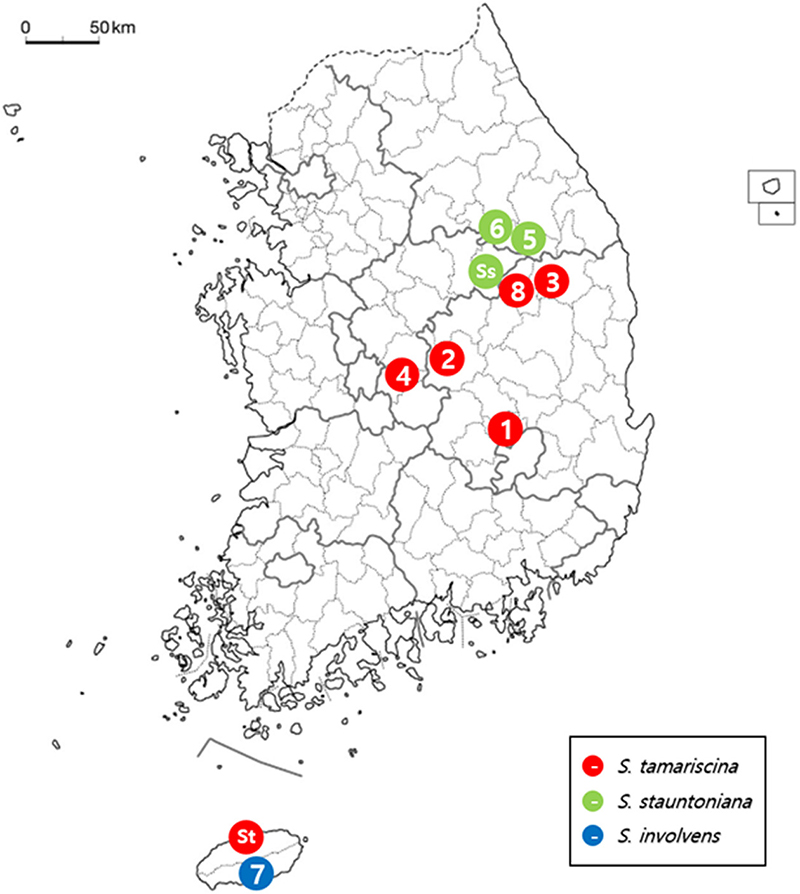
Geographic distribution of collected Selaginella samples.Numbers within circle correspond to sample IDs listed in Table 1, and circle colors denote species: red, S. tamariscina, green, S. stauntoniana, blue, S. involvens.

Source of Selaginella samples used in this study.
본 연구에서 수집한 표준 바위손 시료 (St)와 개부처손 시료 (Ss)는 각각 제주특별자치도 제주시와 충청북도 단양군에서 채집하였다. 이들 표준 시료의 종 동정은 서울대학교 양태진 교수에 의해 수행되었으며, Park (2015)의 한국 부처손속 분류체계를 참고하여 동정하였다. 본 연구에 사용된 DNA 시료는 서울대학교 식물유전체육종연구소에 바위손 (SNU2018) 및 개부처손으로 각각 보관되어 있다.
표본시료 7 점 (1–7)은 한국한의학연구원 (KIOM) 한약자원연구센터로부터 제공받았다. 이들 표본의 종 동정은 KIOM 소속 연구진의 식물분류학자에 의해 수행되었으며, 건조된 지상부의 형태형질 (엽의 배열, 줄기의 색상 및 분지 패턴)을 기준으로 바위손 4 점, 개부처손 2 점, 부처손 1 점으로 동정되었다. 제공된 표본은 KIOM 한약자원연구센터의 한약표준표본관에 보관되어 있으며, 본 연구에 사용된 DNA 시료는 해당 표본과 동일한 시료에서 추출된 것이다.
유통 약재 시료 1 점 (8)은 KIOM 한약표준자원은행 (https://oasis.kiom.re.kr/herblib/rsrc/resrceList.do)에 산지 등의 정보가 제공되어 있으며, KIOM으로부터 분양받아 분석에 활용하였다. 이 시료는 광명당제약에서 제조된 권백 한약재이며 최고야 한약자원연구센터장이 관능감정을 수행하였고, 박인규 한약자원연구센터 연구원의 ITS2 유전자 감정을 통해 바위손으로 판정되었다. 본 연구에 사용된 모든 식물자원은 관련 기관, 국가 및 국제 지침과 법률을 엄격히 준수하여 수집 및 이용되었다.
2. DNA 추출
식물자원의 잎 조직을 액체질소로 급속 냉각한 후 막자사발과 막자를 이용하여 마쇄하였다. 마쇄된 샘플로부터 cetyltrimethylammonium bromide (CTAB) method를 이용하여 genomic DNA를 추출하였다 (Doyle and Doyle, 1987).
추출된 DNA는 NanoDrop ND-1000 (Thermo Fisher Scientific Inc., Waltham, MA, USA)을 사용하여 농도와 순도를 측정하였으며, 1% agarose gel 전기영동을 통해 품질을 확인하였다. 이후 멸균 증류수를 이용하여 DNA 농도를 10 ng/μL로 조정하여 실험에 사용하였다.
3. 엽록체 유전체 서열 및 45S nrDNA 서열 조립
바위손의 엽록체 서열 및 45S nrDNA 서열을 확보하기 위해 Illumina Miseq platform (Illumina Inc., San Diego, CA, USA)을 이용하여 NGS 정보를 생성하였다. 생성된 NGS 데이터는 CLC Genome Assembler program (CLC Inc., Aarhus, Denmark)과 연구실에서 개발한 de novo assembly of low-coverage whole-genome sequencing (dnaLCW) 방법을 통해 조립 및 비교 분석에 이용하였다 (Lu et al., 2017; Park et al., 2021). 엽록체 유전체 서열 분석에 사용된 NGS 데이터는 엽록체 유전체 기준 93.21 X, 45S nrDNA 기준 3233.52 X의 평균 염기서열 깊이 (coverage)를 나타냈다 (Table 2).
Sources of Selaginella raw genome data used in this study
또한 National Center for Biotechnology Information (NCBI, https://www.ncbi.nlm.nih.gov/) 데이터베이스로부터 엽록체 유전체 서열과 45S nrDNA 서열을 추가로 수집하였다.
조립된 엽록체 유전체의 유전자 주석 (annotation)은 GeSeq (https://chlorobox.mpimp-golm.mpg.de/geseq.html)을 이용하여 수행하였으며 (Tillich et al., 2017), Artemis를 통해 시작코돈, 종결코돈 및 인트론 경계를 검토하고 수동으로 보정하였다 (Berriman and Rutherford, 2003). 주석이 검토 및 보정된 엽록체 유전체는 OrganellarGenomeDRAW (OGDRAW) 프로그램을 이용하여 원형 유전체 지도를 작성하였다 (Lohse et al., 2013).
4. 엽록체 유전체 서열 InDel 변이지역 탐색
수집된 엽록체 유전체 서열들은 MAFFT v7.505 (https://mafft.cbrc.jp/alignment/server/index.html)를 이용하여 다중서열정렬을 수행하였다 (Katoh et al., 2002). 엽록체 유전체 내 InDel 변이의 분포를 분석하기 위하여, 다중서열정렬 파일을 custom Python script로 분석하여 InDel 위치를 추출하였다. 정렬 파일의 첫 번째 서열인 S. tamariscina (Genbank ID. PZ744790)를 참조 서열로 설정하고, 참조 서열과 나머지 9개 엽록체 유전체 서열을 정렬 위치별로 비교하여 gap (-)이 포함된 불일치 위치를 InDel로 판정하였다. 이때 연속된 여러 염기의 삽입 또는 결실이 하나의 gap block으로 나타나더라도, 정렬상 gap이 확인되는 개별 염기 위치를 각각 독립적인 InDel 변이로 계수하였다. 추출된 InDel 정보 (정렬상 위치, 변이 유형, 샘플 정보)는 Excel 파일로 정리하였다.
이후 RStudio의 custom R script를 이용하여 InDel 변이지역 분포를 분석하였다. InDel 수는 600 bp의 window를 200 bp 간격으로 이동시키면서 각 window에 포함되는 InDel 위치의 수를 계수하였으며, 참조 서열의 position (bp)을 x축, 해당 window 내 변이 수를 y축으로 하여 sliding-window plot을 작성하였다 (Lee et al., 2026). 본 분석에는 R의 readxl (Wickham and Bryan, 2026), ggplot2 (Wickham, 2016), Biostrings 패키지 (Pagès et al., 2026)를 사용하였다.
5. 엽록체 유전체 서열 및 45S nrDNA 계통분석
계통분석은 엽록체 유전체 내 공통 protein-coding gene (CDS) 서열과 45S nrDNA 서열을 기반으로 수행되었다. 먼저, 각 종의 엽록체 유전체 GenBank 파일을 DTU Health Tech의 FeatureExtract 1.2 웹서버 (https://services.healthtech.dtu.dk/services/FeatureExtract-1.2/)에 업로드하고, 기본 설정 (extract all protein coding genes)으로 CDS 특징만을 추출한 후, 각 CDS의 spliced nucleotide 서열을 FASTA 형식으로 다운로드하였다 (Wernersson, 2005). 종 간 공통으로 주석이 달린 44개 CDS를 선별하고, 각 유전자별로 종 간 서열을 유전자 단위로 MAFFT를 이용하여 다중서열정렬을 수행하였다 (Katoh et al., 2002). CDS 정렬은 nucleotide 수준에서 수행하되, reading frame을 유지하기 위해 codon aware 정렬 전략을 따랐다. 즉, MAFFT 정렬 시 아미노산 서열을 기준으로 정렬한 후 해당 정렬 정보를 nucleotide 서열로 역매핑하는 방식을 사용하였다. 정렬 결과에서 gap 비율이 높거나 정렬 신뢰도가 낮은 ambiguous region은 trim automated1 옵션 (Capella-Gutiérrez et al., 2009) 또는 Gblocks (Castresana, 2000)를 이용하여 제거하였다. 유전자별 정렬 서열은 5′→3′ 방향으로 연결하여 하나의 공통 CDS supermatrix를 구축하였다. 45S nrDNA 영역은 별도의 CDS 추출 과정 없이, 서열을 수집하여 MAFFT로 다중서열정렬을 수행하여 45S nrDNA supermatrix를 생성하였다.
계통수는 공통 CDS와 45S nrDNA의 supermatrix를 이용하여 randomized accelerated maximum likelihood (RAxML) v8.2.12 프로그램으로 Maximum-Likelihood (ML) 방법을 통해 구축하였다 (Stamatakis, 2014). Nucleotide substitution model 은 GTRGAMMA를 적용하였으며, 유전자별 진화속도 차이를 반영하기 위해 유전자 단위의 partition을 설정하고, 각 partition에 GTRGAMMA 모델을 할당하여 분석을 수행하였다. Outgroup으로 Isoetes wormaldii의 엽록체 유전체 서열 (Genbank ID. ON060523.1)을 사용하였으며, 이는 부처손속과 자매군 관계가 잘 확립된 물부추속으로서 외군 설정에 적합하기 때문이다. Bootstrap 반복수는 1,000 회로 설정하여 계통수의 신뢰도를 평가하였다. 계통분석 결과는 FigTree v1.4.4를 이용하여 시각화하였다 (Rambaut, 2007).
6. InDel 마커 개발 및 적용
본 연구에서는 종내에서 안정적이면서 종간에는 명확한 길이 차이를 나타내는 부위를 탐색하여 마커를 설계하였다. 특히 전기영동 시 쉽게 구별할 수 있도록 10 bp 이상의 InDel을 포함하는 후보 영역을 선정하였다. 다중서열정렬 결과를 바탕으로 BioEdit v7.2 (https://bioedit.software.informer.com/7.2/)의 ClustalW Multiple sequence alignment 기능을 이용해 종 특이적인 InDel 변이 지역을 탐색하였다 (Hall, 1999). 선별된 InDel 변이 지역에 대하여 NCBI Primer-BLAST (https://www.ncbi.nlm.nih.gov/tools/primer-blast/)를 이용하여 프라이머를 설계하였다 (Ye et al., 2012). 프라이머 설계 시 안정적인 증폭을 보장하기 위하여 다음과 같은 기준을 엄격히 적용하였다. 증폭 산물 (amplicon)의 크기는 70 – 500 bp로 제한하였다. 프라이머 서열은 GC 함량이 40 – 60% 범위 내에 있고, 용해 온도 (melting temperature)가 58 – 61℃가 되도록 선정하였으며, 2 차 구조 (secondary structures), hairpin loop, primer dimer 형성이 예상되는 영역은 회피하였다.
PCR 반응 혼합물은 총 25 ㎕로 조성하였으며, 10 ng/㎕ genomic DNA 2 ㎕, 10 X Taq buffer (Genocell Inc., Seongnam, Korea) 2 ㎕, 10 mM dNTP 2 ㎕, Forward primer (10 pmole/㎕) 1 ㎕, Reverse primer (10 pmole/㎕) 1 ㎕, 5 U/㎕ Taq Polymerase (Genocell Inc., Seongnam, Korea) 0.3 ㎕, 멸균 증류수 16.7 ㎕로 구성하였다. PCR은 SimpliAmp Thermal Cycler (Thermo Fisher Scientific Inc., Waltham, MA, USA)를 사용하여 혼합물을 증폭시켰다. PCR 반응은 pre-denaturation 94℃ 10 분, denaturation 94℃ 20 초와 annealing 58℃ 20 초 그리고 extension 72℃ 20 초로 총 37 회 반복하였고 final extension 72℃ 7 분, cool down 4℃ 조건으로 수행되었다.
PCR 증폭 산물은 3% agarose gel에서 100V 1시간 동안 전기영동을 진행한 후, GelDocTM XR+ Gel Documentation System (Bio-Rad Laboratories Inc., Hercules, CA, USA)에서 3 종 간의 밴드 크기 차이를 확인하였다. 개발된 모든 InDel 마커에 대하여 동일한 genomic DNA를 이용하여 독립적으로 2회 이상 PCR과 전기영동을 반복 수행하였으며, 각 반복 실험에서 동일한 밴드 크기 차이가 관찰되는 경우에만 해당 마커를 종 판별용 마커로 최종 선정하였다.
결과 및 고찰
1. 엽록체 유전체 서열 및 45S nrDNA 서열 조립
본 연구에서는 바위손의 엽록체 유전체와 45S nrDNA 서열을 신규 조립하였으며, 비교 분석을 위한 동일 속 3 종의 엽록체 및 45S nrDNA 서열은 NCBI 데이터베이스에서 수집하였다 (Table 2, Table 3).
Plastome information about 3 Selaginella species examined in this study.
조립된 바위손의 엽록체 유전체는 126,401 bp였으며, LSC (53,270 bp), SSC (47,571 bp), DRA·DRB (12,780 bp)의 사분구조를 나타냈다. 바위손 엽록체 유전체의 유전자 주석 결과, 총 75 개의 유전자가 확인되었으며, 이 중 60 개의 protein-coding gene, 7 개의 tRNA, 그리고 8 개의 rRNA를 포함하였다. 이러한 유전자 구성과 엽록체 유전체 구조는 본 연구실에서 이전에 보고한 바위손 엽록체 유전체와 동일하였다 (Shim et al., 2021).
엽록체 유전체 크기는 바위손 (126.4 kb)과 개부처손 (126.8 – 127.3 kb)이 유사한 반면, 부처손은 약 143.3 kb로 약 16 kb 크게 나타났다 (Table 3). 이러한 차이는 주로 LSC 영역의 확장 (약 83.4 kb)과 SSC 영역의 축소 (약 35.8 kb)에 기인하였으며, 반복 영역은 3 종 모두 약 12.0 – 12.8 kb로 비교적 안정적으로 유지되었다. 특히 부처손에서 관찰된 엽록체 유전체 확장은 주로 LSC 구간의 증가에 기인하는 것으로 판단되며, 본 속의 엽록체 유전체 크기 차이는 전체 염기서열 변이뿐만 아니라 구간별 확장 및 수축과도 밀접하게 관련되는 것으로 보인다 (Shim et al., 2021). 45S nrDNA의 길이는 바위손 5,789 bp, 개부처손 5,847 bp, 부처손 5,769 bp로 종간 차이가 크지 않았다. 18S, 5.8S 및 ITS2 영역은 높은 보존성을 보인 반면, 길이 차이는 주로 ITS1과 26S 영역에서 확인되었다 (Table 3).
조립된 엽록체 유전체와 45S nrDNA 서열을 이용하여 바위손의 엽록체 원형 지도와 45S nrDNA 지도를 작성하였다 (Fig. 2).
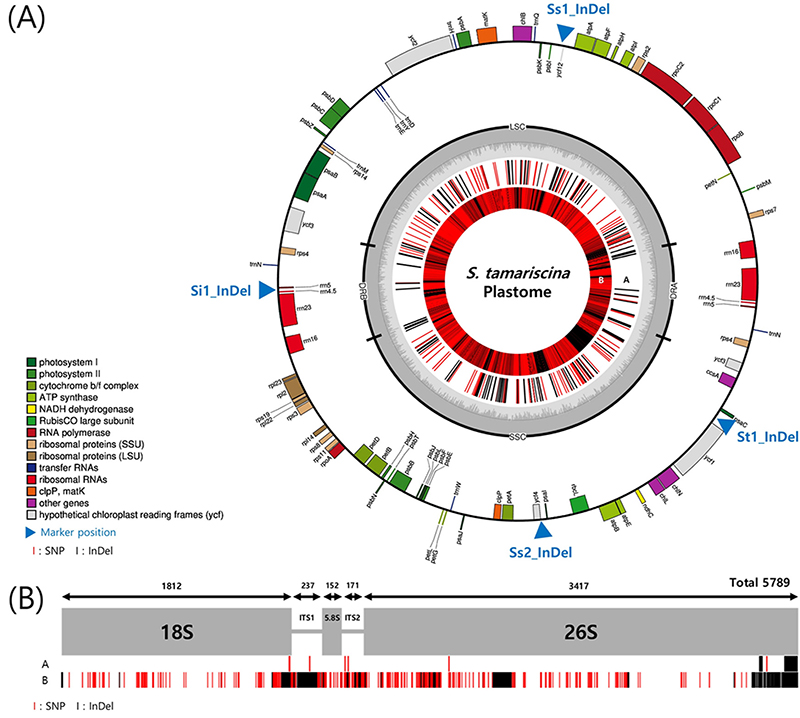
Plastome circular map and 45S nrDNA structure of S. tamariscina.(A) The plastome map was drawn using OGDRAW. The outer and inner gray boxes indicate genes transcribed in the clockwise and counterclockwise directions, respectively. Marker positions are shown as blue triangles. SNP and InDel variants were extracted based on the S. tamariscina reference sequence (PZ744790). Red bars indicate SNP sites, and black bars indicate InDel sites among four S. tamariscina in label A; in label B, they indicate variants among ten plastomes of three species. (B) The 45S nrDNA structure was drawn based on the S. tamariscina nrDNA sequence. Gray boxes indicate transcribed regions. SNP and InDel variants were extracted based on the S. tamariscina reference sequence. Red and black bars show SNP/InDel variants among three S. tamariscina in label A and among seven nrDNA of three species in label B.
엽록체 유전체는 전형적인 사분구조를 나타냈으며, 광계, ATP synthase, NADH dehydrogenase, cytochrome b/f complex, 리보솜 단백질, tRNA 및 rRNA 유전자가 전체 유전체에 분포하였다 (Fig. 2A). 엽록체 유전체의 SNP와 InDel 변이를 비교한 결과, 종내 (label A)보다 종간 (label B)에서 변이가 현저히 많이 확인되었으며, 대부분 비암호화 영역 (intergenic spacer)과 일부 유전자 인접 영역에 집중되었다. 45S nrDNA는 18S, ITS1, 5.8S, ITS2 및 26S로 구성된 전형적인 구조를 나타냈으며, 종간 변이는 ITS1, 5.8S, ITS2 및 26S rRNA 유전자 영역에 주로 분포하는 반면, 18S 영역은 상대적으로 높은 보존성을 유지하였다 (Fig. 2B).
2. 엽록체 유전체 및 45S nrDNA 서열 변이 분석
3 종의 엽록체 유전체 비교 결과, 바위손과 개부처손 사이에서는 3,474 – 3,574 개의 SNP와 676 – 718 개의 InDel이 검출된 반면, 바위손과 부처손 사이에서는 28,912 – 28,973 개의 SNP와 2,341 – 2,361 개의 InDel이 확인되었다 (Table 4).
SNP and InDel counts among the plastome of 3 Selaginella species.
동일 종 내에서는 바위손이 1 – 137 개의 SNP와 15 – 112 개의 InDel, 개부처손이 23 – 652 개의 SNP와 19 – 191 개의 InDel, 부처손이 283 개의 SNP와 96 개의 InDel을 나타내어 종간 변이에 비해 현저히 낮은 변이 수준을 보였다.
45S nrDNA 비교에서도 유사한 경향이 확인되었다 (Table 5).
SNP and InDel counts among 3 Selaginella species 45S nrDNA sequences.
바위손과 개부처손 사이에서는 78 – 90 개의 SNP와 7 – 10 개의 InDel, 바위손과 부처손 사이에서는 457 – 458 개의 SNP와 32 – 35 개의 InDel이 검출된 반면, 동일 종 내에서는 바위손이 0 – 7 개의 SNP와 0 – 2 개의 InDel, 개부처손이 12 개의 SNP와 5 개의 InDel, 부처손이 5 개의 SNP와 2 개의 InDel만 확인되었다.
3 종의 엽록체 유전체 내의 InDel 변이지역 탐색 결과, 총 33,997 개의 InDel 변이가 확인되었으며, sliding-window 분석을 통해 추정한 InDel density는 유전체 전반에 걸쳐 국소적 으로 분포하였다 (Fig. 3).
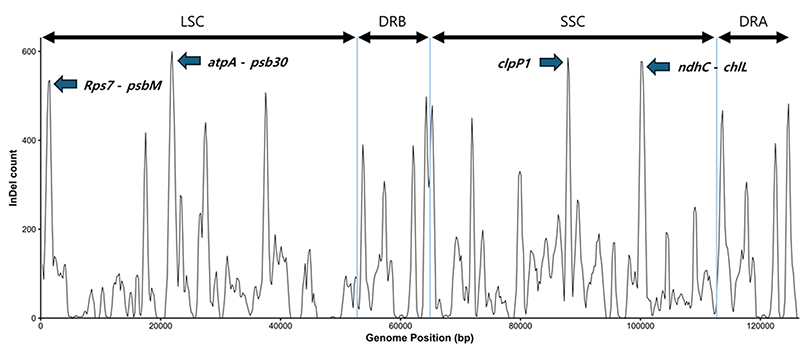
Distribution of InDel density across the ten plastomes of three species using the S. tamariscina plastome as the reference.InDel density was estimated by sliding window analysis using a 600bp window with a 200bp step size. The distribution of InDels was uneven across the plastome, with several localized regions exhibiting elevated levels of sequence variation. Most highly variable InDel hotspots were located within the LSC and SSC regions, whereas the repeat regions remained comparatively conserved. Arrows indicate the major InDel hotspots in the Rps7–psbM and atpA–psb30 regions within the LSC region, and in the clpP1 and ndhC–chlL regions within the SSC region.
특히 LSC와 SSC 구역의 intergenic spacer (IGS)에서 높은 InDel 밀도가 보인 반면, direct repeat (DR) 영역은 상대적으로 보존된 양상을 보였다 (Fig. 3). 이는 IGS 영역이 코딩 영역보다 기능적 제약이 낮아 삽입·결실 변이가 더 쉽게 축적될 수 있음을 시사하며, 엽록체 유전체의 변이 hotspot이 주로 LSC, SSC 구역의 IGS에 분포한다는 기존 비교유전체 연구 및 고사리류 Davalliaceae의 연구 결과와도 일치한다 (Lu et al., 2017; Abdullah et al., 2021; Wang et al., 2025).
3 종 사이의 엽록체 유전체 내 InDel hotspot 영역 4 곳에서 변이 양상을 검증한 결과, hotspot 영역에서는 종 간에 구분 가능한 InDel pattern이 다수 확인되었다 (Fig. 3). 반면 바위손, 개부처손 및 부처손의 종 내 InDel 변이는 매우 적거나 관찰되지 않았다. 이러한 결과는 이들 IGS 영역이 종 내에서는 안정적으로 보존되고 종 간에서는 판별 가능한 변이를 지닌다는 점에서, 종 식별용 InDel 마커로 활용될 수 있는 유용한 후보 영역임을 뒷받침한다.
3. 엽록체 유전체 및 45S nrDNA 계통분석
엽록체 공통 coding DNA sequence (CDS)와 45S nrDNA 서열을 이용하여 ML 계통분석을 수행한 결과, 두 데이터에서 모두 유사한 계통 구조가 관찰되었다 (Fig. 4).
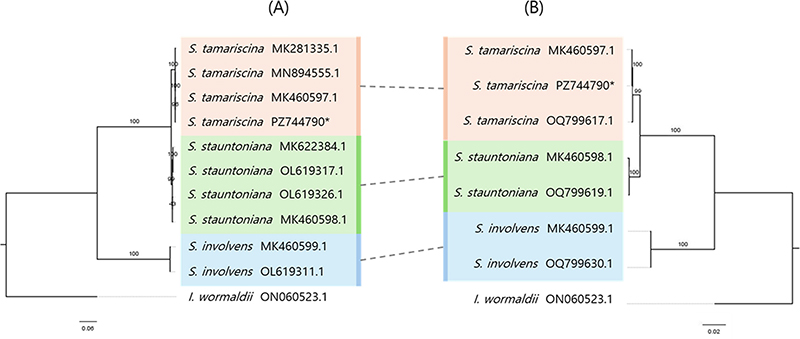
Maximum-likelihood phylogenetic trees of 3 Selaginella species from plastome common CDS and 45S nrDNA sequences.Trees were generated using RAxML software. The outgroup is Isoetes wormaldii, a member of the Isoetaceae family. Bootstrap values are represented above the branches. The scale bar represents genetic distance (substitutions per site). NCBI Genbank/SRA accession ID written next to the species name. (A) Plastome common CDS-based ML phylogenetic tree. (B) 45S nrDNA-based ML phylogenetic tree. Accessions belonging to the same species between two trees are connected with the same color. * Newly assembled in our laboratory.
모든 동일 종 개체는 각각 하나의 계통군을 형성하였으며, 바위손과 개부처손이 자매군 (sister group)으로 묶이고 부처손은 이들과 명확히 분리된 독립적인 계통군을 형성하였다. 또한 본 연구에서 신규 조립한 바위손 엽록체 및 45S nrDNA 서열은 각각 NCBI 서열과 동일한 종 내에서 군집하여 기존 동일 종 서열과 계통학적 일관성을 확인하였다.
이러한 계통적 분리 양상은 엽록체 유전체와 45S nrDNA 모두에서 확인된 SNP 및 InDel 변이 패턴과 일치하며, 본 연구에 포함된 3 종 간에 부처손이 바위손 및 개부처손과 구별되는 유전적 거리를 가짐을 나타낸다. 이는 기존의 부처손속 계통분석 연구에서 보고된 결과와도 일치하는 경향이다 (Shim et al., 2021; Zhou et al., 2022). 본 분석에는 사용된 accession 이 종별로 명확한 군집을 이루며 plastome CDS와 45S nrDNA 두 데이터에서 일관된 종 간 분리 패턴을 보인다는 점을 확인하는 데 중점을 두었다.
4. 종 특이적 InDel 마커 개발
마커 및 프라이머 설계 기준에 따라 6 개의 후보 InDel 마커를 확보하였으며, 이들을 대상으로 PCR 증폭 안정성, 종 특이성 및 전기영동에서의 밴드 분리도를 평가하였다. 그 결과 4개의 마커는 모든 시료에서 안정적인 증폭과 명확한 종 특이적 밴드 패턴을 나타낸 반면, 1 개의 마커후보는 다른 마커후보와 유전자 영역이 중복되었고, 나머지 1 개는 종간 밴드 크기 차이가 충분하지 않아 판독이 어려워 최종 선발 대상에서 제외하였다. 따라서 최종적으로 부처손속 3 종을 판별할 수 있는 4 개의 종 특이적 InDel 마커를 개발하였다 (Table 6).
Information of species specific InDel markers developed in this study.
최종 선발된 마커는 바위손 특이 마커 1 개 (St1_InDel), 개부처손 특이 마커 2 개 (Ss1_InDel, Ss2_InDel), 부처손 특이 마커 1 개 (Si1_InDel)로 구성되었다. St1_InDel과 Ss1_InDel, Ss2_InDel은 각각 ycf1–psaC, ycf12–psbI 및 ycf4–psaI 영역의 InDel을 기반으로 설계되었으며, Si1_InDel은 rrn4.5–rrn23 반복 영역의 InDel을 이용하여 개발되었다. 개발된 마커들은 엽록체 유전체의 서로 다른 영역에 분산되어 있어 특정 유전체 구간에 편중되지 않으며 (Fig. 2A), universal barcode 영역이 아니라 그 밖의 변이 구간을 활용했다는 점에서 차별적이다. 따라서 본 연구에서 개발한 InDel 마커는 기존 universal barcode를 보완할 수 있는 실용적 도구라는 강점을 가진다.
5. 개발된 InDel 마커의 검증 및 활용 가능성
개발된 InDel 마커의 판별 성능을 검증하기 위해 표준시료 2 점, 표본시료 7 점, 유통한약재 1 점을 포함한 총 10 점의 식물자원을 대상으로 PCR 분석을 수행하였다 (Fig. 5).
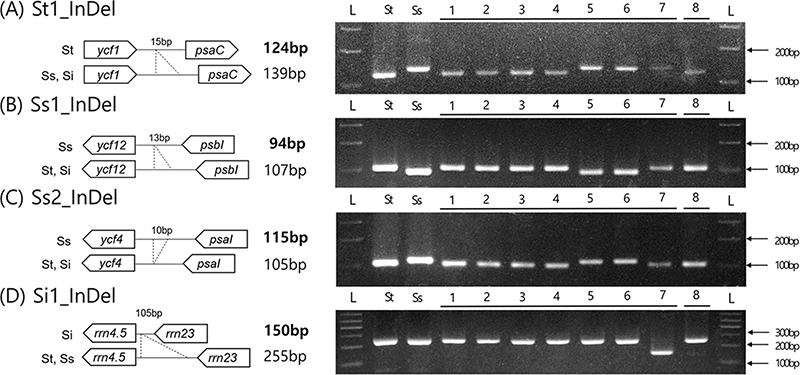
Scheme of 4 InDel marker development within the Selaginella plastomes and its gel-electrophoresis results.Left panels represent schematic illustrations of InDel marker development with InDel variations within the plastome. Right panels show gel electrophoresis result of 4 InDel markers. Labeled L indicates DNA size ladders of 100 bp. St: S. tamariscina, Ss: S. stauntoniana, Si: S. involvens. (A)–(D). InDel markers targeting the InDel located in the intergenic region of ycf1–psaC (A), ycf12–psbI (B), ycf4–psaI (C), rrn4.5–rrn23 (D).
그 결과, 모든 시료에서 예상한 크기의 밴드가 확인되었으며, 한국한의약연구원의 동정 결과와 본 연구에서 개발한 InDel 마커의 판별 결과가 모두 일치하였다 (Table 7).
Genotype information using four InDel markers in 10 Selaginella samples.
St1_InDel 마커는 ycf1–psaC 영역에서 확인된 15 bp InDel 지역을 기반으로 설계되었으며, 바위손에서는 124 bp, 개부처손과 부처손에서는 139 bp의 밴드를 나타내어 바위손을 다른 두 종으로부터 구별하였다 (Fig. 5A). 또한 Ss1_InDel과 Ss2_InDel은 각각 ycf12–psbI 및 ycf4–psaI 영역에서 확인된 13 bp와 10 bp InDel을 이용하여 개발되었으며, Ss1_InDel은 개부처손에서 94 bp, 바위손과 부처손에서는 107 bp의 밴드를 나타냈고 (Fig. 5B), Ss2_InDel은 개부처손에서 115 bp, 바위손과 부처손에서는 105 bp의 밴드를 보여 개부처손을 특이적으로 구별할 수 있었다 (Fig. 5C). 반면, Si1_InDel은 rrn4.5-rrn23 반복 영역에서 확인된 105 bp InDel을 기반으로 설계되었다. Si1_InDel은 부처손에서 150 bp, 바위손과 개부처손에서는 255 bp의 밴드를 나타내 다른 두 종과 명확히 구별되었다 (Fig. 5D). 이와 같이 4 개의 마커 모두 분석된 시료에서 예상한 종별 밴드 차이를 안정적으로 재현하였다. 특히 KIOM 한약표준자원은행의 관능 및 ITS2 감정 결과에서 바위손으로 확인된 유통한약재 시료 8은 4 개 InDel 마커 모두에서 바위손 표준시료와 동일한 증폭 양상을 나타내었다 (Fig. 5, Table 7).
본 연구에서 개발한 마커는 PCR과 전기영동만으로 종을 구별할 수 있는 엽록체 기반 gel-based InDel 마커로, 10 bp 이상의 InDel 변이 영역을 이용하여 염기서열 분석이나 고가의 장비 없이도 신속하고 경제적인 종 판별이 가능하다. 따라서 본 마커는 신속성 및 현장 적용 측면에서 장점을 가진다. 본 연구는 국내 부처손속 3 종의 제한된 표준시료와 소수의 유통한약재 시료를 기반으로 검증하였으므로, 엽록체 유전체 기반 마커가 형태학적 동정이 어려운 한약재의 종 판별에 활용될 수 있음을 보여주는 예비적 사례이다. 향후 수집지 및 유통경로가 다른 다수의 시료를 대상으로 종 특이성 및 재현성을 검증하고, 시료 정보를 사전에 공개하지 않는 blind test를 수행함으로써 실제 품질관리 환경에서의 판별 성능을 평가하고자 한다.
본 연구에서는 엽록체 유전체 기반 InDel 마커의 종 구분력을 검증하기 위해, 엽록체와 독립적으로 유전되는 핵 유래 영역인 45S nrDNA 계통분석을 수행하였다. 엽록체는 모계 계통을, 45S nrDNA는 핵 게놈의 계통정보를 반영하므로, 두 결과의 일치 여부는 엽록체 기반 마커가 제시하는 종 간 유연관계 및 종 구분 결과의 신뢰성을 간접적으로 평가하는 근거가 된다. 그 결과, 엽록체 기반 InDel 마커에 의해 구분된 3 종의 계통관계는 45S nrDNA 계통분석 결과와 대체로 일치하였다. 이는 엽록체 기반 InDel 마커가 핵 유래 계통정보와도 부합하는 종 수준의 유연관계를 반영함을 시사하며, 엽록체 및 핵 유래 정보를 함께 활용할 경우 근연종의 동정 정확성을 높일 수 있음을 뒷받침한다 (Kim et al., 2017; Lee et al., 2026). 다만 엽록체 유전체와 45S nrDNA는 각각 모계 유전 및 제한된 반복 영역을 지니므로, 종간 교잡에 의한 유전자 침투, 불완전계통정렬, 그리고 종내 유전적 다양성을 충분히 반영하기 어려울 수 있다. 따라서 본 연구에서 확인된 InDel 마커의 종 구분력을 보다 강건하게 검증하기 위해서는 향후 추가 핵 마커 또는 핵유전체 수준의 분석이 필요하다 (Zhou et al., 2015; Kang et al., 2024; Kim et al., 2025).
Acknowledgments
본 연구는 보건복지부 연구사업(과제번호: HI23C1420)의 지원을 받아 수행되었으며, 이에 감사드립니다.
References
-
Abdullah, Mehmood F, Rahim A, Heidari P, Ahmed I and Poczai P. (2021). Comparative plastome analysis of Blumea, with implications for genome evolution and phylogeny of Asteroideae. Ecology and Evolution. 11:7810-7826.
[https://doi.org/10.1002/ece3.7614]

-
Banks JA, Nishiyama T, Hasebe M, Bowman JL, Gribskov M, dePamphilis C, Albert VA, Aono N, Aoyama T, Ambrose BA, Ashton NW, Axtell MJ, Barker E, Barker MS, Bennetzen JL, Bonawitz ND, Chapple C, Cheng C, Guedes Correa LG, Dacre M, DeBarry J, Dreyer I, Elias M, Engstrom EM, Estelle M, Feng L, Finet C, Floyd SK, Frommer WB, Fujita T, Gramzow L, Gutensohn M, Harholt J, Hattori M, Heyl A, Hirai T, Hiwatashi Y, Ishikawa M, Iwata M, Karol KG, Koehler B, Kolukisaoglu U, Kubo M, Kurata T, Lalonde S, Li K, Li Y, Litt A, Lyons E, Manning G, Maruyama T, Michael TP, Mikami K, Miyazaki S, Morinaga S, Murata T, Mueller-Roeber B, Nelson DR, Obara M, Oguri Y, Olmstead RG, Onodera N, Petersen BL, Pils B, Prigge M, Rensing SA, Riaño-Pachón DM, Roberts AW, Sato Y, Scheller HV, Schulz B, Schulz C, Shakirov EV, Shibagaki N, Shinohara N, Shippen DE, Sørensen I, Sotooka R, Sugimoto N, Sugita M, Sumikawa N, Tanurdzic M, Theissen G, Ulvskov P, Wakazuki S, Weng JK, Willats WGT, Wipf D, Wolf PG, Yang L, Zimmer AD, Zhu Q, Mitros T, Hellsten U, Loqué D, Otillar R, Salamov A, Schmutz J, Shapiro H, Lindquist E, Lucas S, Rokhsar D and Grigoriev IV. (2011). The Selaginella genome identifies genetic changes associated with the evolution of vascular plants. Science. 332:960-963.
[https://doi.org/10.1126/science.1203810]
-
Berriman M and Rutherford K. (2003). Viewing and annotating sequence data with Artemis. Briefings in Bioinformatics. 4:124-132.
[https://doi.org/10.1093/bib/4.2.124]
-
Capella-Gutiérrez S, Silla-Martínez JM and Gabaldón T. (2009). trimAl: A tool for automated alignment trimming in large-scale phylogenetic analyses. Bioinformatics, 25:1972–1973. (cited by 2026 Oct 15).
[https://doi.org/10.1093/bioinformatics/btp348]
-
Castresana J. (2000). Selection of conserved blocks from multiple alignments for their use in phylogenetic analysis. Molecular Biology and Evolution, 17:540–552. (cited by 2026 Oct 15).
[https://doi.org/10.1093/oxfordjournals.molbev.a026334]
- Chu SJ, Heo JS and Sohn KH. (2016). Selaginella tamariscina extract improves scopolamine-induced learning and memory dificits in rats. Korean Journal of Pharmacognosy. 47:319-326.
-
Daniell H, Lin CS, Yu M and Chang WJ. (2016). Chloroplast genomes: diversity, evolution, and applications in genetic engineering. Genome Biology. 17:134.
[https://doi.org/10.1186/s13059-016-1004-2]
- Doyle JJ and Doyle JL. (1987). A rapid DNA isolation procedure for small quantities of fresh leaf tissue. Phytochemical Bulletin. 19:11-15.
- Hall TA. (1999). BioEdit: A user-friendly biological sequence alignment editor and analysis program for Windows 95/98/NT. Nucleic Acids Symposium Series. 41:95-98.
-
Jansen RK, Raubeson LA, Boore JL, dePamphilis CW, Chumley TW, Haberle RC, Wyman SK, Alverson AJ, Peery R, Herman SJ, Fourcade HM, Kuehl JV, McNeal JR, Leebens-Mack J and Cui L. (2005). Methods for obtaining and analyzing whole chloroplast genome sequences. Methods in Enzymology. 395:348-384.
[https://doi.org/10.1016/S0076-6879(05)95020-9]
-
Kang JS, Yu JG, Xiang QP and Zhang XC. (2024). The possible earliest allopolyploidization in tracheophytes revealed by phylotranscriptomics and morphology of Selaginellaceae. Molecular Biology and Evolution. 41:msae153.
[https://doi.org/10.1093/molbev/msae153]
-
Katoh K, Misawa K, Kuma K and Miyata T. (2002). MAFFT: A novel method for rapid multiple sequence alignment based on fast Fourier transform. Nucleic Acids Research. 30:3059-3066.
[https://doi.org/10.1093/nar/gkf436]
-
Kim J, Lee J, Kang JS, Shim H, Kang D, Lee SH, Choi JP, Kim HS, Kim MS, Kim YI, Lee Y, Ziyaev Z, Shin YK, Bhak J and Yang TJ. (2025). Contributions of interspecific hybrids to genetic variability in Glycyrrhiza uralensis and G. glabra. Scientific Reports. 15:8764.
[https://doi.org/10.1038/s41598-025-92115-4]
-
Kim K, Nguyen VB, Dong J, Wang Y, Park JY, Lee SC and Yang TJ. (2017). Evolution of the Araliaceae family inferred from complete chloroplast genomes and 45S nrDNAs of 10 Panax-related species. Scientific Reports. 7:4917.
[https://doi.org/10.1038/s41598-017-05218-y]
- Kim YJ and Lee JA. (2021). Anti-oxidant, anti-inflammatory, and wound healing activities of Selaginella tamariscina leaf extract. Journal of Convergence for Information Technology. 11:194-202.
- Korea Institute of Oriental Medicine. (2014). Defining Dictionary for Medicinal Herbs[Korean, 'Hanyak Giwon Sajeon']. Korea Institute of Oriental Medicine. Naju, Korea. Published on the Internet; https://oasis.kiom.re.kr/herblib/hminfo/hbmcod/hbmcodList.do, .
-
Lee JJ, Kang JS, Kim YJ, Lee YS, Park JY, Jang W, Moon BC, Kim Y, Kim TY and Yang TJ. (2026). Super-barcoding of four Agrimonia species distributed in Korea based on complete plastid genomes and nuclear ribosomal DNAs. PLoS One. 21:e0341151.
[https://doi.org/10.1371/journal.pone.0341151]
-
Lohse M, Drechsel O, Kahlau S and Bock R. (2013). OrganellarGenomeDRAW-a suite of tools for generating physical maps of plastid and mitochondrial genomes and visualizing expression data sets. Nucleic Acids Research. 41:W575-581.
[https://doi.org/10.1093/nar/gkt289]
-
Lu RS, Li P and Qiu YX. (2017). The complete chloroplast genomes of three Cardiocrinum(Liliaceae) species: Comparative genomic and phylogenetic analyses. Frontiers in Plant Science. 7:2054.
[https://doi.org/10.3389/fpls.2016.02054]
-
Pagès H, Aboyoun P, Gentleman R and DebRoy S. (2026). Biostrings: Efficient manipulation of biological strings (R package version 2.80.2). Bioconductor.
[https://doi.org/10.18129/B9.bioc.Biostrings]
-
Park JS, Kim YS, Lee GH and Park CH. (2020). The complete chloroplast genome of Selaginella tamariscina(Beauv.) Spring (Selaginellaceae) isolated in Korea. Mitochondrial DNA Part B. 5:1654-1656.
[https://doi.org/10.1080/23802359.2020.1715885]
- Park JW. (2015). Flora of Korea - vol.1 : Pteridophytes & Gymnosperms. National Institute of Biological Resources. Incheon, Korea. p.19-22.
-
Park YS, Kim YJ, Yang TJ and Kim JY. (2021). Authentication of Rubus coreanus and related species via DNA barcoding and HPLC approaches. Korean Journal of Medicinal Crop Science. 29:425-433.
[https://doi.org/10.7783/KJMCS.2021.29.6.425]
- Rambaut A. (2007). FigTree: Tree figure drawing tool, version 1.4.4. Molecular Evolution, Phylogenetics and Epidemiology. http://tree.bio.ed.ac.uk/software/figtree/, .
-
Schuettpelz E, Schneider H, Smith AR, Hovenkamp P, Prado J, Rouhan G, Salino A, Sundue M, Almeida TE, Parris B, Sessa EB, Field AR, de Gasper AL, Rothfels CJ, Windham MD, Lehnert M, Dauphin B, Ebihara A, Lehtonen S, Schwartsburd PB, Metzgar J, Zhang LB, Kuo LY, Brownsey PJ, Kato M and Arana MD. (2016). A community-derived classification for extant lycophytes and ferns. Journal of Systematics and Evolution. 54:563-03.
[https://doi.org/10.1111/jse.12229]
-
Shim H, Lee HJ, Lee J, Lee HO, Kim JH, Yang TJ and Kim NS. (2021). Plastid genomes of the early vascular plant genus Selaginella have unusual direct repeat structures and drastically reduced gene numbers. International Journal of Molecular Sciences. 22:641.
[https://doi.org/10.3390/ijms22020641]
-
Stamatakis A. (2014). RAxML version 8: A tool for phylogenetic analysis and post-analysis of large phylogenies. Bioinformatics. 30:1312-1313.
[https://doi.org/10.1093/bioinformatics/btu033]
-
Tillich M, Lehwark P, Pellizzer T, Ulbricht-Jones ES, Fischer A, Bock R and Greiner S. (2017). GeSeq - versatile and accurate annotation of organelle genomes. Nucleic Acids Research. 45:W6-W11.
[https://doi.org/10.1093/nar/gkx391]
-
Wang Y, Xiang Z, Liu K, Lin Y and Dong S. (2025). Complete chloroplast genome and phylogenomic analysis of Davallia trichomanoides(Polypodiaceae). Genes. 16:1310. https://www.mdpi.com/2073-4425/16/11/1310, (cited by 2026 Oct 15).
[https://doi.org/10.3390/genes16111310]
-
Wernersson R. (2005). FeatureExtract—Extraction of sequence annotation made easy. Nucleic Acids Research, 33:W567–W569. (cited by 2026 Oct 15).
[https://doi.org/10.1093/nar/gki417]
-
Wicke S, Schneeweiss GM, dePamphilis CW, Müller KF and Quandt D. (2011). The evolution of the plastid chromosome in land plants: Gene content, gene order, gene function. Plant Molecular Biology. 76:273-297.
[https://doi.org/10.1007/s11103-011-9762-4]
-
Wickham H. (2016). ggplot2: Elegant graphics for data analysis (2nd ed.). Springer-Verlag. New York, USA.
[https://doi.org/10.1007/978-3-319-24277-4]
- Wickham H and Bryan J. (2026). readxl: Read Excel files (R package version 1.5.0). readxl. https://readxl.tidyverse.org
-
Ye J, Coulouris G, Zaretskaya I, Cutcutache I, Rozen S and Madden TL. (2012). Primer-BLAST: A tool to design target-specific primers for polymerase chain reaction. BMC Bioinformatics. 13:134.
[https://doi.org/10.1186/1471-2105-13-134]
-
Zhou XM, He ZR, Zhao J, Yang JJ, Zhang LB, Le Péchon T and Zhang L. (2022). Plastome structure, evolution, and phylogeny of Selaginella. Molecular Phylogenetics and Evolution. 169:107410.
[https://doi.org/10.1016/j.ympev.2022.107410]
-
Zhou XM, Rothfels CJ, Zhang L, He ZR, Le Péchon T, He H, Lu NT, Knapp R, Lorence D, He XJ, Gao XF and Zhang LB. (2015). A large-scale phylogeny of the lycophyte genus Selaginella(Selaginellaceae: Lycopodiopsida) based on plastid and nuclear loci. Cladistics. 32:360-389.
[https://doi.org/10.1111/cla.12136]